Spain's Right Wins 185 Seats, Setting Stage for Far-Right Return to Government
- Input
- 2026-11-30 07:40:14
- Updated
- 2026-11-30 07:40:14

[Financial News] Spain's right-wing camp won the general election held on Nov. 29, paving the way for the first change of government in eight years.
With 95.0% of the votes counted, the conservative main opposition People's Party (PP) provisionally secured 134 of the 350 seats in the lower house, while the center-left governing Spanish Socialist Workers' Party (PSOE), led by Prime Minister Pedro Sánchez, won 115, according to Spain's Interior Ministry. The totals were down by three and six seats, respectively, from the 2023 general election.
Far-right Vox came third with 51 seats, up 18 from the previous general election.
The Republican Left of Catalonia (ERC), a separatist party that had cooperated with Sánchez's government, won 11 seats. The Broad Front (FA), a left-wing alliance reconfigured from Sumar, the Socialist Workers' Party's coalition partner, took 10. The separatist Basque Regional Union and Together for Catalonia (Junts) won seven and five seats, respectively.
The People's Party and Vox won a combined 185 seats, comfortably exceeding the 176 needed for a majority. Their total would be higher still with the two seats held by the Navarrese People's Union (UPN), a regional ally of the People's Party.
The People's Party and Vox still need to agree on forming a coalition government, but a change of government appears all but certain.
Far-right forces set to join government for first time in half a century since Franco dictatorship ended in 1975
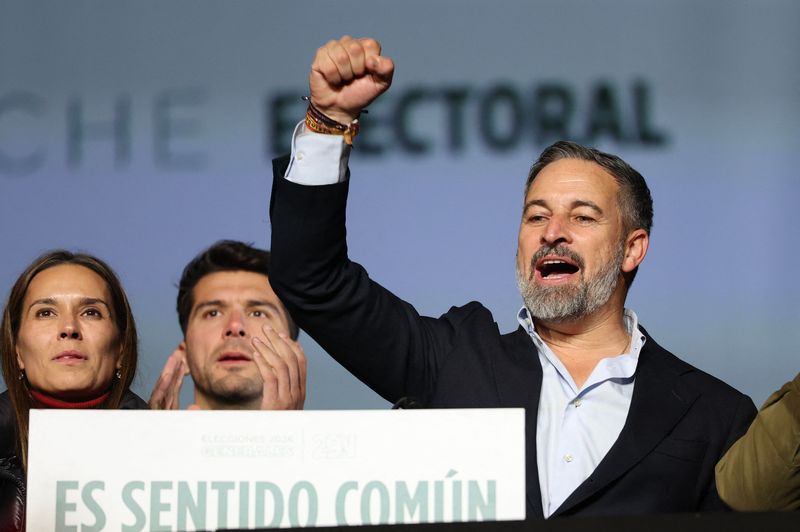
Prime Minister Sánchez, who leads the Spanish Socialist Workers' Party, is expected to lose office eight years after taking office in 2018. People's Party leader Alberto Núñez Feijóo is expected to become the new prime minister.
Sánchez congratulated Feijóo on the People's Party's victory, a spokesperson for the prime minister said, according to Reuters.
The People's Party wrote on X, formerly Twitter, "The PP will win the election, and Feijóo will become prime minister of Spain."
The prevailing view is that Vox is likely to join the government. Even if it does not, the party is expected to support the People's Party and help bring about a change of government.
The People's Party and Vox have already joined forces in four regional governments and have long campaigned against the left-wing coalition led by Sánchez, signaling a push for change. In some constituencies in this election, a candidate from one of the two parties withdrew to help defeat the left, the BBC reported.
If Vox enters the cabinet, far-right forces will join the government for the first time in half a century since Francisco Franco's dictatorship ended in 1975.
Vox leader Santiago Abascal is expected to wield considerable influence as a "kingmaker" in forming the next government.
Turnout at 80%, highest in more than 40 years... Vox leader to be a “kingmaker” in government formation
Since taking office in 2018, Sánchez has become one of Europe's leading left-wing figures opposing the global rise of the far right and has openly clashed with U.S. President Donald Trump.
During his tenure, Spain's economic growth rate reached twice the eurozone average. But questions have been raised about his governance amid corruption scandals involving close associates, a string of disasters, a mass influx of migrants in Ceuta and a housing crisis.
Feijóo has attacked the Sánchez government while presenting himself as "a cool-headed administrator taking on incompetent and corrupt leaders."
After voting on Nov. 29, Feijóo said, "Today is the day the Spanish people take the initiative and decide Spain's future, destiny and direction."
Spain has no set deadline for coalition negotiations. But if a government is not formed within two months after the first parliamentary vote to elect a prime minister, another general election will automatically be held.
Turnout in the general election was 79.6%, up 9.2 percentage points from the 2023 election. It was the highest in more than 40 years.
[email protected] Lee Seok-woo, international affairs correspondent Reporter