Spain's Conservative-Far-Right Alliance Could Win Majority for First Time in 50 Years
- Input
- 2026-11-30 05:33:32
- Updated
- 2026-11-30 05:33:32
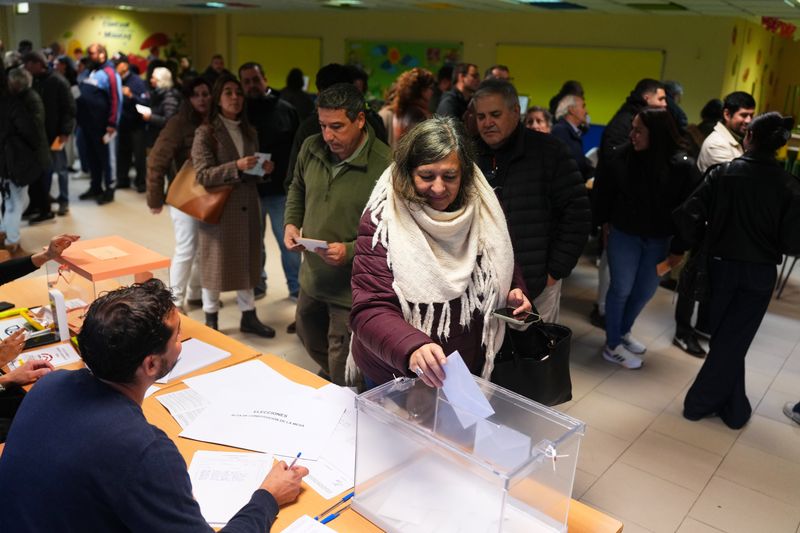
[Financial News] The conservative and far-right alliance is expected to defeat left-wing forces, including the ruling Spanish Socialist Workers' Party (PSOE), and win a majority of seats in the lower house in Spain's general election held on Nov. 29.
Spain's public broadcaster RTVE predicted in a poll released immediately after voting ended at 8 p.m. on Nov. 29 that the conservative People's Party (PP) would win 129 to 134 of the lower house's 350 seats, making it the largest party.
The far-right Vox is projected to win 44 to 48 seats, which could give the two parties a combined majority of at least 176 seats. Vox promotes Spanish nationalism, advocates expelling immigrants and is skeptical of European integration.
The center-left Spanish Socialist Workers' Party, led by Prime Minister Pedro Sánchez, is expected to finish second with 119 to 124 seats.
The left-wing Broad Front (FA), formed by reorganizing Sumar, its coalition partner in government, is projected to win 10 to 11 seats. The separatist Republican Left of Catalonia (ERC), which has cooperated with the Sánchez government, is expected to win nine to 10. The political outlet Politico said even the maximum projected seat total for the left-wing camp, including parties in the current governing coalition, would fall short of a majority.
If the exit poll proves accurate, a coalition government including far-right forces is likely to be formed for the first time in half a century since Francisco Franco's dictatorship ended in 1975.
The People's Party also came first in the 2023 general election with 137 seats, but failed to take power because its 137 seats and Vox's 33 still fell short of a majority.
Since taking office in 2018, Prime Minister Sánchez has led one of Europe's few remaining left-wing governments. But after a series of setbacks—including corruption allegations involving close associates, a massive blackout, floods, a high-speed train disaster and a mass incursion by migrants into Ceuta—Sánchez is on the verge of losing office after eight years.
Spain's general election was originally scheduled for next summer but was brought forward by about eight months after Prime Minister Sánchez decided to dissolve parliament. Last September, public anger over the housing shortage erupted after the forced eviction of 87-year-old Maricarmen Abascal, prompting Sánchez to gamble on an early election.
By 6 p.m. on Nov. 29, two hours before voting ended, turnout had reached 68.2%, already exceeding the 66.6% total turnout in the 2023 general election. Turnout in the 16 general elections held from 1977 to 2023 averaged 71.8%.
[email protected] Lee Seok-woo, International Affairs Correspondent Reporter