South Korean President Lee Backs Fund Increase, Questions Whether It Can Deliver Results
- Input
- 2026-11-29 19:52:28
- Updated
- 2026-11-29 19:52:28
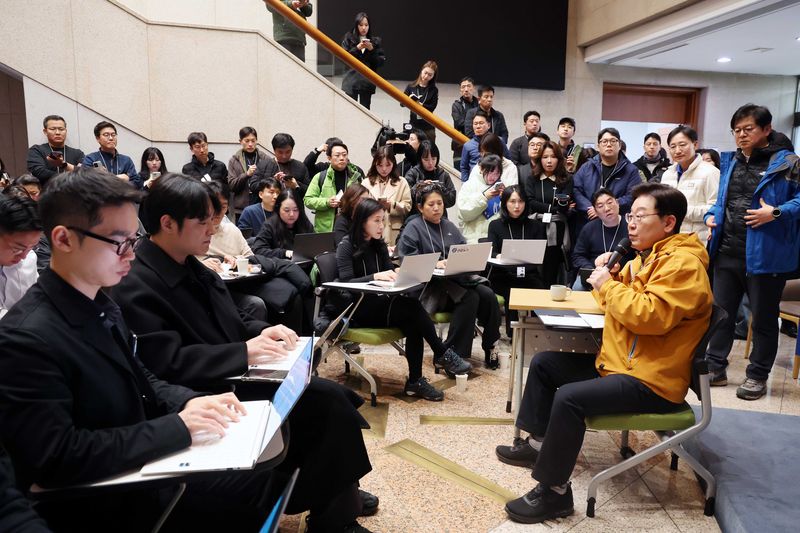
[Financial News] South Korean President Lee Jae Myung on Nov. 29 left open the possibility of increasing the stock market stabilization fund, which is being prepared for activation as market volatility grows, saying, “We should try everything we can.” The fund is currently in the 10-trillion-won range, and attention is focused on whether it will be expanded.
■ Lee: “We should try everything we can” on the stock market stabilization fund
During a hike with the press corps on Bukaksan Mountain near Cheong Wa Dae that day, President Lee said, “Volatility in the [stock] market is abnormally high,” adding, “It’s important to improve the market’s underlying structure. [The stabilization fund] could help in the short term, at least psychologically.”However, Lee said, “Compared with the overall scale, I question whether a fund of a reasonable size can produce tangible results.” He said experts should decide on the fund’s size.
Asked at an afternoon briefing at Chunchugwan Press Center how much the fund should be expanded, Lee said, “It would be inappropriate for me to give an opinion on a specific size.” On the possibility of using public funds, he said, “I will follow whatever Kim Yong-beom, vice chairman of Meritz Financial Group and chair of a committee on capital market transformation, decides.” Financial institutions are discussing expanding the fund, whose current capital commitments total 10.76 trillion won, into the 20-trillion-won range.
Lee said he had initially tried to recruit Kim as chairman of the Korea Exchange. After Kim declined, Lee said, he proposed giving Kim full authority over a committee that would lead capital market reform.
Lee said he had instructed that there should be no co-chair system, but a sole chair, and that the chair should be given full responsibility for appointing committee members. He said he had also ordered, “Carry out everything discussed there, and if any ministry says it cannot accept it, report everything to me.” He added, “I may meet him in person soon. I think we should give him more authority.”
Regarding the relocation of financial institutions outside the capital region, he said, “That is also a subject of debate. Nothing has been finalized,” explaining that the government was weighing the nature of each institution under a “one nation, two capitals” vision, with the Seoul metropolitan area as the economic capital and Sejong City as the administrative capital. He also noted that the Financial Services Commission (FSC) is a government body, while the Financial Supervisory Service (FSS) is formally a private organization. President Lee said, “We’re considering which of these concepts—the economic capital or the administrative capital—should carry more weight,” adding, “Let’s wait for the final decision.”
■ Mega special zones to use existing exemptions, with additional nuclear plants also possible
Lee said existing systems and adjustments to enforcement decrees could be used to address debate over labor-hour exceptions, including exemptions from the 52-hour workweek, under the law on super-regional special zones that supports megaprojects.Explaining discussions on labor exemptions under the Semiconductor Special Act, Lee said, “There is almost no difference from using the existing system.” He stressed that local governments’ choice was important for exemptions intended to attract businesses to regional areas. On signs of conflict between labor and management, he said, “Whether people wear mourning clothes for three days or a week may be important, but what matters from the people’s perspective? Should we split the country in two over this? Let’s hope it can be resolved well.”
Lee called for an active government role in fostering advanced industries. “This is no longer an era of competition between companies; it has become an era of competition between nations,” he said, describing it as “an era of national competition, with companies fielded as the players.” As investment in advanced industries grows in scale and strategic importance, he said, the government must create conditions that allow companies to establish operations.
Lee vowed to press ahead with building a semiconductor fabrication plant in Honam, saying, “I will make it happen, even if I have to stake my political future on it.” He said, “If we include rice paddies and fields, we can secure 3.5 million pyeong. We will take care of all the water and electricity needs.” He also said the plan would provide conditions for people to settle there, including research institutes, universities, housing, education and medical facilities. The aim is to provide comprehensive support for industrial infrastructure and workers’ living conditions to encourage companies to invest in regional areas.
Lee emphasized a pragmatic approach to nuclear power and left open the possibility of building more plants. Referring to nuclear plants included in existing plans, he said, “We should basically go ahead with those, and if we have the capacity, shouldn’t we consider building more?”
Lee stressed the need to prepare for rising electricity demand, saying, “Future advanced industries are fundamentally large-scale consumers of electricity.” On the energy transition, he said, “There may be some ups and downs, but we have no choice but to keep shifting toward renewable energy.” He said whether to build more nuclear plants was not a decision policymakers should make unilaterally, adding, “We need to gather the public’s views.”
On security issues, Lee reaffirmed his determination to secure an early transfer of wartime operational control (OPCON). “We call it a transfer of OPCON, not a recovery,” he said. “It was ours to begin with. It is central to asserting our sovereignty.” He added, “We are in a position to defend ourselves sufficiently,” and said, “We must secure the transfer of OPCON early.”
Asked about the ruling Democratic Party’s push to impeach Supreme Court Chief Justice Cho Hee-dae amid growing opposition within the judiciary, Lee replied only, “No comment. I have no opinion.”
[email protected] Choi Jong-geun Reporter