Rebuilding Korea Party Exploits DPK Infighting, Challenges the Ruling Party’s Strongholds
- Input
- 2026-11-29 16:37:35
- Updated
- 2026-11-29 16:37:35
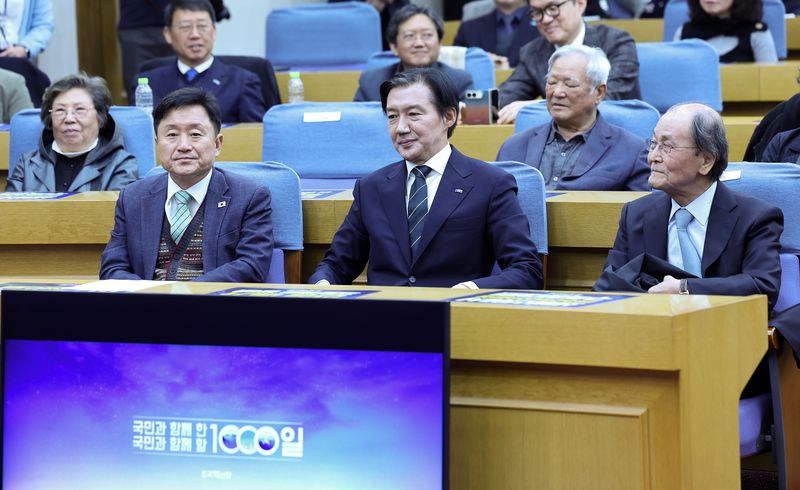
At a ceremony marking 1,000 days since the party’s founding at the National Assembly Members’ Office Building on the 29th, Cho Kuk, head of the Institute for Innovation Policy Studies, said, “Some within the ruling DPK, which should be responsible for uniting the camp, are instead driving wedges within it and splitting it apart,” adding bluntly, “The public are fed up with the DPK’s endless internal fighting.” Cho said that simply restoring the existing “coalition to defeat insurrection” would not be enough, and proposed a “grand coalition for livelihoods and welfare” to rebuild the democratic and progressive camp. The plan is to broaden the party’s support base around livelihood issues such as housing, care and jobs, as the U.S. New Deal coalition did in the past, and to transform the Rebuilding Korea Party into the camp’s central party.
Shin Jang-sik, leader of the Rebuilding Korea Party, went further, targeting the DPK leadership. “It is incompetent when it comes to solidarity and unity. It is powerless in the face of clearing away the insurrection and pursuing reform,” he said, adding, “We will compete with the DPK. We will hold the People Power Party to account.” The aim is to broaden the reach of a party that has foregrounded prosecution reform and the clearing away of the insurrection, and to emerge as the leading reform party competing with the DPK.
Specifically, the party will immediately target the Seoul metropolitan area and Honam, key bases of DPK support. Targeting constituencies represented by politicians who have worked against reform or caused divisions within the camp, it plans to establish footholds in 30 locations by March 3 next year, the third anniversary of its founding, and first unveil potential replacement candidates in the Seoul metropolitan area and Honam. Alongside recruiting talent from outside the party, it will comprehensively overhaul its name, platform, logo and signature color, and use the third anniversary as a turning point to shift the entire party into a 2028 general election footing.
The Rebuilding Korea Party also took aim that day at key economic legislation from the DPK. Examples include the Future Fund, which has prompted concerns about declines in local allocation tax and local education finance grants, and megaprojects that include exemptions to the 52-hour workweek. With the DPK pushing economic growth, the move is seen as an effort to distinguish the party’s policies within the progressive camp by focusing on labor, welfare and local government finances. “If the DPK pushes ahead with legislation that erases the boundaries of social consensus as things stand, the Rebuilding Korea Party has absolutely no intention of becoming either an automatic door or a rubber stamp,” Shin said, calling for alternatives to be drawn up.
The party also stepped up pressure on the DPK over judicial reform. Shin urged that the impeachment motion against Supreme Court Chief Justice Cho Hee-dae be reported to a plenary session of the National Assembly on December 2 and taken up on the 3rd, the second anniversary of the martial law crisis.
[email protected] Jiwon Song Reporter