Choi Min-hee’s Two-Year Suspension of Party Membership Rights Spurs Street Protests ... No End in Sight for Ruling Party Factional Rift
- Input
- 2026-11-29 15:45:46
- Updated
- 2026-11-29 15:45:46
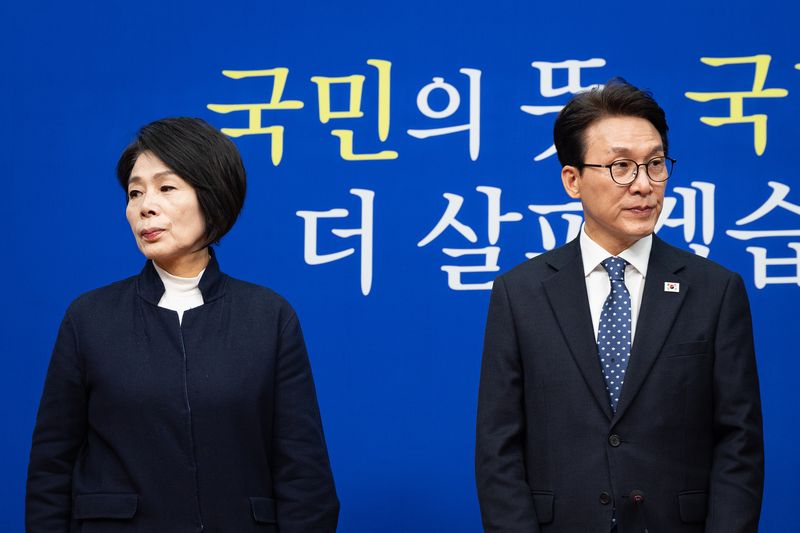
According to political sources on the 29th, senior DPK lawmakers including Woo Won-shik, Lee Hack-young and Nam In-soon issued a joint statement that day in the names of 152 party lawmakers, calling for an end to factional strife and a focus on people’s livelihoods. The lawmakers spent two days gathering their colleagues’ views after concerns about prolonged internal discord were raised at a meeting of senior lawmakers on the 26th.
Woo held a news conference that day at the National Assembly Communication Center and stressed, “If we waste precious time on internal conflict, there will be no time left.” Nam also said disappointment among supporters was growing as open factional strife continued over matters that had nothing to do with people’s livelihoods or the party’s political direction.
Although Choi, the Supreme Council member facing disciplinary action, also joined the statement, nine lawmakers—including party leader Kim Min-seok and former leader Jeong Cheong-rae, as well as Kim Yong-min, Kim Jeong-ho, Moon Jeong-bok, Park Seong-jun, Song Young-gil, Lee Seong-yoon and Jeong Dong-young—did not sign it, according to reports. Nam explained that some lawmakers could not be reached, while others said they wanted time to think it over.
The senior lawmakers’ move to mediate collectively comes as factional conflict, sparked by the disciplinary action against Choi, has escalated into collective action by supporters. After the DPK Ethics Tribunal announced its decision on the 27th, the pro-Jeong faction protested, saying the same disciplinary standards should be applied to the allegation Kim raised during the party convention of a “secret three-way alliance among anti-Lee forces, divisive elements and Shincheonji.” Over the weekend, pro-Jeong supporters even held a rally outside the National Assembly calling for Choi’s penalty to be rescinded and Kim to resign. An unofficial police estimate put the crowd at about 2,000 to 3,000 people.
By contrast, the pro-Lee Jae Myung faction appears to be holding back from responding. Kang Deuk-gu, head of the DPK’s Institute for Democracy, stressed the independence of the Ethics Tribunal and said the matter should be handled according to principle. Kim reportedly did not answer reporters’ questions about the disciplinary action.
The problem is that even if the disciplinary issue is resolved, sources of conflict remain on multiple fronts. Within the pro-Jeong faction, some are calling for the current leadership to be held accountable for fueling controversy by reviewing the party membership rolls without specific criteria for updating them; there is also discontent over the leadership’s delay in assessing the local elections. Differences over a merger with the Rebuilding Korea Party and the three major reforms—of the prosecution, judiciary and media—also remain unresolved.
With the statutory deadline for passing next year’s budget just three days away, a host of other pressing issues require decisive talks between ruling and opposition party leaders, including the creation of a Future Response Fund. The ruling party, which needs to focus its efforts on negotiations with the opposition, is instead having to contain its internal conflict first. Woo urged Kim and former leader Jeong to talk, calling on Kim to adopt an attitude of candor and mutual trust and Jeong to show “Solomon’s wisdom.”
[email protected] Jiwon Song Reporter