Innospace to Make Another Attempt at Launching 'SEBIT' Early Tomorrow
- Input
- 2026-11-29 14:42:09
- Updated
- 2026-11-29 14:42:09
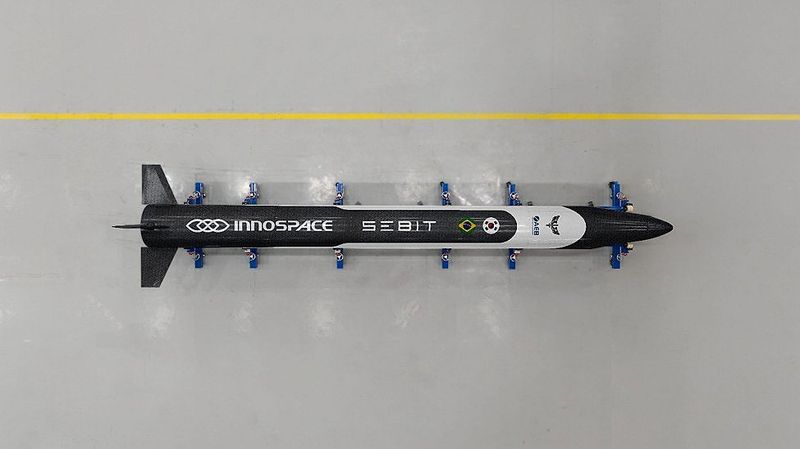
[Financial News] Innospace, a South Korean private space launch vehicle company, will conduct the second test flight of its multipurpose suborbital rocket 'SEBIT' in the early hours of the 30th.
Innospace said on the 29th that this test flight comes about three months after SEBIT's first test flight in August, when the mission was ended early after the rocket veered off its planned flight path. As with the first test flight, it will take place at the Alcantara Launch Center in Brazil. The target time is 2:30 a.m. on the 30th Korea time, or 2:30 p.m. on the 29th local time in Brazil.
Innospace said, "There is also a possibility that the launch schedule could change depending on local weather conditions or launch operations," adding, "We will announce major changes, including to the test flight schedule, as well as the flight results."
SEBIT is a multipurpose suborbital rocket that Innospace first unveiled in March. The single-stage vehicle measures 8.7 meters in length and 0.7 meters in diameter, and is equipped with a hybrid rocket engine that uses solid fuel and liquid oxidizer.
Unlike conventional launch vehicles that place satellites into Earth's orbit, SEBIT is designed to carry customers' payloads to altitudes of 100 km or less. It can expose payloads to high-altitude and microgravity environments that are difficult to reproduce on the ground, allowing various scientific experiments and performance tests of space components to be conducted.
Innospace previously conducted SEBIT's first test flight on August 20 at 4:30 a.m. Korea time. SEBIT lifted off normally after engine ignition, but a trajectory anomaly was detected during the flight. The Brazilian Air Force then activated the flight termination system (FTS), and SEBIT came down in a designated maritime safety zone.
An analysis of the cause based on flight data Innospace collected at the time found that the control algorithm needed refinement. The algorithm adjusts the rocket's attitude and direction by moving four fins mounted on the lower part of the vehicle. A discrepancy emerged between the predictions made during the design phase and the actual flight results in the low-speed flight segment.
Since then, Innospace has been working to redesign the control algorithm based on actual flight data and improve its design and testing procedures. It also increased engine thrust by about 33%, from the 3-ton class to the 4-ton class. The final investigation report by Brazil's Center for Investigation and Prevention of Aeronautical Accidents (CENIPA) was also released on the 5th of this month, bringing the official investigation into the first test flight to a close.
The key to this test flight is to determine whether these technical improvements are effective under actual flight conditions. Innospace plans to verify the improved vehicle's performance while gathering additional flight data and launch operations experience to accelerate SEBIT's commercialization. It also aims to expand its business, previously focused on small satellite launches, into national defense and defense industries, biotechnology and healthcare, and advanced materials, and to make suborbital launch services a new source of revenue.
[email protected] Yeon Ji-an Reporter