Budget Bill Deadline D-3... Will a Compromise Emerge on the 162 Trillion Won Future Fund? Ruling Party's Going It Alone Also Discussed
- Input
- 2026-11-29 13:09:57
- Updated
- 2026-11-29 13:09:57
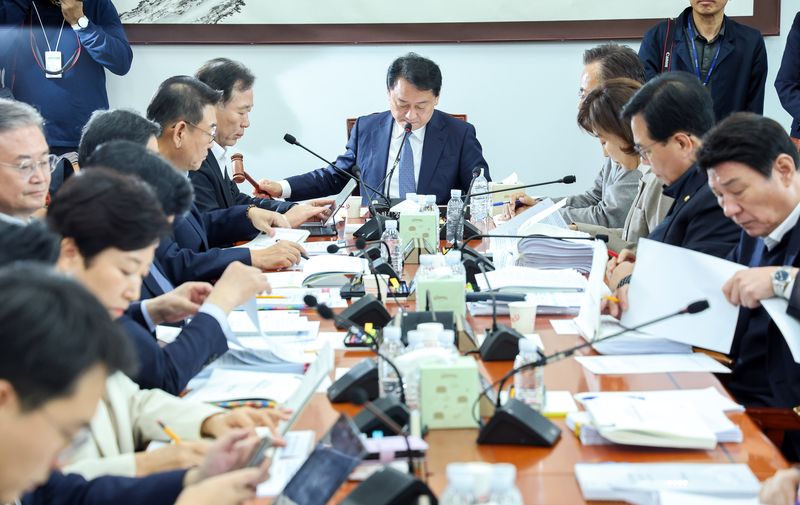
[Financial News] With the statutory deadline for passing next year's 820.9 trillion won budget just two days away, the ruling and opposition parties have yet to find common ground on the creation of the 162.3 trillion won Future Fund, a key sticking point. Unlike the People Power Party, which opposes creating the fund at all, some members of the Democratic Party of Korea (DPK) say the fund's framework should be retained but its operating methods revised. If negotiations ultimately fail, the DPK could draw up its own revised budget proposal and push it through on its own, a possibility that is also being discussed.
According to political sources on the 29th, the ruling and opposition parties have agreed not to hold a plenary session on December 1 and instead to convene one at 2 p.m. on the 2nd, the statutory deadline for passing the budget. The DPK plans to hold a party caucus on the 1st to brief its lawmakers on the budget and related bills. If budget negotiations do not proceed smoothly, an additional plenary session could be held on the 3rd.
National Assembly Speaker Cho Jung-sik said that day in Canberra, Australia, “I will do my utmost to ensure the budget is passed by agreement between the ruling and opposition parties while meeting the statutory deadline.” He meant that he would urge the leadership of both parties to reach an agreement by the deadline.
The biggest hurdle in the final round of negotiations is the Future Fund. The government and ruling party plan to use excess tax revenue generated in part by strong semiconductor industry conditions to promote advanced industries and support future generations. The People Power Party, by contrast, is calling for the fund to be cut in its entirety and related programs transferred to the general account. It maintains that at least 50% of excess tax revenue and surplus funds should be used to repay the national debt.
The cap on changes to the fund's spending plan is also in dispute. Under the government's proposal, spending on major fund items could be changed by up to 30% without a vote by the National Assembly. Some members of the DPK also say the cap should be lowered to protect the National Assembly's budget review authority.
The People Power Party is also calling for the restoration of 30.5 trillion won in local share tax. Differences between the parties over budgets for power institutions remain, including 8.2 billion won in special activity funds for the Blue House and 4.2 billion won for the Serious Crimes Investigation Agency.
Under the National Assembly Act, if the budget review is not completed by the 30th, the government's budget proposal is automatically referred to a plenary session on December 1, in principle. The parties' floor leaders are expected to seek a final agreement afterward through direct negotiations.
The DPK's push to impeach Cho Hee-dae, chief justice of the Supreme Court of Korea, is another factor. As the possibility of a People Power Party boycott of National Assembly proceedings is being discussed, the DPK says no specific date has been set for introducing the impeachment motion because its in-house impeachment task force is still drafting it.
Wrangling over the scale of budget cuts and increases is also expected to continue. The People Power Party plans to cut at least 27 trillion won from the government's budget proposal and increase spending by 11.5 trillion won for youth, people's livelihoods, safety and jobs. The DPK aims to keep the proposal's total size unchanged.
With National Assembly standing committees and members of the Special Committee on Budget and Accounts seeking net increases totaling 71.9228 trillion won—more than four times the previous year's figure—attention is also focused on how much constituency-requested spending the parties will include in their confidential negotiations.
[email protected] Kim Gyeong-min Reporter