Jeju National University and Korea Aerospace University Share Educational and Research Resources... Jointly Train Talent for Future Industries
- Input
- 2026-11-29 12:18:25
- Updated
- 2026-11-29 12:18:25
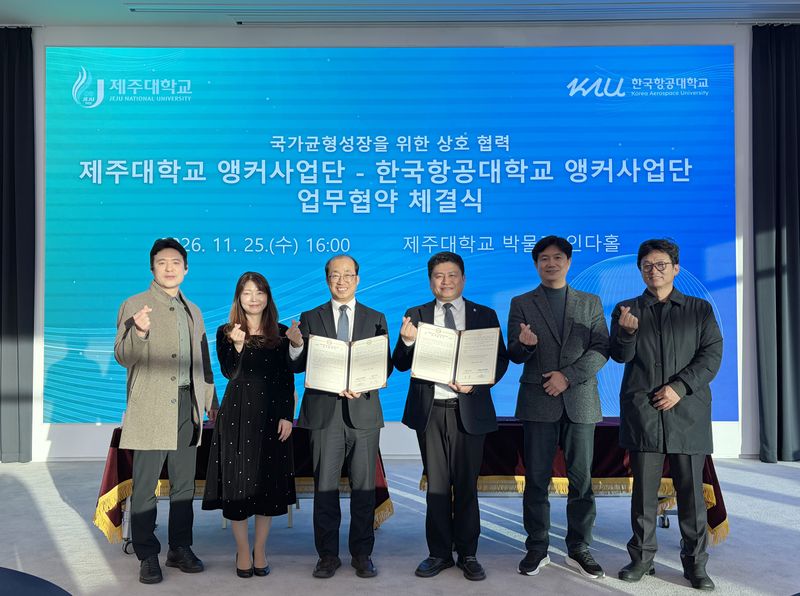
【Financial News Jeju = Jeong Yong-bok】 Jeju National University and Korea Aerospace University will jointly train talent for future industries, extending beyond regional administrative boundaries. They plan to share educational and research facilities and equipment, and develop field-focused curricula involving companies and research institutes.
According to Jeju National University on the 29th, the Anchor project teams at Jeju National University and Korea Aerospace University signed an MOU at Inda Hall in the Jeju National University Museum on the 25th to develop talent for regional growth industries and strengthen educational and research cooperation between Jeju and Gyeonggi.
The signing ceremony was attended by Jeju National University President Yang Deok-soon, Korea Aerospace University President Heo Hee-young, Jeju National University Anchor project team head Oh Wook, Korea Aerospace University Anchor project team head Hwang Wan-sik, and others.
The policy backdrop to the agreement is the government's overhaul of its support system for regional universities. In April, the Ministry of Education changed the Regional Innovation-Centered University Support System (RISE) to the Regional Growth Talent Development System (ANCHOR). It restructured the program so that financial support for universities would lead to the development of talent needed by regional industries, employment and entrepreneurship, and settlement in the region.
A key policy direction is also to expand the existing city- and province-based university support system through super-regional cooperation centered on industrial and economic zones. This involves jointly using specialized personnel, research facilities and curricula that individual regions or universities would find difficult to secure on their own.
Jeju Island plans to invest 62.7 billion won in this year's Anchor project and provide a cumulative 299.8 billion won through 2029. Jeju National University, Jeju Tourism University and Cheju Halla University will take part, supporting the development of talent for future strategic industries such as artificial intelligence (AI), aerospace and semiconductors, as well as settlement in the region.
The agreement between Jeju National University and Korea Aerospace University is significant because it extends this talent development system through cooperation with universities in other regions. The two universities plan to develop curricula and conduct joint research with companies and research institutes, and to provide students with hands-on training opportunities at test facilities where technologies can be evaluated in real-world conditions. They also agreed to jointly use educational and research facilities, equipment, data and specialized personnel.
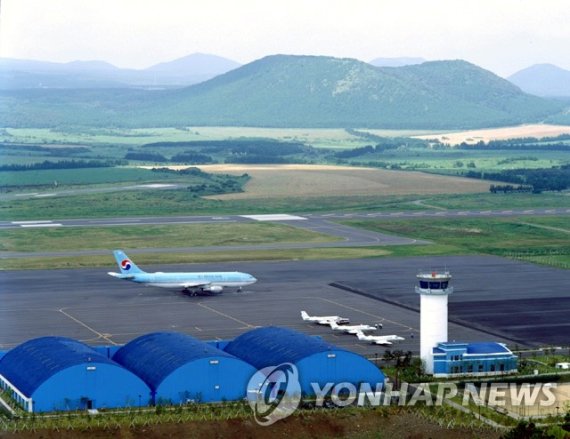
In particular, there is potential to link the agreement with Korea Aerospace University's space and aviation cooperation projects in Jeju. Korea Aerospace University earlier signed an MOU with Jeju Special Self-Governing Province on the 16th to promote the development of future space and aviation industries.
Key areas of cooperation include strengthening flight training using Jeongseok Airfield in Pyoseon-myeon, Seogwipo City; researching and developing future aviation technologies; and establishing a foundation for test flights. The parties also agreed to cooperate on building vertiports for urban air mobility (UAM), developing unmanned aerial vehicles (drones), and attracting related national government projects.
While cooperation between Korea Aerospace University and Jeju Island focuses on establishing an industrial and research base, this agreement between the universities differs in that it broadens cooperation to include education, research and the development of specialized personnel.
The two universities will also jointly develop a Learncation program. Learncation combines the words Learning and Vacation and refers to staying in another region for a set period while taking part in education, research and hands-on experiences. Jeju Island has reorganized this year's Anchor project Learncation program into three models—Jeju region-based, domestic super-regional cooperation and global cooperation—and 12 implementation models.
The next task is to draw up concrete implementation plans so that cooperation between the universities leads to the actual delivery of curricula, joint research with companies and the securing of personnel for regional industries.
Jeju National University President Yang Deok-soon said, “This agreement is a meaningful starting point for connecting the educational and research capabilities of Jeju and Gyeonggi and jointly developing talent needed by regional growth industries.” He added, “We will strengthen cooperation so that collaboration between the universities leads to tangible educational and research outcomes, and those outcomes contribute to innovation and growth in regional industries.”
Korea Aerospace University President Heo Hee-young said, “Following our partnership with local governments, joining hands with Jeju National University has further broadened the foundation for cooperation with local communities and universities in Jeju.” He added, “We will expand field-focused education and joint research, train talent to lead future industries beyond regional boundaries, and contribute to the development of regional industries.”
[email protected] Jeong Yong-bok Reporter