Hyundai Motor Group Drives 883 Laps Around Earth ... 'Quality Management' Behind 30 Million U.S. Vehicle Sales
- Input
- 2026-11-29 10:09:27
- Updated
- 2026-11-29 10:17:22
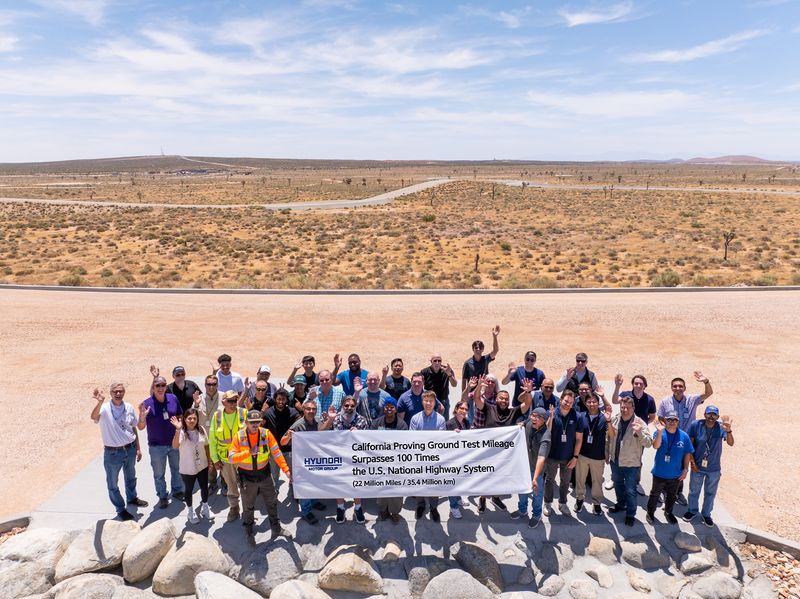
[Financial News] Hyundai Motor Group has spent 21 years testing vehicle quality in California's Mojave Desert, driving a distance equivalent to 883 laps around the Earth. Observers say rigorous quality testing in extreme conditions lies behind its surpassing 30 million cumulative sales in the United States, 40 years after entering the market, and winning 15 top honors at the world's three major automotive awards ceremonies.
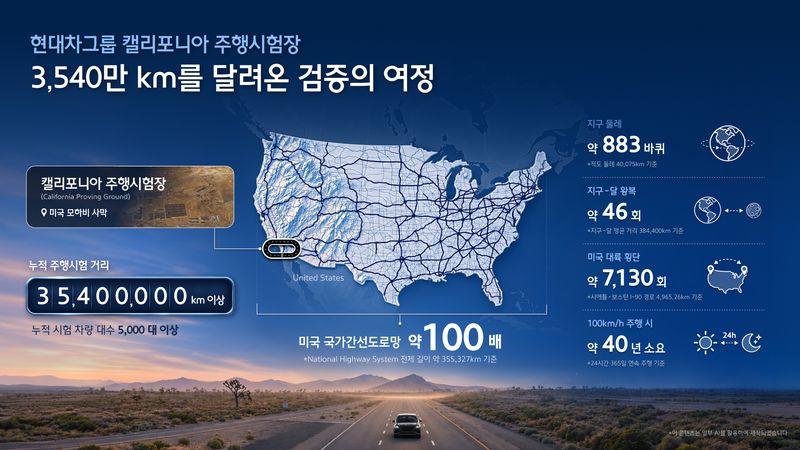
Hyundai Motor Group announced on the 29th that cumulative testing at its California proving ground had surpassed 35.4 million km. The total reflects the use of some 5,000 Hyundai Motor Company, Kia and Genesis vehicles since the facility was established in 2005. That is about 100 times the length of the U.S. national highway network—a distance one car would have to travel nonstop at 100 km/h for 40 years to cover.
After entering the U.S. market in 1986 with the Excel, Hyundai Motor Group built a proving ground covering about 17.7 million square meters in the Mojave Desert in 2005 to develop vehicles optimized for the North American market.
The facility conducts 14 key tests, including a high-speed circuit, ride comfort and noise test track, off-road test track and desert driving track, to verify vehicle safety, durability and suitability for local roads.
On the 10.3-km high-speed circuit, a new vehicle must repeatedly travel about 48,000 km over an average of three months to pass the test. On the durability test track, where conditions are about 10 times harsher than on ordinary roads, driving 10,000 km is enough to verify durability equivalent to 100,000 km on ordinary roads.
The group is also stepping up testing of future vehicle technologies, including electrification and autonomous driving. It tests electric vehicle battery and motor cooling performance in summer temperatures of 45°C or higher, while checking the perception and decision-making accuracy of autonomous-driving sensors and advanced driver-assistance systems (ADAS). The ability of high-performance models such as the Genesis GV60 Magma, Hyundai Ioniq 5 N and IONIQ 6 N to maintain performance after repeated driving is also a key testing focus.
This quality edge is translating into results in global markets. Hyundai Motor Group has won a cumulative 15 top honors at the world's three major automotive awards ceremonies: World Car of the Year, the North American Car, Truck and Utility Vehicle of the Year Awards, and European Car of the Year. Including awards in individual categories, the total comes to 25.
Cumulative sales in the U.S. market surpassed 30 million vehicles this year, and in August the group reached 2 million cumulative sales of eco-friendly vehicles, including hybrids and plug-in hybrids.
A Hyundai Motor Group representative said, "Along with sophisticated design, analysis and simulation, we plan to keep enhancing our proving-ground infrastructure, where we continually test vehicles under harsher conditions than on actual roads, to secure customer safety and trust in the era of electrification, autonomous driving and high-performance vehicles."
[email protected] Kim Dong-ho Reporter