K-beauty Export Landscape Shifts... Number of Companies Exporting $50 Million Quadruples in 10 Years
- Input
- 2026-11-29 11:00:00
- Updated
- 2026-11-29 11:00:06
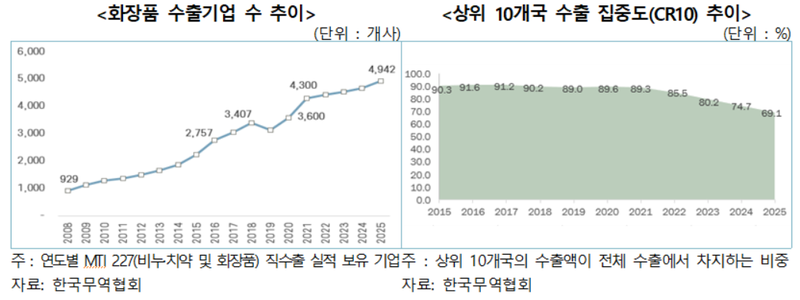
[Financial News] The K-beauty export ecosystem is shifting from a focus on large companies and Greater China to one centered on emerging companies and global markets. The number of cosmetics companies exporting at least $50 million a year has nearly quadrupled in 10 years, while companies that entered export markets in the past five years have emerged as key players, accounting for at least 30% of total exports.
According to a report titled “Changes in the K-beauty Export Landscape and Strategies for Entering Key Markets,” released on the 29th by the Korea International Trade Association’s Institute for International Trade (IIT), 60.3% of domestic cosmetics exporters last year were companies that had begun exporting for the first time in 2020 or later. These companies accounted for 30.2% of total cosmetics exports. Of the top 50 exporters, 12 had also entered export markets in 2020 or later.
The number of cosmetics companies exporting at least $50 million a year rose 3.9-fold, from eight in 2016 to 31 last year. Over the same period, the number of companies directly exporting cosmetics increased 1.8-fold, from 2,757 to 4,942.
Export markets are also diversifying rapidly. As exports once concentrated in China and Hong Kong have expanded to the United States, Japan and elsewhere, the share of exports going to the top 10 countries fell by 22.5 percentage points, from 91.6% in 2016 to 69.1% last year. Exports to emerging markets such as Russia, Poland, the United Arab Emirates (UAE) and Vietnam have also grown by an annual average of at least 20% over the past 10 years.
Korean-made products’ share of the global cosmetics import market rose from 3.9% in 2016 to 6.3% last year. In the United States, the world’s largest market, Korea’s ranking in the import market jumped from eighth to second.
The Korea International Trade Association (KITA) said that the growth of specialized companies across fields ranging from OEM and ODM to branding, distribution and platforms, along with the expansion of online distribution channels, had supported K-beauty’s growth. Online sales’ share of the global cosmetics retail market rose from 9.3% in 2016 to 27.8% last year.
However, it was noted that sustaining K-beauty’s growth will require tailored strategies that take into account the competitive landscape and distribution environment in each country.
In the United States, the report said it is important to prove a product’s competitiveness through online sales and then expand sales channels through specialized local distribution networks. For China, it recommended focusing on differentiated core products and strengthening digital distribution capabilities in response to the growth of local cosmetics brands.
In Japan, where Korean cosmetics ranked first in the import market last year with a 27.6% share, the report said companies should expand everyday consumer purchasing touchpoints such as drugstores and convenience stores. In Southeast Asia and the Middle East, it proposed strengthening partnerships with specialized local distributors and using the UAE as a regional distribution and logistics hub for the Middle East.
Kang Seong-eun, a senior researcher at KITA, emphasized, “K-beauty is evolving from a structure dependent on specific markets and a handful of companies into an industry in which emerging companies are also driving exports.” Kang added, “Support should be provided to help new companies secure sales channels suited to each country’s distribution environment so they can establish a foothold locally rather than limiting themselves to one-off exports.”
[email protected] Kim Dong-ho Reporter