South Korea Borrowers See 2% Mortgages Reset Above 6% After Five Years
- Input
- 2026-11-30 06:00:00
- Updated
- 2026-11-30 06:00:13
Borrowers Brace for Rising Rates
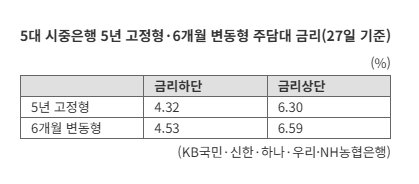
According to the financial sector on the 30th, as of the 27th, six-month variable-rate mortgages at the five major commercial banks (KB Kookmin, Shinhan, Hana, Woori, and Nonghyup Bank) had annual rates ranging from 4.53% to 6.59%. Five-year fixed-rate mortgages ranged from 4.32% to 6.30% annually.This year, borrowers who took out five-year fixed-rate mortgages during the low-rate period in 2021 are reaching their rate-reset dates one after another. In the first half of 2021, the Bank of Korea’s base rate remained at 0.50% annually, its lowest level on record. At the time, COFIX, or the Cost of Funds Index, used as a benchmark for banks’ variable-rate mortgages, was in the 0% range on a new-transaction basis.
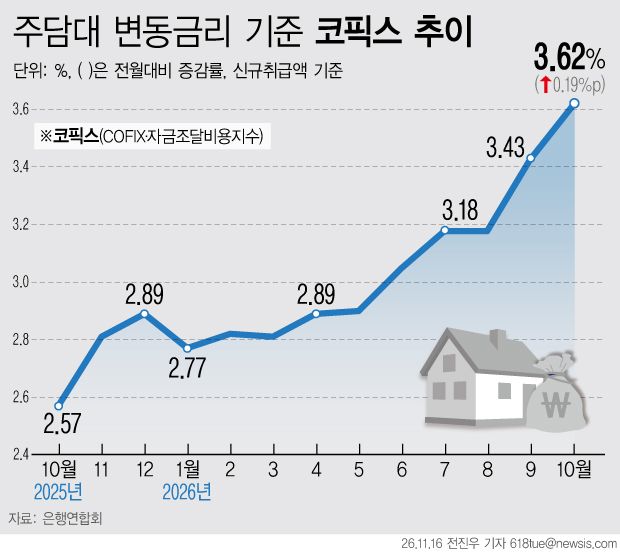
The rate environment has changed significantly as loan benchmarks have climbed sharply following increases in the base rate. COFIX, the benchmark for variable-rate mortgages, rose for a second consecutive month, according to the Korea Federation of Banks. New-transaction COFIX came in at 3.62% in October this year, up 0.19 percentage points from the previous month. That was its highest level in two years and eight months, since February 2024, and 2.70 percentage points above its June 2021 level of 0.92%.
The Bank of Korea’s latest base-rate increase is expected to add further upward pressure on lending rates. The central bank’s Monetary Policy Board raised the rate by 0.25 percentage points to 3.25% from 3.00% on Nov. 26.
The five-year bank bond yield, a benchmark for fixed-rate mortgages, also rose. On Nov. 26, the day the Bank of Korea raised its base rate, the yield climbed to 4.00%, up 0.03 percentage points from the previous day.
Household Lending Rules Also Limit Refinancing
Borrowers seeking to refinance to reduce their interest costs are facing growing uncertainty. A was told that switching the existing mortgage to a product from an internet-only bank could save about 21.3 million won in interest over the remaining loan term, and applied to refinance.But tighter household lending controls at banks could also restrict refinancing. Banks must manage the overall volume of household loans, making it difficult for them to attract customers by cutting rates aggressively even if demand for refinancing grows.
A banking sector official said refinancing demand generally rises when interest rates are increasing, but banks cannot simply lower rates and extend loans this year as household lending restrictions remain in place. Some borrowers are offered rates below those on their current loans, the official said, but refinancing does not necessarily mean getting a lower rate.
Mortgage borrowers are likely to remain under pressure for some time, as the base rate could rise further. Another banking sector official said borrowers tend to choose the lower rate available now during periods of rising rates without considering the possibility of future rate changes. The official said the possibility of another base-rate increase would further raise borrowers’ interest-payment burden.
[email protected] Lee Hyun-jung Reporter