As Global Vehicle Shipping Reaches 30 Million, Hyundai Glovis Secures 20 of the World's Largest Car Carriers
- Input
- 2026-11-29 08:30:00
- Updated
- 2026-11-29 08:30:02
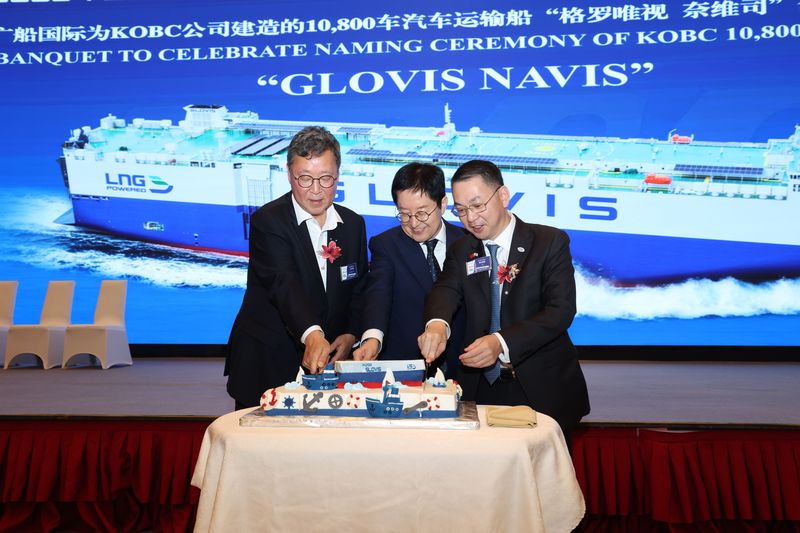
“I hereby name this ship the ‘Glovis Navis (GLOVIS NAVIS).’”
[Financial News, Guangzhou (China) = Reporter Kim Yun-ho]The Navis, the world’s largest pure car and truck carrier (PCTC), is 230 meters long and 40 meters wide, and weighs 102,590 tons. Its 14 decks can carry 10,800 vehicles based on compact-car capacity. Hyundai Glovis has now brought its total to seven PCTCs with a capacity of 10,800 cars, including the Navis, and plans to take delivery of 20 in all by the first half of the year after next. With global seaborne vehicle volumes reaching 30 million units, the ships are a major boost.Investment in a 128-Ship Fleet Backed by Hyundai Motor Company
Hyundai Glovis plans to expand its fleet from 106 ships today (equivalent to a capacity of 6,500 cars) to 128 ships by 2030. Deliveries of large PCTCs are lined up, including 20 ships with a capacity of 10,800 cars each—both owned vessels and chartered ships—with the Navis set to make its maiden voyage on December 1. This was made possible by the company’s decision to make a large-scale investment as early as 2023.The attendees at the Navis naming ceremony offer a clue as to how the company was able to expand its fleet at a time when today’s boom in Chinese cars was difficult to predict.
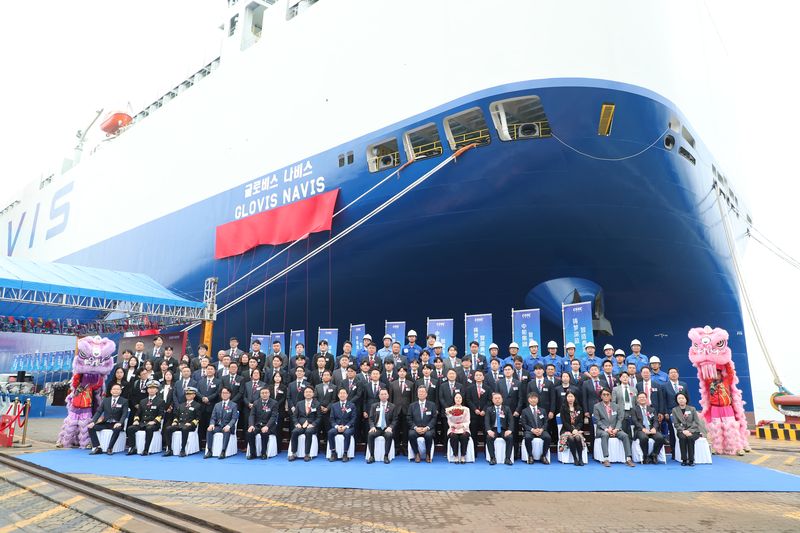
The naming ceremony, held at Guangzhou Shipyard on the 26th, was attended by Hyundai Glovis employees led by CEO Lee Kyoo-bok, as well as Kim Hyung-jun, head of KOBC’s Maritime Strategy Division, which provided ship financing, and Hyundai Motor Company employees. Lee Seo-young, head of Hyundai Motor Company’s Global SCM Support Office, also served as the ship’s “godmother,” bestowing its name.
Hyundai Glovis is an affiliate of Hyundai Motor Group and a “captive carrier” with long-term shipping contracts guaranteed by Hyundai Motor Group. Its affiliate business provides a base of cargo volumes from Hyundai Motor Group, while its non-affiliate business takes on overseas automakers’ shipments, including the rapidly growing volumes of Chinese cars.
In other words, even if cargo volumes decline, the ships will not be left completely empty. That is what enabled the company to boldly expand its fleet.
Winning Shippers With E2E Even as Vehicle Volumes Peak
The company’s early investment is now translating into clear growth. Global vehicle shipping volumes, including Chinese cars, are forecast to reach 28.79 million units this year and exceed 31 million next year. Meanwhile, a ship shortage is all but inevitable.At a press briefing the day before the naming ceremony, Hyundai Glovis CEO Lee Kyoo-bok explained, “Even Chinese shipping companies didn’t know exports of Chinese cars would grow this quickly, and they haven’t built ships. Even if they place orders now, the ships won’t be delivered until the 2030s, so there is concern that this could coincide with the peak and subsequent decline in vehicle volumes.”
There is a strong expectation that even if the market peaks, cargo volumes will not hit bottom anytime soon, because the backlog keeps growing.

“Half of Chinese car exports are being transported inefficiently on container ships because there aren’t enough PCTCs, while used cars are being crowded out by new cars and cannot be loaded,” Lee said. He forecast that the tight market would continue, as some vessels more than 25 years old should have been considered for scrapping.
The company is also confident it can cement a unique position with a service that covers inland transportation as well as shipping. In the United States and Europe, Hyundai Glovis transports cargo after unloading by rail and truck all the way to dealers. Its E2E (end-to-end) service tracks cargo from the sea route to its final destination.
Hyundai Glovis continues to enhance its E2E services. For example, it has nearly doubled the land available at Port Tampa Bay in the United States for storing cargo and inland transport vehicles to strengthen its E2E service. The finished-vehicle terminal it established at the Port of Philadelphia can hold around 37,000 vehicles.
[email protected] Kim Yun-ho Reporter