Ukraine's Drone Offensive Batters Russian Oil Refineries and Data Centers ... War Shackles Russia's Ambition to Become an 'AI Powerhouse'
- Input
- 2026-11-29 01:27:38
- Updated
- 2026-11-29 01:27:38
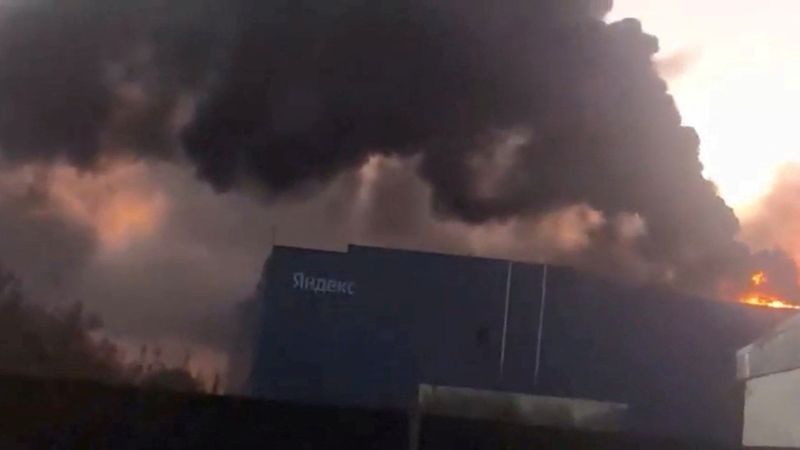
[Financial News] Ukraine has intensified large-scale drone attacks targeting energy facilities, Russia’s lifeline for funding the war and its “weak link,” escalating the exchanges between the two countries. The effects of the protracted war appear to be hampering not only Russia’s energy supply but also President Vladimir Putin’s plan to make the country an “AI powerhouse,” which he has presented as a solution to national challenges.
■ Ukraine strikes three Russian oil refineries again; massive drone exchanges involving more than 1,200 drones
On the 28th (local time), Ukraine’s Ministry of Defense said it had attacked three oil facilities in Russia’s Rostov Oblast, Samara Oblast and the Republic of Bashkortostan, according to The New York Times (NYT) and other foreign media. The Novoshakhtinsk refinery in Rostov Oblast was hit for the second time in the past five days. The Russian independent outlet Astra reported powerful explosions and a large fire near the fuel storage tanks at the refinery and a complex of oil pumping and storage facilities in Samara Oblast that handles shipments of Urals crude for export.
At least 15 refineries have been hit by Ukrainian medium- and long-range drone attacks this month alone, prolonging concerns over energy supplies in Russia. Peace talks between the two sides, mediated by the United States, resumed in Abu Dhabi, United Arab Emirates, on the 10th after a nine-month hiatus, but there are no signs of tensions easing.
Russia’s Defense Ministry said it had intercepted and destroyed 1,246 Ukrainian fixed-wing drones over 15 regions, including Moscow, Rostov and Samara, as well as over the Crimean Peninsula. Moscow Mayor Sergei Sobyanin also said that 462 drones had flown toward Moscow between the previous night and that morning, and that 123 had been shot down as they approached.
Russia, too, continued retaliatory airstrikes against Ukraine. Russia’s Defense Ministry announced that it had struck a substation in Kyiv and a nearby thermal power plant, while the Ukrainian Air Force said it had shot down 141 of 162 Russian drones. In Zaporizhzhia Oblast, more than 700 Russian drones descended over the past 24 hours, killing one person and injuring five.
■ Sanctions, brain drain and data center strikes... War shackles ambition to become an “AI powerhouse”
The quagmire of the war in Ukraine is also dealing a direct blow to Russia’s AI industry, which the country is developing as a future engine of growth. NYT reported that Russia is trying to use AI to overcome severe population decline and labor shortages, but faces a triple burden of Western sanctions, brain drain and attacks on its infrastructure.
In a keynote address at an AI conference in Moscow on the 26th, President Putin said, “We are betting on sovereign foundation models,” and declared that Russia would expand AI adoption across all areas of the economy and people’s lives. With Russia’s population expected to shrink by about 820,000 this year, the plan is to use AI to fill labor gaps. German Gref, CEO of Sberbank, Russia’s largest bank, also unveiled the latest model of its chatbot GigaChat, claiming it was approaching leading Chinese models.
But the reality is challenging. Western sanctions on Russia have blocked access to advanced U.S.- and Chinese-made semiconductors; massive wartime spending has concentrated resources in the military sector, and large numbers of technology workers have left the country. Russian entrepreneur Stepan Gershuni told NYT, “Building a competitive model would require tens of billions to hundreds of billions of dollars, but Russian companies don’t have that kind of money right now.”
Ukrainian drone attacks are also threatening technology infrastructure. This fall, Ukrainian long-range drones hit a facility under construction by Sberbank as well as three of Yandex’s six data centers. In response, President Putin approved a plan on the 24th to build data centers using the workings and vertical shafts of abandoned coal mines in Kuzbass and Yakutia, far from the front lines in Ukraine.
Even so, the Russian government continues to pursue domestic AI development, citing inexpensive and abundant energy, a cold climate and vast territory as advantages. Kirill Dmitriev, a Russian presidential envoy, said, “Russia has a unique advantage: it can supply power to data centers at the lowest cost in the world,” and also raised the possibility of building data centers for the United States and China in the future.
[email protected] Park Ji-hyun Reporter