Picking Up Sick Children for Medical Care and Childcare: Japan's Expanding Telemedicine [Japan Inside]
- Input
- 2026-11-29 08:00:00
- Updated
- 2026-11-29 08:00:08
【Financial News, Tokyo—Correspondent Seo Hye-jin】“Your child has a fever. You’ll need to come pick them up.”
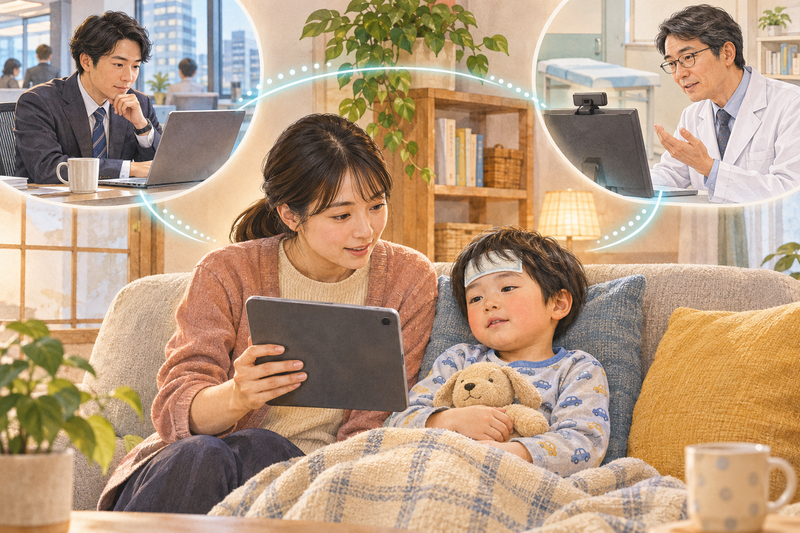
When working parents get a call like this from daycare, they have to rearrange their schedules in a hurry. Even after taking their child to the hospital and back, they still have to figure out who will care for them. An experiment is beginning in Japan to link the entire process in one go. A sitter picks up the child on the parents’ behalf and cares for them at home, while the parent at work joins a video consultation with the doctor alongside the child and sitter.
As South Korea prepares to formally institutionalize telemedicine next month, a service combining existing online medical consultations with childcare is being put to the test in Japan. The aim is not only to reduce time spent traveling to and from hospitals but also to ease the childcare burden on working people.
Parents Who Had to Go to the Hospital Even After Finding a Sitter
Mednext Japan said on the 29th that, together with Japanese travel company JTB and childcare provider Le Ange, it will launch a pilot project for “three-way online medical consultations” on the 15th of next month in selected areas of Tokyo Metropolis. The first phase will assess the service’s usefulness and operational challenges among JTB employees and their children.
Services that care for sick children at home are available in Japan, too. The problem is the process of accessing them. Whether same-day bookings are available varies by provider, and some require a prior consultation as a condition of using the service. Even if parents find a sitter, they still have to leave work first and take their child to the hospital and back.
The pilot was designed to reduce this burden by arranging the child’s trip home, medical consultation, and subsequent care together. Once a guardian applies, a sitter affiliated with Le Ange picks up the child from daycare or another location that same day and accompanies them home. Mednext Japan’s platform then connects three locations simultaneously: the home where the child and sitter are, an outside location such as the workplace where the parent is, and the medical institution where the doctor is.
Parents explain their child’s symptoms and medical history to the doctor, then review the consultation and the doctor’s explanations together with the sitter. The consultation itself is conducted by a doctor at a partner medical institution. After it ends, the sitter cares for the child based on the consultation.
A child’s sudden illness can have a significant impact on work. In an online survey JTB conducted last June among 600 working guardians with preschool-aged children, 82.7% of respondents said they had received a call in the past year from a daycare or similar facility asking them to pick up their child. The proportion whose work was affected by a child’s illness, through leaving early or taking time off, reached 87.2%.
Online Consultations Available on an Ongoing Basis, Linked to Corporate Benefits
These experiments are underpinned by Japan’s established online consultation system. In 2018, Japan set out relevant guidelines and a medical fee framework. In 2022, it allowed online consultations from the initial visit if certain requirements were met and the doctor deemed them appropriate. This made online consultations available in routine circumstances, beyond temporary measures introduced in response to COVID-19. A revised law specifying the definition of online consultations and standards for conducting them in the Medical Care Act also took effect this April.
In South Korea, telemedicine will become a formal system next month, on the 24th, when the amended Medical Service Act takes effect, following a period of temporary authorization and a pilot program. Discussions continue over detailed criteria, including the scope of initial consultations allowed online and the number of days’ worth of medication that may be prescribed. Japan’s pilot tests the effects of combining an existing online consultation service with other everyday services.
Japan does not allow online consultations without restrictions, either. Narcotics and psychotropic drugs cannot be prescribed at an initial consultation, and limits apply to the types of medication and prescription duration when the patient’s information is insufficient. If an issue cannot be appropriately assessed online, the patient must switch to an in-person consultation. However, a system is in place to have medication delivered after an online consultation and online medication guidance from a pharmacy, reducing the need to travel from consultation through to receipt of the medication.
Having a system in place does not mean it is widespread. According to a response by the Ministry of Health, Labour and Welfare to the Diet, as of October 1 last year, 14,240 medical institutions had filed notifications to bill for online initial consultations and other services—about 10% of hospitals and general clinics nationwide. This is the number of institutions that filed notifications, and should be distinguished from actual consultation figures.
Reducing Travel Time and Providing Care, Too: Expanding into Corporate Benefits
Users identify time savings as a key benefit. In a survey of 309 people with experience using online consultations, conducted in March this year by Leverages, which operates the Japanese online consultation platform “RevaCli,” 84.8% said they had experienced benefits. Specific reasons cited included reduced travel time to hospitals, at 54.2%, and less stress from waiting at hospitals, at 51.9%.
But even if a child receives a consultation at home, parents still bear the burden of interrupting work if no one is there to care for the child. The pilot by Mednext Japan and JTB includes that responsibility in the service as well.
Travel company JTB is designing the overall service by drawing on its business-to-business connections and experience arranging and operating services, developed through its travel and corporate businesses. Mednext Japan connects the consultation platform with medical institutions, and Le Ange assigns sitters; JTB coordinates the process from the child’s trip home through consultation and care.
After the pilot, the participating companies will consider developing the service into an employee benefit that companies contract for and provide to their staff. Introducing it at daycare centers and offering individual contracts to guardians are also under consideration. The results of the pilot, selected for Tokyo Metropolis’s startup support program, are expected to be announced next February. The companies plan to assess not only connection stability and ease of use but also whether parents’ work-related burden has actually been reduced.
Meanwhile, Mednext Japan began as DoctorNow’s Japanese subsidiary, but its existing management took over the business, and it now operates separately from DoctorNow. It will apply to this project the technology and experience collaborating with local medical institutions that it gained while operating the online medical service “MediNow.”
[email protected] Seo Hye-jin Reporter