Spain's Snap Election One Day Away: Sánchez Seeks to Extend His Eight-Year Rule; Conservatives and Far Right Seek First Change of Government in 51 Years
- Input
- 2026-11-28 23:47:47
- Updated
- 2026-11-28 23:47:47
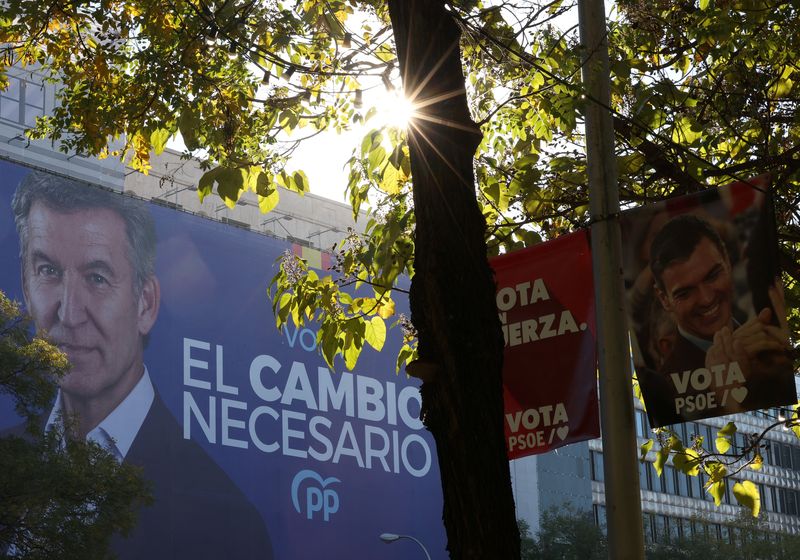
[Financial News] Spain will hold its 17th snap general election on the 29th (local time) to determine the country's next government. As center-left Prime Minister Pedro Sánchez, who has been in power for eight years, seeks to extend his rule, a coalition government led by the conservative main opposition party and a far-right party is widely seen as a strong possibility, drawing attention across Spain and Europe.
■ Housing crisis triggers snap election... Ruling and opposition parties make all-out final campaign push
The election is being held nine months earlier than originally scheduled. After protests against the nationwide housing crisis spread following the case of an 87-year-old woman who was forcibly evicted last September from a rental home where she had lived for 71 years, Sánchez pushed for legislation to regulate rents and restrict forced evictions. But when parliament rejected the bill on the 2nd of last month, Sánchez dissolved parliament and took the gamble of calling a snap election.
During his time in office, Sánchez has delivered notable economic gains, including economic growth, lower unemployment and a reduced budget deficit, and has made his presence felt on the international stage. But he is struggling amid a string of setbacks, including corruption scandals involving close aides and family members, a major blackout last year, two high-speed train disasters this year and a mass influx of migrants into Ceuta this summer.
On the 27th, two days before the election, the ruling and opposition parties made an all-out effort in their final campaign rallies. Standing before 13,000 supporters in Madrid, Sánchez said the conservative People's Party (PP) and far-right Vox were “getting nervous,” and appealed to voters: “This election is not a verdict on me; it's about citizens' jobs, housing and dignity. We can do it again.”
Meanwhile, People's Party leader Alberto Núñez Feijóo, who is seeking a change of government, voiced confidence at a rally in Seville, saying, “In the 2023 general election, we won the most votes but still couldn't take power. This time, we will secure a majority and change the country.” Vox leader Santiago Abascal also urged people to vote to bring down the Sánchez government, using forceful language at a rally attended by 14,000 people in Valencia.
■ Right-wing coalition likely to win majority... Europe watches closely as far right may enter government for first time in 51 years
Polls favor a victory for the right-wing camp. The average support figures in polls compiled by Spanish daily El País put the People's Party at 31.4–31.5%, the Spanish Socialist Workers' Party (PSOE) at 29.0–29.1% and Vox at about 18%. The PSOE has gained ground in the final stretch, narrowing its gap with the People's Party to around two percentage points. But smaller left-wing parties have failed to agree on a joint candidate list, making a split in the vote inevitable.
Spain's public broadcaster RTVE forecast that the People's Party would win 128 of the 350 seats in the lower house and Vox 61, giving them 189 combined—comfortably above the 176 seats needed for a majority. The PSOE was projected to win just 116 seats. El País also put the likelihood of the People's Party and Vox securing a majority at 83%. However, late surprises remain possible: in a poll by Spain's Center for Sociological Research (CIS), the PSOE (34.4%) led the People's Party (24.7%).
If the People's Party and Vox form a coalition, Feijóo would become prime minister and Vox would take roughly a third of the cabinet posts. It would mark the first time in 51 years since Francisco Franco's dictatorship ended in 1975 that a far-right party entered the central government. With elections in major European countries including France, Italy and Poland coming next year, countries are watching closely for the impact that a far-right government in Spain—the EU's fourth-largest economy—could have on Europe's broader political landscape.
■ Head-on clashes over housing, immigration and corruption... Election outcome to take shape early on the 30th
The main issues in the election are the housing crisis and immigration policy. Sánchez is calling for strict measures such as rent caps and a ban on short-term rentals. Feijóo, by contrast, is proposing to ease regulations and increase supply by encouraging private construction, and has pledged to scrap the current government's rental regulations. Vox blames large-scale immigration for the housing crisis and is calling for immigration restrictions to be tightened substantially.
A total of 38.6 million voters, including 2.7 million living abroad, will take part in the election to choose 350 members of the lower house and 209 senators. Polls in mainland Spain close at 8 p.m. on the 29th (4 a.m. on the 30th Korea time). Preliminary results will be released from 5 a.m. Korea time on the 30th, with the outcome expected to become clear around 6:30 a.m. The new parliament will hold its first session on the 23rd of next month and begin the process of confirming the prime minister.
[email protected] Park Ji-hyun Reporter