One in Three Sixth-Grade Elementary Students 'Hardly Reads Books'
- Input
- 2026-11-29 13:19:27
- Updated
- 2026-11-29 13:19:27
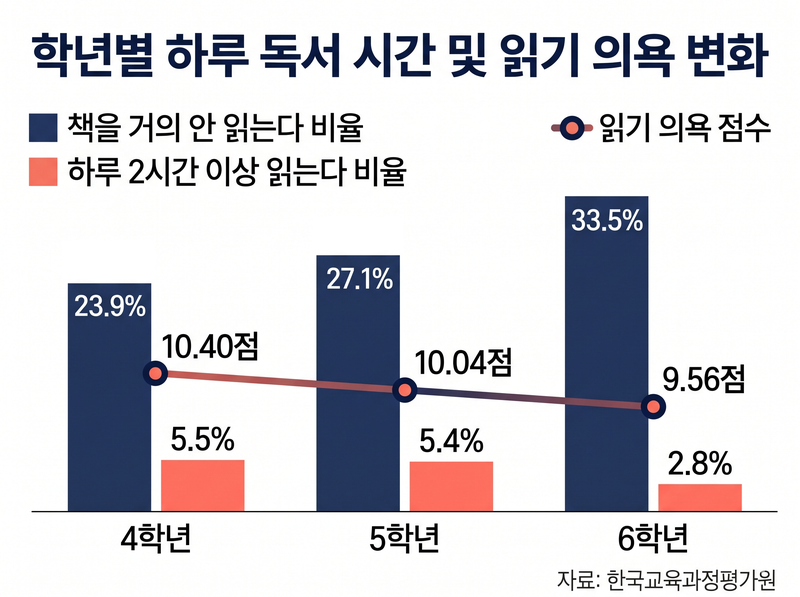
[Financial News] One in three sixth-grade elementary students rarely reads books in their daily lives, a report has found. As students advance through the grades, both the time they spend reading and their desire to read decline, while gaps of at least 40 percentage points in word comprehension emerge even among students in the same grade, prompting calls for urgent efforts to establish reading habits early. The researchers stressed that a supportive reading environment at home and differentiated instruction in the classroom must go hand in hand.
According to the report “Analysis of Elementary Students’ Literacy and Exploration of Educational Support Measures,” released on the 29th by the Korea Institute for Curriculum and Evaluation (KICE), a survey of daily reading time among 4,073 elementary school students in grades 4–6 found that the proportion who said they “hardly read books” was 23.9% in grade 4, 27.1% in grade 5 and 33.5% in grade 6. In effect, one in three sixth-graders had all but given up reading.
By contrast, the share of students who read for at least two hours a day fell by half, from 5.5% in grade 4 and 5.4% in grade 5 to 2.8% in grade 6. As academic pressures and video viewing increase, students are clearly moving further away from written texts. The average reading motivation score on a 10-point scale also declined each year, from 10.40 points in grade 4 to 10.04 in grade 5 and 9.56 in grade 6.
As more students disengage from reading, gaps in reading comprehension within the same grade have also widened. An analysis of the rates at which students correctly identified word meanings, with literacy levels divided into high, middle and low groups, found that the gaps within a grade were far larger than those between grades.
In grade 4, the gap in correct-answer rates between the high and low groups reached 45 percentage points for both everyday words (79% versus 34%) and academic words (83% versus 38%). In grade 5, the gaps were 41 percentage points for everyday words (87% versus 46%) and 37 percentage points for academic words (90% versus 53%). Grade 6 also showed gaps of 39 percentage points for everyday words (92% versus 53%) and 33 percentage points for academic words (94% versus 61%).
A supportive home environment and active reading habits were identified as key to narrowing the gaps. Factors that had a clear impact on improving literacy across grades 4–6 were the number of books at home, the time students usually spent reading, and the habit of guessing the meaning of unfamiliar words from the surrounding sentences. For students in grades 5 and 6, looking up unfamiliar words during class also helped considerably.
Careful support in schools was also proposed as part of the solution. The researchers recommended that teachers regularly monitor students’ motivation and reading habits during class and provide instruction tailored to their levels. They added that lower-performing students need 10–20 minutes of focused instruction every day, supported by compensation for teachers providing the instruction and the assignment of dedicated literacy staff.
[email protected] Kim Man-gi Reporter