'Evolving Childcare Support Centers': AI Assigns Substitute Teachers and Parent Education Goes to Workplaces
- Input
- 2026-11-29 09:00:00
- Updated
- 2026-11-29 09:00:13
[Financial News] Comprehensive childcare support centers across the country are lowering barriers to childcare through AI-based administrative systems and tailored services that reach people on their way home from work and even in remote mountain villages.
The Ministry of Education and the Korea Institute for the Promotion of Early Childhood Care and Education announced on the 29th that they would hold the 2026 Awards for Outstanding Institutions Operating Comprehensive Childcare Support Centers at Inspire in Incheon on the 30th, selecting and sharing 23 outstanding cases that led innovation in the field this year. Currently operating at 144 locations nationwide, comprehensive childcare support centers serve as local hubs supporting young children, their guardians and childcare centers.
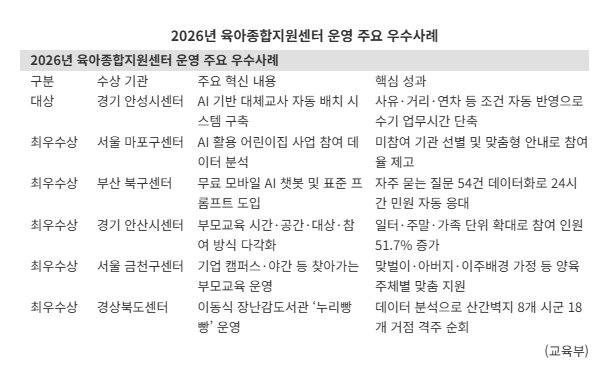
The Anseong City Comprehensive Childcare Support Center in Gyeonggi Province, which won the grand prize in this year’s competition, significantly improved administrative efficiency by introducing AI to the assignment of substitute teachers, a task previously handled manually. When complex factors—including a childcare center’s reason for requesting support and its priority, teachers’ annual leave, and travel distance—are entered into the system, AI automatically matches the center with the best-suited substitute teacher. With staff workloads reduced, urgent substitute placements have also become much faster.
Cases of using data and AI to identify gaps in childcare services are also drawing attention. The Mapo District Center in Seoul, which received an excellence award, combined and analyzed basic information on childcare centers and their records of participating in programs, then used AI to identify institutions with low participation in training and provide them with tailored information, boosting participation rates. The Buk District Center in Busan introduced a free mobile AI chatbot trained on 54 frequently asked questions, establishing a system that automatically responds to inquiries around the clock.
Everyday services tailored to dual-income couples and families in farming and fishing communities have also expanded. The Ansan City Center in Gyeonggi Province and the Geumcheon District Center in Seoul, both recipients of excellence awards, moved parent education beyond the weekday daytime sessions traditionally held at centers, extending its hours and locations to workplaces such as corporate campuses, as well as weekday evenings and weekends. The Ansan City Center also opened participation to young people, prospective parents and families, recording 725 participants this year, up 51.7% from the same period last year.
The Gyeongsangbuk-do Center analyzed data on the population of young children and where they live to identify 18 hubs across eight cities and counties in remote mountain areas with insufficient childcare infrastructure. It won an excellence award for operating a mobile toy-library van, “Nuri Ppangppang,” which provides a roving lending service every two weeks.
Around 450 people affiliated with centers nationwide will attend the event to share the winning institutions’ operational know-how and discuss ways for central and local centers to cooperate. The selected best practices will be published on the Central Childcare Support Center website and shared with centers across the country.
Kang Min-kyu, the Ministry of Education’s director-general for early childhood policy, said, “We will continue to strengthen close collaboration between central and local comprehensive childcare support centers so that young children can receive comprehensive, high-quality support for their care and upbringing, regardless of where they live.”
[email protected] Kim Man-gi Reporter