One Year of the Korea-Cambodia Joint Task Force for Koreans... 289 Suspects Arrested, Reports of Kidnapping and Confinement Down 93%
- Input
- 2026-11-29 09:00:00
- Updated
- 2026-11-29 09:00:07
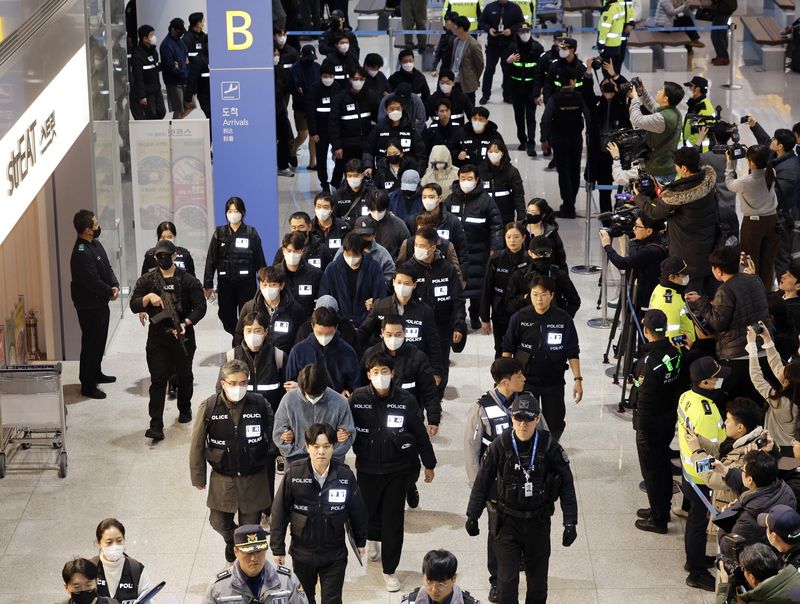
[Financial News] The Korea-Cambodia Joint Task Force for Koreans, launched by the police of South Korea and Cambodia to jointly combat transnational crime in Cambodia, arrested 289 offenders and rescued 10 South Koreans held in criminal compounds and elsewhere over the course of a year. A comparison of the periods before and after the task force began operating showed that reports of South Koreans being kidnapped or confined in connection with online scams in Cambodia fell by about 93%. Local criminal groups also appeared to have scaled back efforts to recruit South Koreans.
According to the Korean National Police Agency on the 29th, the joint South Korea-Cambodia task force, which began full operations last December, carried out more than 70 joint operations through October this year and arrested 289 suspects in transnational crimes.
Online scams accounted for the largest number of arrests by crime type, with 256 people (88.5%), followed by online gambling with 19 (6.5%) and drugs with 3 (1.0%).
Among the 256 scam suspects, reservation no-show fraud accounted for the largest share, with 103 people (40.2%). They were followed by investment chatroom scams with 64 (25.0%), romance scams with 54 (21.1%), voice phishing with 26 (10.2%), and other types with 9 (3.5%).
The task force also rescued 10 South Koreans who had been held in criminal compounds and elsewhere. Those rescued included people with intellectual disabilities and women.
Reported South Korean victims of kidnapping and confinement fall from 477 to 33... recruitment of South Koreans also curbed
Reports of South Korean victims filed locally fell sharply after the task force began operating.The number of people reported to the Embassy of the Republic of Korea in Cambodia as South Korean victims of kidnapping and confinement linked to online scams plunged by about 93%—from 477 in the period before the task force began operating, December 2024 to October 2025, to 33 in the period after it began operating, from last December to this October.
Domestic voice phishing losses also declined amid intensive crackdowns on scam hubs in Cambodia. From January to October this year, there were 10,118 reported cases of voice phishing in South Korea, down 49.3% from 19,972 in the same period a year earlier. Over the same period, losses fell 58%, from 1.0566 trillion won to 443.5 billion won.
The police believe that crackdowns on overseas criminal hubs and stronger international cooperation can also help prevent crime-related losses at home.
There were also signs that local criminal groups were becoming reluctant to recruit South Koreans.
Last September, the Korea-Cambodia Joint Task Force for Koreans arrested 35 members of a multinational scam organization suspected of running investment chatroom scams and other schemes from two homes in Sihanoukville, Cambodia. Five of those arrested were South Korean, and three were on Interpol Red Notices. Authorities also raided the residence of a Chinese ringleader at the same time.
A Chinese member of the organization at the level of a mid-ranking ringleader said that, out of concern about the task force’s crackdowns, the group had only recently recruited South Koreans, but was ultimately caught.
However, even as large-scale scam compounds are dismantled one after another, some criminal groups are believed to be avoiding crackdowns and continuing to operate as small, decentralized cells.
Joint on-site investigations go beyond information sharing... US and Japan also show interest
The Korea-Cambodia Joint Task Force for Koreans was launched after transnational crime issues in Cambodia came to the fore, including the death of a South Korean university student there last August.Last October, the government dispatched a joint response team to Cambodia, led by the Second Vice Minister of Foreign Affairs and including the Korean National Police Agency and the National Intelligence Service. On the 27th of that month, President Lee Jae-myung and Cambodian Prime Minister Hun Manet agreed at a summit to establish and activate the task force. The police agencies of the two countries signed a memorandum of understanding (MOU) last November, and the task force began full operations in December that year.
Whereas previous international cooperation was centered on exchanging information between countries, the Korea-Cambodia Joint Task Force for Koreans differs in that police from both countries carry out joint operations directly on the ground.
South Korean police support the collection and analysis of criminal intelligence and the analysis of digital evidence, while Cambodian police conduct on-site investigations, including arrests and searches, in accordance with local law. This division of responsibilities between the two countries makes up for the fact that South Korean police cannot exercise direct compulsory investigative powers locally.
South Korean police also supported the digital forensic examination of electronic devices obtained by Cambodian police, enabling related materials to be used as evidence in investigations in South Korea. Forensic officers helped identify South Korean suspects who pretended to be foreigners or gave false personal details.
In one case, DNA collected and analyzed from an item left behind by a person wanted by Interpol provided a lead to an arrest.
The United States, Japan, Indonesia and others have also expressed interest in this model of cooperation and requested that operational experience and investigative know-how be shared.
At a meeting of police chiefs last April, the two countries agreed to expand the task force’s remit beyond online scams to include drug and online gambling crimes.
Personnel with investigative experience and expertise in related fields have also recently joined the task force. As it enters its second year, the task force plans to focus its investigative efforts not only on arresting individual members but also on tracing criminal organizations’ higher-ups and funds.
Kim Dong-kwon, head of the Korean National Police Agency’s International Security Cooperation Bureau, said, “We will continue to work closely with Cambodian police to thoroughly track criminal organizations’ higher-ups and funds, and do our utmost to protect the lives and property of our citizens wherever they are overseas.”
[email protected] Kim Ye-ji Reporter