K-Ramen Boom Puts Factories at Full Capacity... Ramen Industry Speeds Up Expansion of Export Hubs
- Input
- 2026-11-29 14:26:21
- Updated
- 2026-11-29 14:26:21
[Financial News] The global popularity of K-ramen is driving export growth, prompting South Korea's ramen industry to step up efforts to expand production capacity. With exports surging—surpassing last year's full-year total in just the first 10 months of this year—the industry is expanding production facilities and building new plants to meet rising demand.
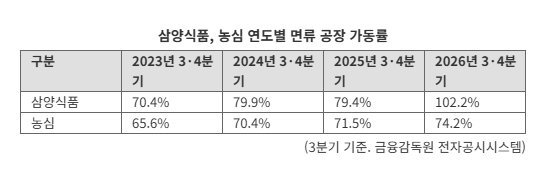
According to the Financial Supervisory Service's Data Analysis, Retrieval and Transfer System (DART) on the 29th, Samyang Foods Co., Ltd.'s noodle plant operating rate in the third quarter of this year was 102.2%, up 22.8 percentage points from 79.4% in the same period last year.
The operating rate has exceeded 100%, as the company handles overseas orders flooding in at levels beyond its existing production capacity. Samyang Foods Co., Ltd.'s noodle plant operating rate stood at 70.4% in the third quarter of 2023, 79.9% in the same period of 2024, and 79.4% last year.
Nongshim, which is actively marketing in global markets as it marks the 40th anniversary of the launch of Shin Ramyun, has also seen a sharp rise in operating rates at its noodle plants.
The rate has climbed steadily from 65.6% in the third quarter of 2023 to 70.4% in the same period of 2024, 71.5% last year and 74.2% this year.
This is because overseas demand for K-ramen continues to grow. According to the Korea Agro-Fisheries & Food Trade Corporation (aT), ramen exports from January to October this year totaled $1.5851 billion (about 2.13 trillion won), up 26.3% from the same period a year earlier. The figure surpassed last year's record annual exports of $1.52 billion in just 10 months.
To handle the flood of orders from overseas markets, the ramen industry is accelerating construction of export-only plants in South Korea and the establishment of overseas production bases.
Nongshim recently began operating its export-dedicated plant, built in Noksan National Industrial Complex in Gangseo District, Busan, at a cost of 204.3 billion won. At the new Noksan plant, production equipment using artificial intelligence (AI) can turn out at least 600 units of Shin Ramyun and other products per minute, providing the capacity to produce an additional 500 million ramen units annually.
Samyang Foods Co., Ltd., which has until now maintained a domestic production-and-export system, is also expanding its overseas production bases.
Samyang Foods Jiaxing Plant, the company's first overseas production facility, is reportedly in trial production, with operations targeted to begin next January. The strategy is to supply the Chinese market with products made at the Jiaxing plant, while domestic plants focus on serving other overseas markets, including the United States and Europe. In addition, the company plans to invest 218.6 billion won in Vietnam to build its second overseas plant, aiming for completion by 2029.
Ottogi is also stepping up efforts to expand its production base at home and abroad. By 2029, it will invest about 200 billion won to build an export-only ramen plant in Gumi 2 National Industrial Complex in North Gyeongsang Province.
Industry observers predict that, with K-ramen having established itself as a mainstream food in overseas markets rather than a passing fad, securing export-only plants and overseas production bases will be a key turning point for future earnings growth.
An industry official said, "Competition in the ramen industry is moving beyond simply increasing export volumes and entering a phase of streamlining supply chains through the stable operation of new plants and the securing of local distribution networks. It remains to be seen how steadily overseas markets can absorb the expanded production capacity."
[email protected] Park Kyung-ho Reporter