67-Year-Old Security Guard: “Even Though I’m Sick, I Can’t Retire Because I Have a Loan... What Should I Do?” [Personal Finance Q&A]
- Input
- 2026-11-28 08:00:00
- Updated
- 2026-11-28 09:40:05

Q. A, 67, works as a security guard and lives with his 65-year-old wife. Their two children are both independent. In poor health, he is considering retirement but cannot stop working because of the burden of loan repayments and living expenses. They are already running a monthly deficit and dipping into their emergency savings. He feels anxious and at a loss when he thinks that his salary would disappear as soon as he retires.
The couple’s monthly income totals 4.28 million won: A’s after-tax salary of 2.3 million won, 900,000 won in National Pension Service benefits for the couple, a Basic Pension of 480,000 won, and 600,000 won from his wife’s part-time job.
Their fixed monthly expenses total 2.67 million won, including 1.97 million won in loan principal and interest payments, 260,000 won in insurance premiums, 340,000 won in building maintenance fees, and 80,000 won in phone bills. They spend 1.06 million won on variable living costs, including groceries and household essentials, fuel, dining out, and medical bills, and the couple’s personal allowances total 550,000 won.
Annual irregular expenses, including costs for weddings and funerals, property taxes, car insurance, vacations, and major medical bills, total 5.4 million won. Averaged over the year, that comes to 450,000 won a month, bringing average monthly expenses to 4.73 million won—450,000 won more than their income.
Their assets total 1.132 billion won: a Seoul apartment valued at 1.1 billion won, a 20-million-won term deposit, and 12 million won in a checking account. Their liabilities total 360 million won, comprising a 300-million-won bank loan and a 60-million-won savings bank loan. Their net assets amount to 772 million won.
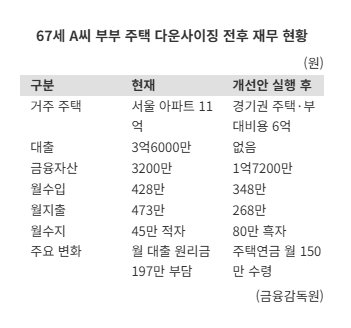
A. According to the Financial Supervisory Service (FSS), the couple’s biggest problem is their 360 million won in debt and the monthly burden of loan repayments, which amount to 1.97 million won. They are running a monthly deficit of 450,000 won even though A is still working.
They are covering the shortfall in living expenses with the 12 million won in emergency funds in their checking account. If their current spending pattern continues, the account will be depleted in about two years and two months. Even if they also use their 20-million-won term deposit, they will exhaust all their financial assets in about five years and 11 months.
When A retires, his 2.3-million-won salary will disappear, reducing monthly income to 1.98 million won: 1.38 million won in public pensions and 600,000 won from his wife’s part-time job. After paying 1.97 million won in monthly loan principal and interest, virtually nothing will be left for living expenses.
Even if they repay all their loans, they will need 2.76 million won a month for living expenses, personal allowances, and irregular spending. Compared with their income after retirement, that would leave them with a monthly deficit of 780,000 won. They therefore need to repay their loans, increase their monthly cash flow, and build up emergency savings.
The FSS proposed that the couple downsize the apartment they currently live in, pay off their loans, and receive a Korean Home Pension. The plan is to sell their Seoul apartment, valued at 1.1 billion won, and move to a home in Gyeonggi Province near Seoul costing 600 million won, including associated expenses.
If they use 360 million won of the 500-million-won difference to pay off all their loans, the monthly burden of 1.97 million won in principal and interest payments will be eliminated. They would keep the remaining 140 million won as an emergency fund for future medical and caregiving expenses.
They would use their newly acquired 600-million-won home for the Korean Home Pension. Based on the younger spouse, the wife, being 65, the monthly payment would be about 1.5 million won. The couple can continue living in the home and receive the pension until both have died. They should confirm the actual payment amount and eligibility requirements with the Korea Housing Finance Corporation.
If the couple downsizes their home and A retires, their monthly income would total 3.48 million won: 1.5 million won from the Korean Home Pension, 900,000 won in National Pension Service benefits for the couple, a Basic Pension of 480,000 won, and 600,000 won from his wife’s part-time job.
Monthly expenses would fall to 2.68 million won as loan payments disappear and property taxes and A’s personal allowance decrease. They would keep annual irregular expenses to 5 million won. This would leave 800,000 won a month, of which they would put 500,000 won into a regular savings plan and 300,000 won into a short-term emergency fund. Even if his wife later stops working part-time, they could maintain a monthly surplus of 200,000 won.
Adding the 140 million won left over after downsizing to their existing 32 million won in financial assets would bring the total to 172 million won. If they invested it at an annual interest rate of 3.5%, they could also expect about 5 million won a year in interest income after taxes. That income was not included in the monthly income calculation.
After retirement, they should check whether they meet the requirements to be covered as dependents under the health insurance plan provided through an employed child’s workplace. If registering as dependents is difficult, they could consider the health insurance continued-enrollment program, which allows them to pay premiums for up to three years at about the level they paid through their workplace before retiring.
The FSS advised the couple to downsize their home, eliminate their debt, and secure cash flow through the Korean Home Pension rather than keep their current home and exhaust their financial assets. If they follow this plan, they can go from a monthly deficit of 450,000 won to a surplus of 800,000 won while retaining financial assets for medical and caregiving expenses.
Consumers can get free, personalized financial counseling by entering “FINE,” the Financial Consumer Portal run by the Financial Supervisory Service, into an internet search engine, or by calling the FSS call center at 1332 and pressing 7 for financial advisory services.
[email protected] Lee Jeong-hwa Reporter