Minister Hong Ji-seon: “Ensure the Bujeon-Masan Double-Track Railway’s Partial Opening Next April Proceeds Without a Hitch”
- Input
- 2026-11-27 17:15:13
- Updated
- 2026-11-27 17:15:13
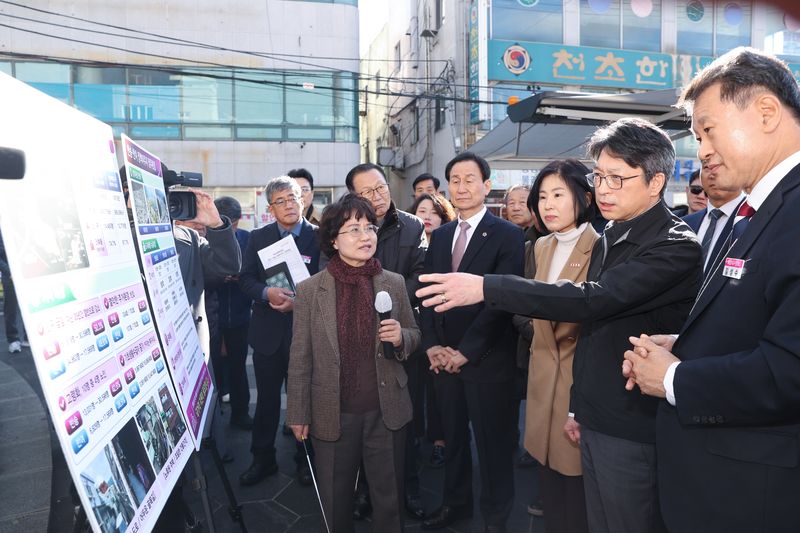
[Financial News] Hong Ji-seon, Minister of Land, Infrastructure and Transport, visited the site of the Bujeon-Masan Double-Track Railway, whose opening has been delayed for more than five years by a 2020 collapse, and called for the partial opening next April to proceed without a hitch.
According to the Ministry of Land, Infrastructure and Transport on the 27th, Minister Hong visited the Bujeon-Masan Double-Track Railway construction site that afternoon and received a briefing on plans for the partial opening from project operator Smart Rail (with SK ecoplant as the lead company) and the operating agency, the Korea Railroad Corporation. The project is a build-transfer-lease (BTL) private investment project to construct a new 32.7-kilometer line from Bujeon in Busan to Jinye in Gimhae, South Gyeongsang Province. Once completed, trains will run between Bujeon and Masan. The opening was delayed by more than five years by a collapse in March 2020, and restoration work on the collapsed section was completed this January.
Minister Hong urged officials to “complete the remaining procedures without a hitch and draw up train operating plans carefully so that local residents who have waited a long time for the opening can use the trains starting next April.” After touring the section where restoration work had been completed, he stressed that “now that restoration work has been completed despite difficult conditions, every effort must be made to manage the facilities so that the public can use them with peace of mind.”
He inspected the interior of the 3.2-kilometer-long Nakdong 1 Tunnel on foot. Minister Hong said, “The opening had been delayed because the evacuation cross passages were unfinished, but now that the project has reached a turning point, the Ministry of Land, Infrastructure and Transport will actively support safe construction through an advisory council and make every effort to bring forward the full opening.” He also told the project operator that safety management of the remaining work must not be neglected and urged it to do its utmost to advance the full opening as much as possible.
On the 19th, the Ministry of Land, Infrastructure and Transport announced the findings of the Construction Accident Investigation Committee’s inquiry and said it would resume the remaining work, which had been halted, together with the project operator and expedite the full opening. The committee cited as the main causes of the collapse that occurred during excavation of Evacuation Cross Passage No. 3 in Nakdong 1 Tunnel on March 18, 2020, a ground reinforcement method used without prior validation and excessive injection pressure reaching up to 20 times the allowable limit. It said that work was not halted and reinforcement material continued to be injected even after cracks and water leaks appeared in the tunnel. The committee recommended reducing the inner diameters of the remaining Evacuation Cross Passages Nos. 1 and 2 from 3.6 meters to 2.0 meters, and beginning full-scale construction only after verifying the water-blocking effect through test construction. The ministry is considering administrative sanctions, including fines and business suspensions, against the contractor and construction management company, and plans to announce the outcome of its business suspension decision in the first half of next year.
Earlier that morning, Minister Hong visited the government resettlement site in the Bansong-Banyeo district of Haeundae District, Busan, and looked at aging homes and inconveniences in residents’ daily lives. He also discussed ways to improve the living environment with Busan Metropolitan City, Haeundae District, Korea Land and Housing Corporation (LH), and others. The Bansong-Banyeo district was established to accommodate people displaced when substandard housing in the elevated areas of central Busan was cleared in the 1960s and 1970s.
Minister Hong said, “The most important thing is to fully reflect the characteristics of each region and the views of its residents.” He added, “The Ministry of Land, Infrastructure and Transport will work with LH to investigate how government resettlement sites across the country were established and their current status, and seek effective ways to improve living conditions so residents can live in a better environment.”
[email protected] Jeong Gyeong-su Reporter