Mechanization Is the Answer to Forestry Labor Shortages... A System Is Needed to Train Young Operators
- Input
- 2026-11-27 18:28:06
- Updated
- 2026-11-27 18:28:06
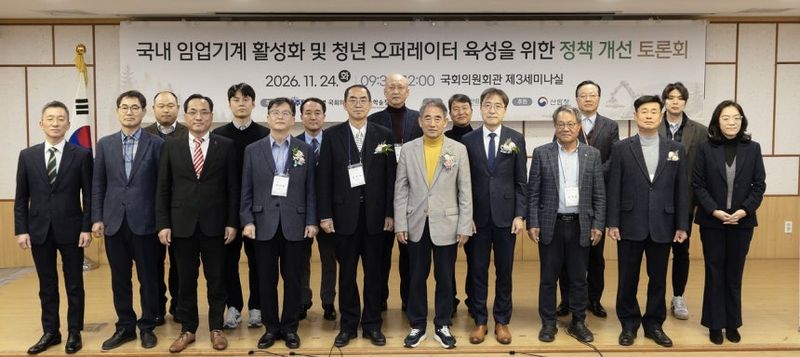
According to industry sources on the 27th, the Jeong In-uk Academic Scholarship Foundation, the scholarship foundation of SAMPYO Group, held a “Policy Improvements to Promote Domestic Forestry Machinery and Train Young Operators” forum on the 24th at the National Assembly Members' Office Building in Yeouido, Seoul, jointly with Democratic Party of Korea (DPK) lawmaker Yoon Joon-byung.
The forum, organized by the Korean Society of Forest Science and sponsored by the Korea Forest Service, discussed ways to expand mechanization and train skilled workers in response to an aging workforce and labor shortages in forestry.
Experts at the forum agreed on the need to introduce forestry machinery suited to working conditions in Korea’s forests and expand infrastructure. Professor Park Sang-jun of Kyungpook National University (KNU) said that, as the country’s growing stock increases, the need to expand timber production is growing, but low forest road density and work practices centered on chainsaws are obstacles to mechanization. He proposed expanding forest roads and work trails and shifting to a machine-based timber harvesting system that uses cable yarding systems and processors.
The need for mechanization to improve safety in forestry work was also raised. Oh Jae-heon, director of the Forest Technology and Management Research Center at the National Institute of Forest Science, cited the fact that 78.8% of forestry fatalities occur during felling and yarding, and proposed as an alternative a work system combining cable yarding equipment with excavator-based multipurpose machinery.
Alongside mechanization, improving training systems to develop the expertise of forestry workers and their working conditions were also identified as key tasks. Han Han-seop, a former professor at Northern Arizona University in the United States, introduced California’s Licensed Timber Operator (LTO) licensing system for forestry workers. Citing the system, which requires 3,000 hours of field experience as well as safety and legal training, he emphasized the need for systematic training and staged career development pathways.
Choi Seong-min, director of the Forest Technology Research Institute at the Korean Forest Engineers Association, presented survey results showing that 54.1% of university students majoring in forestry were willing to work in the field if safety and compensation were guaranteed. He argued that, to attract young workers, wage rates should be made more realistic to reflect actual pay levels in the field and relevant laws and systems should be improved.
The Korea Forest Service also plans to pursue institutional reforms to expand mechanization. Kim Jin-a, director of the Forest Resources Division at the agency, said it would seek funding to introduce multipurpose machinery for mountainous terrain and pursue a plan to require the submission of machinery-use plans when standing timber in national forests is sold.
Yoo Yong-jae, secretary-general of the Jeong In-uk Academic Scholarship Foundation, said, “I hope the issues raised at the forum lead to tangible policy changes so that young operators can establish themselves as professionals in a safe working environment with fair compensation.”
[email protected] Lee Ju-mi Reporter