Culture Minister Nominee Kang Yoo-jung Faces 'Paper Self-Plagiarism' Allegations...Hearing Prep Team Denies Research Ethics Violations
- Input
- 2026-11-27 17:19:46
- Updated
- 2026-11-27 17:24:57
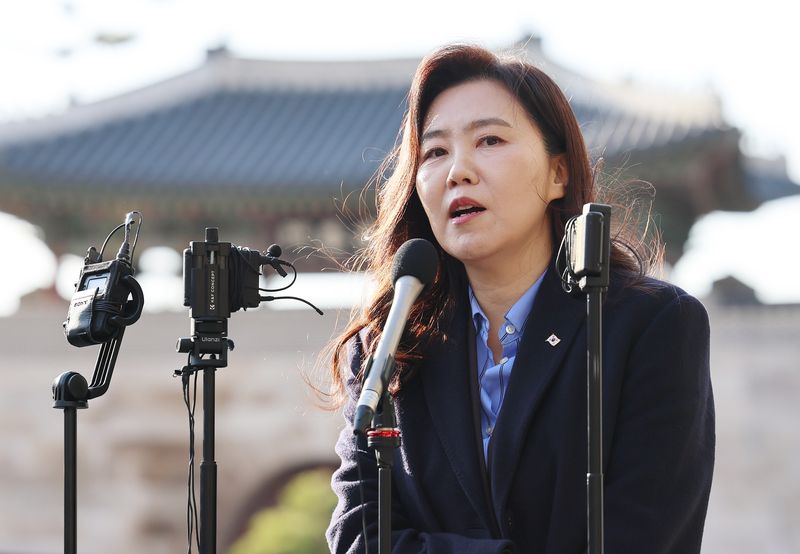
The allegations emerged after the office of Kim Seung-soo, a People Power Party lawmaker on the National Assembly’s Culture, Sports and Tourism Committee, compared two papers by nominee Kang Yoo-jung. The papers were “A Study of Narcissism in Kim Seung-ok’s Novels,” published in the journal Minjok Munhwa Yeongu in December 2004, and “A Study of Narcissism in 1960s Novels,” a doctoral dissertation Kang submitted to Korea University’s graduate school the following December.
The lawmaker’s office analyzed that 16,395 of the 20,119 characters in the journal article’s main text (81.5%) overlapped with the dissertation. It said that about 20.2% of the dissertation as a whole overlapped with the earlier paper, and that 86.2% of the text in Sections 1 and 2 of Chapter 3 matched sentences in the journal article. It also presented passages in the main text and notes of the two papers where only some words or particles differed.
Kim’s office pointed out that the dissertation’s main text and footnotes contained no indication that the journal article had been cited. The office said the article was included in the bibliography, but that its publication venue was incorrectly listed as Minjok Eomun Hakhoe and its publication year as 2005. The Korea Citation Index (KCI) lists the article as having appeared in the 41st issue of Minjok Munhwa Yeongu in 2004, published by Korea University’s Research Institute of Korean Studies.
In an explanatory statement issued that afternoon, the preparation team said the dissertation review had concluded in 2005 and that whether there had been a research ethics violation should be assessed in light of the standards and academic practices at the time. The government’s “Guidelines for Securing Research Ethics” were first established in February 2007. “Unjustified duplicate publication” was explicitly listed as a separate type of research misconduct in November 2015.
Under the revised guidelines, this includes an act in which a researcher publishes, without citing the source, a work identical or substantially similar to the researcher’s own previous research findings and gains an undue benefit, such as receiving research funding or having the work recognized as a separate research achievement. The supplementary provisions stipulate that cases predating the guidelines’ implementation are to be assessed under the rules or academic practices in effect at the time.
The preparation team also cited guidance from the Center for Research Ethics Information posted on Korea University’s website. According to the guidance, in fields such as the humanities and social sciences, reusing in a degree dissertation one’s own research findings previously published in a journal is not, in itself, considered self-plagiarism. Even in such cases, the source of the previously published paper must be clearly identified and cited.
The preparation team acknowledged that incorrectly listing the journal’s name in the bibliography was due to the nominee’s carelessness. However, the explanatory statement issued that day offered no separate explanation about the citations in the dissertation’s main text and footnotes or the publication year listed in the bibliography. Kang is expected to address the matter at the confirmation hearing.
[email protected] Jang In-seo Reporter