'Rights to Request Interviews With Prosecutors and Review Records Are Now in Place, but ... Protection for Crime Victims Still Has 'Gaps'
- Input
- 2026-11-27 17:16:34
- Updated
- 2026-11-27 17:16:34
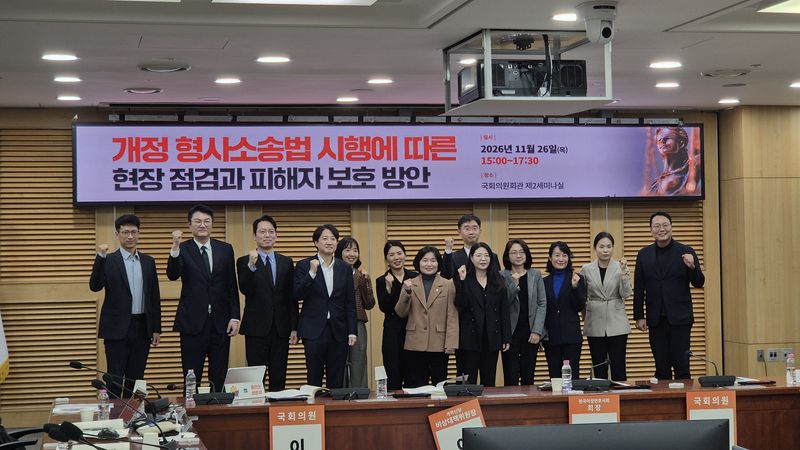
[Financial News] Nearly two months after the revised Criminal Procedure Act, which separates investigations from prosecutions, took effect, calls have emerged for institutional improvements to ensure crime victims’ procedural rights.
Although the right to request an interview with a prosecutor and the right to inspect and copy records were established to fill gaps in victim protection following the abolition of prosecutors’ authority to conduct supplementary investigations, their exercise remains subject to restrictions in practice. However, some argued that suspects’ and defendants’ right to a defense must also be considered as their participation in criminal proceedings expands.
According to legal circles on the 27th, the Korean Women Lawyers Association, the Reform Party and Rep. Lee Ju-young held the forum the previous day at the National Assembly Members' Office Building.
Jinhee Shin, a lawyer specializing in court-appointed representation for victims at the Korea Legal Aid Corporation, delivered the presentation and questioned the effectiveness of the newly introduced prosecutor interview system. Shin said that around the 10th of this month, at a victim’s request, Shin applied for an interview with a prosecutor, but was asked to submit detailed reasons in writing and had still received no response by the day of the forum, even after submitting them.
Shin said, “Even if the reasons given by a complainant or others for requesting an interview are valid, the statement or material cannot be used as evidence, so it is difficult to rule out the possibility that a prosecutor may decline the request. I am very concerned that the right to request an interview could become a merely formal system used only in highly exceptional cases.”
Victims’ right to access information was also identified as a problem. Although inspection and copying of investigative records were generally allowed for filing objections to police decisions not to refer cases for prosecution, notices at some prosecution office public service desks still stated that access was limited to documents submitted by the victims themselves. Concerns were also raised that victims’ representatives were not being notified of case progress because the Criminal Justice Information System (KICS) was not smoothly connected between the police and prosecution offices.
Park Sang-min, an associate research fellow at the Korean Women’s Development Institute (KWDI), proposed improving the system so that victims’ requests for interviews with prosecutors would generally be accepted and reasons would be given when a request was rejected. Park said, “When a victim presents new evidence or facts, procedures and records should be established to determine who will secure the evidence, by when it will be investigated, and how the results will be explained to the victim, so that the interview can lead to a request for supplementary investigation or reinvestigation.”
Park also stressed that investigation guidelines should be made more specific so prosecutors can be consulted from the outset of cases where evidence is at serious risk of being lost or the legal issues are complex, and that compliance with requests for supplementary investigations should be assessed qualitatively, including whether evidence was actually secured. Park also proposed guaranteeing victims the right to express their views in proceedings such as hearings on arrest warrants and establishing the risk of harm to a victim as an independent ground for detention.
However, views were expressed in court circles that a balance must be struck between protecting victims and safeguarding the rights of suspects and defendants. Judge Kim Jae-ho of the Incheon Family Court, who took part in the discussion, said it was highly feasible to submit assessments of risks to victims, including the possibility of retaliation, when applying for an arrest warrant. On the other hand, he said consideration should also be given to the possibility that suspects’ detention could be prolonged if notices of hearing dates for proceedings such as reviews of the legality of arrest or detention were routinely extended to victims.
Judge Kim also said a cautious approach was needed to expanding victims’ participation in trials by granting them, among other things, the right to question defendants and witnesses. This was because a victim’s perspective may not align with the prosecutor’s approach to pursuing the case, and repeated testimony or additional cross-examination could also place a burden on the victim.
Judge Kim stressed, “The most important protection that can be provided to victims is ensuring they are not excluded from the proceedings. At the same time, the court must remain an impartial arbiter, not a representative of either side.”
[email protected] Choi Eun-sol Reporter