International Gold Prices Down 35% From Peak... Rebound if U.S. Tightening Ends?
- Input
- 2026-11-27 16:18:28
- Updated
- 2026-11-27 16:18:28
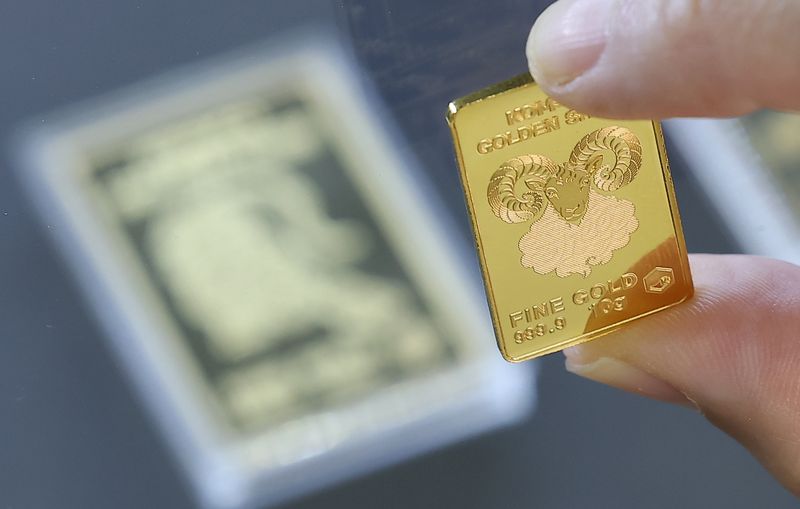
According to the Korea Exchange (KRX) on the 27th, the 1-kilogram gold contract on the KRX Gold Market closed at 157,350 won per gram, up 1.85% from the previous trading day. It rose for two consecutive sessions after hitting a year-to-date closing low of 152,200 won on the 25th, but remained 41.68% below the year-to-date high of 269,810 won on January 29. Through the 27th of this month, the KRX Gold Market’s average daily trading value was 29.318 billion won, roughly one-eighth of January’s 241.705 billion won.
The international spot price of gold rose as high as $5,595.46 an ounce this year before falling to around $4,000 at the end of the first half and around $3,500 in the second half. The largest drop this year, as calculated by NH Investment & Securities, was about 35%, greater than the roughly 21% drop in 2022, when the United States embarked on aggressive tightening amid the fallout from the Russia-Ukraine war. As real interest rates rise, gold—which pays no interest—becomes less attractive as an investment, and a stronger dollar makes gold purchases more costly for investors using other currencies.
Analysts say selling pressure on gold futures has also increased recently amid growing uncertainty over whether investment in artificial intelligence (AI) will continue.
Hwang Byeong-jin, head of FICC Research at NH Investment & Securities, said, “As volatility in risk assets increased, investors seeking to secure cash reduced their long positions in gold futures on the U.S. Commodity Exchange (COMEX),” and added, “The physical holdings of GLD, a U.S. spot gold exchange-traded fund (ETF), showed a steadier trend than in the first half.”
Hwang added that “similar phenomena also occurred during the Global Financial Crisis (2008) and the COVID-19 pandemic (2020).”
Short-term factors in a rebound in gold prices are interest rates and the dollar’s trajectory after the Federal Open Market Committee’s (FOMC) December meeting. Industry observers said the possibility of further tightening was already largely reflected in gold prices and expected that, if inflationary pressures ease next year, the market’s focus would shift to when tightening ends. The forecast range for international gold prices next year remained at $3,500–$5,000 an ounce.
Hwang said, “Global central banks have become structural net buyers as they diversify their foreign exchange reserves,” and forecast, “In the short term, if financial investors’ position unwinding subsides and the upward trends in real interest rates and the dollar index ease, gold prices will gradually find a floor.”
[email protected] Bae Han-geul Reporter