Migrants Head to the Atlantic as Mediterranean Routes Close: Canary Islands [Park Jong-won's Then and There]
- Input
- 2026-11-28 06:00:00
- Updated
- 2026-11-28 06:00:11
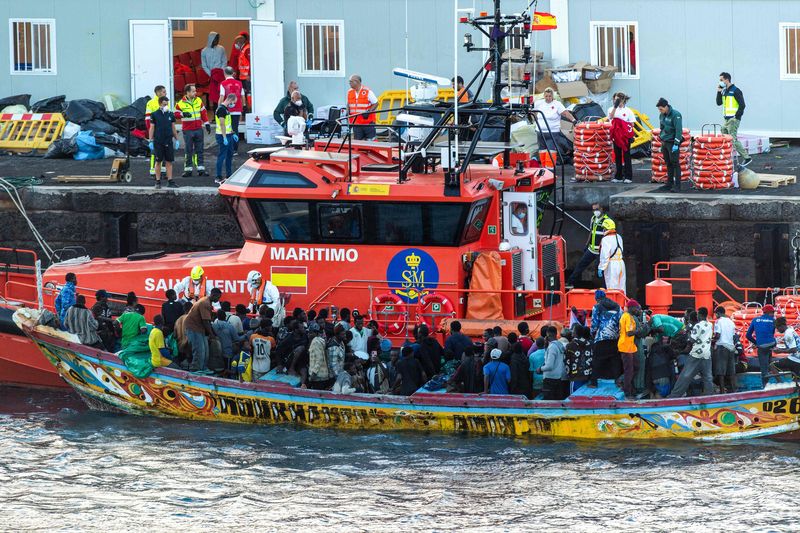
[Financial News] Spain's maritime rescue service said in an announcement on the 25th (local time) that 2,100 migrants had arrived in the Canary Islands in the preceding 24 hours. This was the largest number ever recorded locally in a 24-hour period.
As of the 15th, 24,364 migrants had arrived in the Canary Islands this year, a sharp increase from a year earlier. The number who qualified for legal immigration status is unknown. However, statistics from Spain's Interior Ministry refugee office for January through May show that only 10–20% of migrants arriving in the Canary Islands, depending on their country of origin, were granted legal residence on grounds of “international protection.” This means that most of those who crossed the sea were illegal migrants. How did the islands become a gateway for illegal migrants to cross into Europe?
The Canary Islands lie off the Atlantic coast and consist of eight inhabited islands and several other small, uninhabited ones. Their total area is 7,447 km2, about the same as North Chungcheong Province, and their population of 2.26 million is roughly one-quarter of Seoul's.
The islands are closest to the African continent. Traveling about 100 km west from southern Morocco brings you to the easternmost point of the Canary Islands. But they are about 1,000 km from Cádiz in southern Spain. That is roughly the distance between Seoul and Tokyo, Japan.
The original inhabitants were Indigenous people of North African nomadic origin known as the Guanches. In 1402, lords under the Kingdom of Castile, the predecessor to Spain, set out on expeditions, occupied some of the islands and made them new domains. In the latter half of the 15th century, the Castilian Crown launched a large-scale war of conquest, bringing the entire Canary Islands under its control after the final war in 1496. The islands then became a royal domain governed directly by the Crown and were rapidly absorbed into Spanish culture.
The Canary Islands served as a supply base for Christopher Columbus's 1492 voyage to the Americas and flourished during the Age of Exploration as a trade hub linking the Americas, Africa and Europe. But as trade declined after Spain lost its South American colonies, many island residents emigrated to former South American colonies in the 19th and 20th centuries to make a living.
The Canary Islands experienced a new boom in tourism in the 1960s. In 1993, with the establishment of the European Union (EU), they became a frontline border for entry into EU territory.
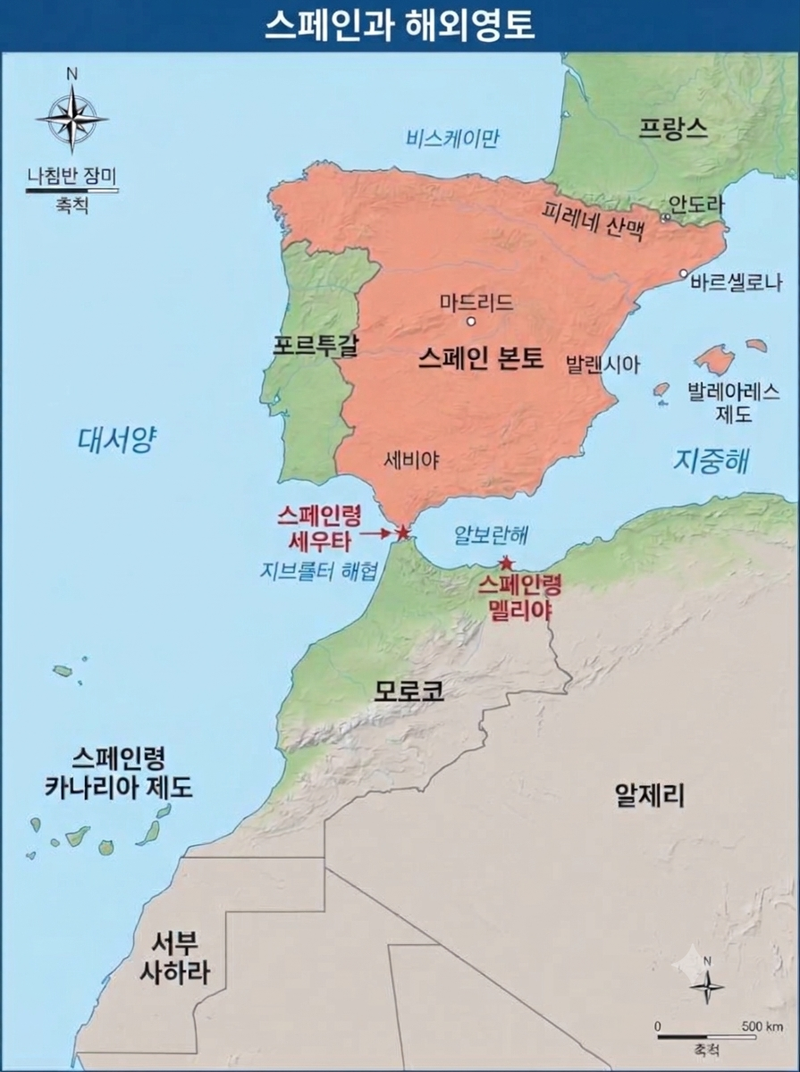
The first officially recorded arrival of illegal migrants by boat from Africa to the Canary Islands was in 1994. In fact, the islands were not a popular route for migrants because they lie at the western edge of the African continent. Most people heading to Spain instead used Ceuta and Melilla, Spanish cities bordering Morocco.
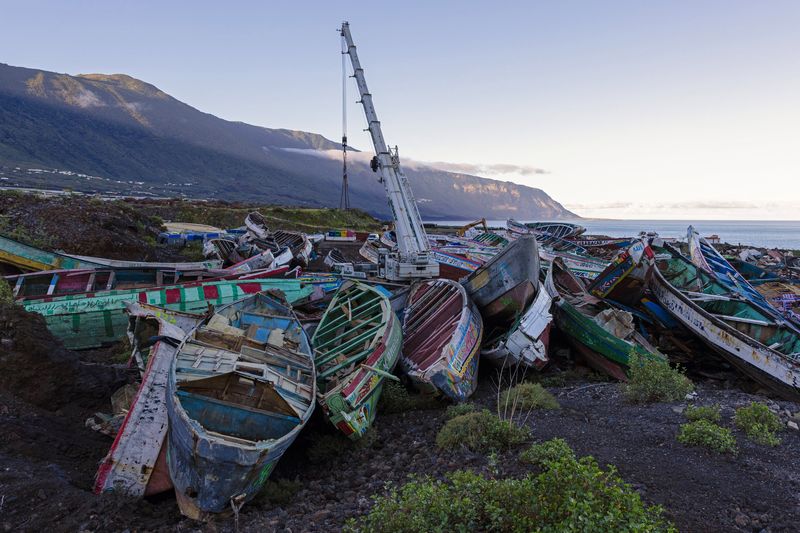
After Spain tightened controls on the Ceuta and Melilla borders in 2005, illegal migrants built wooden boats and attempted to cross to the Canary Islands in large numbers. In response, Spain signed agreements on repatriation and development aid with Senegal, Mauritania and other countries from which many illegal migrants departed, and strengthened maritime patrols in 2006. The number of migrants crossing the Atlantic then fell for a time, but rose again as the global economic downturn worsened amid the COVID-19 crisis in 2020, and continued to increase in 2023–2024.
Experts attribute the continued flow of illegal migrants to the Canary Islands to the “balloon effect.” According to statistics for January through October this year released by the European Border and Coast Guard Agency, the busiest route for illegal migrants traveling from the Mediterranean to the EU was the eastern Mediterranean route from Libya in North Africa to the Greek island of Crete. The next busiest was the central Mediterranean route from Libya, Algeria and Tunisia to the Italian islands of Lampedusa and Sicily, followed by the western Mediterranean route. That route runs from Algeria to Spain's southeastern coast, including the Balearic Islands, and also encompasses crossings through Ceuta and Melilla.
According to the statistics, detections of illegal crossings on the eastern and central Mediterranean routes fell by 12% and 55%, respectively, this year, while those on the western Mediterranean route surged by 21%. This was because tighter controls in Greece and Italy pushed the flow of illegal migrants westward. In addition, security around Ceuta was tightened to an unprecedented degree after more than 100 people died during an illegal crossing there last July. As a result, illegal migrants in North Africa have converged on the Canary Islands at the continent's western edge in search of a final route to Europe. Ultimately, stopping the flow of refugees across the Atlantic will require either reopening another Mediterranean route or preventing them from setting out in the first place.
[email protected] Park Jong-won Reporter