Non-Regular School Workers Launch General Strike, Call for an End to Pay Discrimination and More Cafeteria Staff
- Input
- 2026-11-27 16:01:58
- Updated
- 2026-11-27 16:01:58
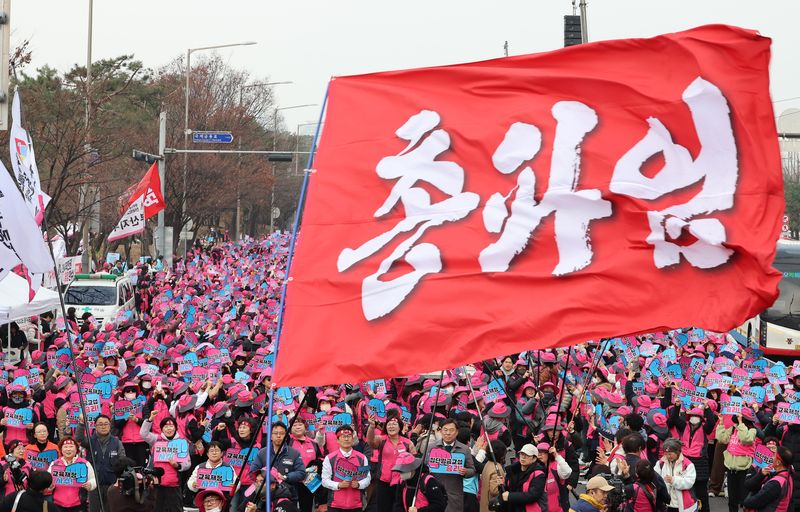
[Financial News] Non-regular school workers across the country began a one-day general strike on the 27th. They called for higher long-service allowances to narrow the pay gap with civil servants and for funding to increase staffing in school cafeterias.
At around 1:30 p.m. that day, the National School Non-Regular Workers’ Union (School Non-Regular Workers’ Union) held a general strike rally in Yeouido, Seoul. Organizers expected about 20,000 people to attend. The Nationwide School Non-Regular Workers’ Solidarity Conference, comprising the School Non-Regular Workers’ Union, the National Education Public Service Workers’ Headquarters and the National Women’s Workers’ Union, expected about 40,000 people to join the nationwide strike.
The School Non-Regular Workers’ Union called for an end to pay discrimination, including through higher long-service allowances; funding to increase cafeteria staffing; livelihood support for workers who do not work during school breaks; an end to reforms of the Local Education Finance Grant and expanded education-welfare funding; the creation of quality jobs for young people in schools; and enactment of an Education Public Service Workers Act.
Min Tae-ho, chair of the School Non-Regular Workers’ Union, criticized the government, saying, “The government is trying to force through a bill that would make massive cuts to the education budget at a plenary session of the National Assembly on December 2. Management says a monthly increase of just 500 won in the long-service allowance is the best it can offer. Education bureaucrats are sitting on their hands, using budget cuts as an excuse, even though they are not fighting to protect education finances.”
Min Tae-ho also said, “Let’s prepare for a second general strike to defend education finances, address the low-wage disparity and expand cafeteria staffing,” and argued that “low-paid, high-intensity jobs for non-regular school workers should be turned into good jobs that young people want to take.”
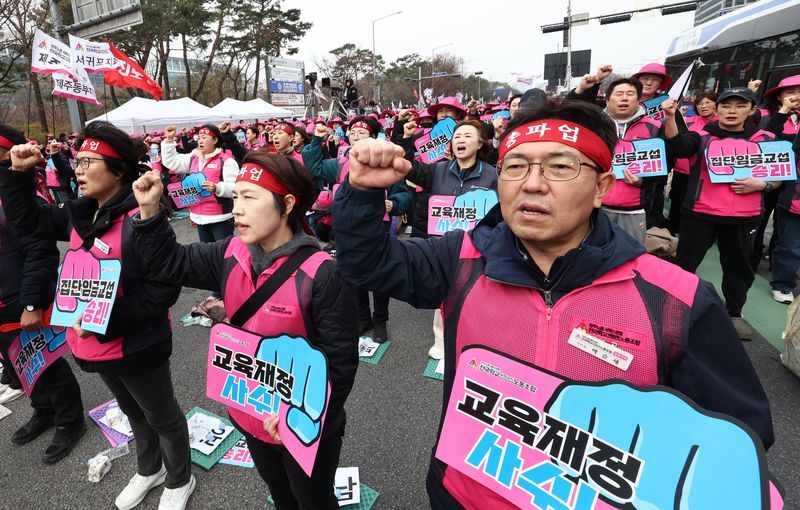
Kim Hyun-chan, 24, a food-service worker at an elementary school on Jeju, took the podium next. “After working for four years, my monthly pay is only 2.2 million won,” Kim said, lamenting that it was “nowhere near enough to meet someone I love, get married, start a family and plan for the future.”
Kim stressed that, because of staff shortages, older colleagues could not even get proper rest, adding, “We need to increase staffing and guarantee workers’ health and right to rest.”
Kim Seon-mi, a school environmental services worker at an elementary school in Busan and head of the School Non-Regular Workers’ Union’s National Cleaning Division, also said, “I’m responsible for 15 restrooms across four floors by myself for six hours a day. By the time I leave work, my wrists and knees can barely function.”
Kim added, “Education public-service workers receive an annual bonus of 1 million won, while environmental services workers get 500,000 won, paid in 250,000-won installments during school breaks. The education office has put us in a separate special operations occupational group and cut our wages on the grounds that our retirement age is five years higher. Does a longer retirement age mean your back hurts any less?”
In their resolution, participants said that schools’ roles in areas such as childcare and special education were growing even as student numbers fell, and urged the government and National Assembly to halt reforms to the Local Education Finance Grant.
On the issue of increasing cafeteria staffing, they said, “We can never allow the School Meals Act, won through our colleagues’ sacrifices and our blood and sweat, to become an empty shell without staff or funding,” and called for funding to hire more workers.
According to metropolitan and provincial education offices, the strike’s impact meant that, as of 11 a.m. that day, 926 schools in Gyeonggi were serving substitute meals, while 11 did not serve meals. Normal meal service was disrupted at 454 schools in Gangwon, 392 in Jeonbuk, 251 in Chungbuk, 195 in Gyeongbuk and 117 in Ulsan. Another 262 schools in Gyeongnam, 145 in Incheon and 97 in Sejong replaced lunch with substitute meals or lunch boxes. In Busan, 150 schools provided substitute or simple meals.
The Solidarity Conference had previously called for, among other things, a 105,000-won increase in monthly base pay, and since last September had held three rounds of main negotiations and six rounds of working-level negotiations with the Ministry of Education and 16 metropolitan and provincial education offices. Saying that the pay gap with civil servants widened the longer workers stayed on the job, the union also included in its proposal raising the monthly long-service allowance from 41,000 won to 50,000 won for each year of service and abolishing the 24-year cap on payments.
On the 12th, education authorities proposed raising monthly base pay by 64,300 won and the monthly long-service allowance by 500 won for each year of service. The Solidarity Conference said it submitted a revised proposal with lower demands at working-level negotiations on the 19th, but no agreement was reached because education authorities maintained their original proposal.
[email protected] Park Sung-hyun Reporter