China's Auto Exports Near 12 Million Vehicles, but South Korea's Tax Credit Is Spinning Its Wheels
- Input
- 2026-11-29 14:19:17
- Updated
- 2026-11-29 14:19:17
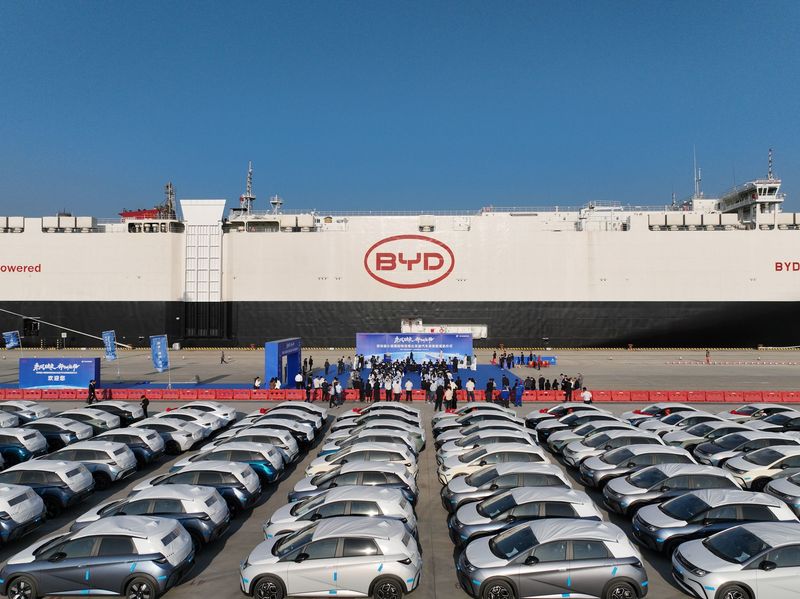
[Financial News] China's auto industry is stepping up its push into global markets, making up for sluggish domestic demand with exports. With the country's auto exports forecast to reach 12 million vehicles this year, nearly 15,000 Chinese-made battery electric passenger cars headed to South Korea last month alone. An oversupply from China is threatening the production base of South Korea's auto industry, but discussions on introducing a domestic production tax credit for electric vehicles are being delayed.
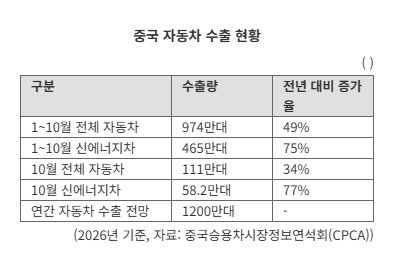
According to an export analysis released on the 29th by Cui Dongshu, secretary-general of the China Passenger Car Association (CPCA), China's auto exports totaled 9.74 million vehicles from January to October this year, up 49% from the same period a year earlier. Exports reached 1.11 million vehicles last month alone. Cui forecast that exports would reach 12 million vehicles this year, exceeding the 10.83 million global EV deliveries in 2022 compiled by market research firm SNE Research.
Exports of new energy vehicles, including electric vehicles and plug-in hybrid electric vehicles (PHEVs), surged 75% year on year to 4.65 million from January to October this year. Exports last month also rose 77% to 582,000 vehicles.
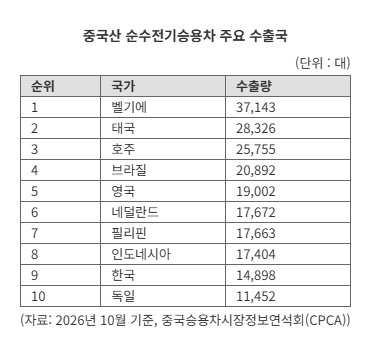
South Korea has also emerged as a major export market. Last month, shipments of Chinese-made battery electric passenger cars to South Korea totaled 14,898, ranking the country ninth worldwide as a destination. That was more than the 11,452 shipped to Germany. New energy vehicle exports to South Korea reached 140,164 from January to October this year.
A report released that day by China's Guotai Haitong Securities said the number of new insurance registrations for passenger cars sold domestically in China fell 20.8% year on year from January to October this year. By contrast, passenger car exports, according to the China Association of Automobile Manufacturers (CAAM), surged 70.7% to 8,091,000. Exports accounted for 35.8% of total passenger car sales.
China's export offensive is spreading to key markets for Hyundai Motor Company and Kia Corporation, including Europe, Australia, Latin America and Southeast Asia. Chinese PHEV exports, including range-extended models, also grew 162.1% last month, adding to the pressure on Korean-made eco-friendly vehicles to defend their market share and profitability. South Korea's auto trade deficit with China surged 92.7% to $4.23056 billion from January to October this year.
By contrast, the policy response to protect South Korea's EV industry has been slow. The Ministry of Finance and Economy canceled an emergency economic ministers' meeting scheduled for the 27th to announce a plan to strengthen the competitiveness of the EV industry. The meeting, initially scheduled for the 25th, had already been postponed twice. With parliamentary discussions on EV tax credits delayed, the announcement of support measures is increasingly likely to be pushed back until next week.
In its tax reform plan last August, the government selected six sectors, including secondary batteries and semiconductors, for domestic production tax credits, but excluded electric vehicles. The 30th, the deadline for standing committee review of bills accompanying the budget, is expected to be the first key turning point for introducing the tax credit.
As Chinese-made EVs gain ground in the domestic market, a delayed policy response could lead to lower utilization rates at domestic plants, less work for parts suppliers and a contraction in employment.
Kim Pil-su, a professor in the Future Automotive Studies Division at Daelim University College, said, "Chinese-made EVs are threatening enough to be price-competitive even without purchase subsidies, so the domestic production tax credit will play an important role." He added, "It is the government's responsibility to create an environment where businesses can operate successfully in South Korea. Otherwise, automakers may accelerate their relocation overseas, leading to the hollowing out of domestic industry."
[email protected] Kim Dong-ho Reporter