K-College Students’ Climate Solutions Go Beyond the Classroom and Resonate on the UN Stage
- Input
- 2026-11-27 13:55:24
- Updated
- 2026-11-27 13:55:24
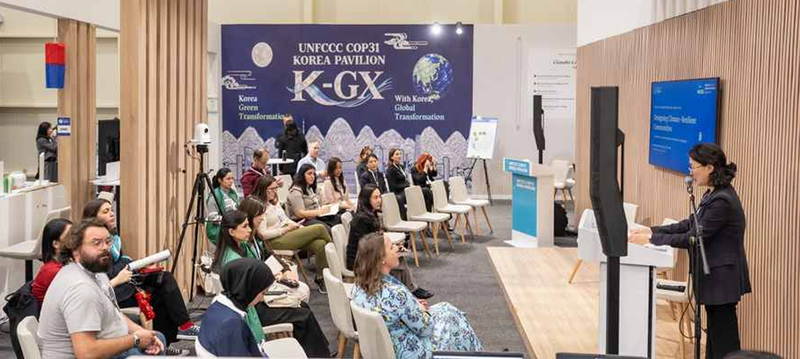
[Financial News] Kookmin University said on the 27th that Korean university students and faculty had drawn the attention of the global academic community by taking the stage at a UN climate summit and directly presenting solutions to the climate crisis in Korea’s industrial cities and tourist destinations.
The Environmental Consortium under Kookmin University’s Humanities and Social Sciences Convergence Talent Development Project (HUSS) held an event on responding to the climate crisis at the Korean Pavilion during COP31, held in Antalya, Türkiye, on the 9th.
The event highlighted field projects that went beyond university classrooms to tackle real-world local problems. Professor Giovanna Di Ciro of Swarthmore College said, “The presentations featuring specific local cases, such as Ulsan and Jeju, were very impressive,” adding, “It stands out that students presented their research findings directly on the UN stage, building on hands-on education at universities.”
The presentations featured cases from Ulsan, a leading industrial city in Korea, and Jeju, a tourist destination. Professor Benjamin of the University of Ulsan outlined Ulsan’s industrial structure, with its concentration of factories in high-emission sectors such as heavy and chemical industries, shipbuilding and automobiles. He said the city faces two challenges at once—transitioning its industries to reduce carbon emissions and responding to climate disasters—and outlined the role local universities can play.
Professor Yeon Myeong-heum of Kookmin University and student Lee Yu-jin presented practical environmental measures they identified through first-hand fieldwork on Jeju Island. Their student-led assessment of Jeju’s climate issues and proposed design solutions that would not harm the environment caught attendees’ attention.
Also joining the discussion were Lee Su-gyeong, deputy director of Qatar’s Global Carbon Council (GCC); Professor Liz Bentley of the University of Reading in the United Kingdom; and Professor Kim Min-jeong of Inha University. Attendees shared cases from the Gulf region, Europe and Incheon, and discussed ways to communicate climate risks to residents and bring local governments and universities together.
Five universities—Kookmin University, Duksung Women’s University, Inha University, Chosun University and the University of Ulsan—are part of the HUSS Environmental Consortium, which organized the event. “Through education that brings together multiple disciplines and universities, we will nurture talent equipped to respond to the climate crisis and expand activities carried out alongside local communities,” said Kang Yun-hee, the consortium’s director.
[email protected] Kim Man-ki Reporter