“Mutual Aid Associations’ Money Isn’t Government Money” ... Mutual Aid Association Union Coalition Moves to Block Relocation to Regional Areas [fn Market Watch]
- Input
- 2026-11-27 17:01:58
- Updated
- 2026-11-27 17:02:51
[Financial News] The debate over relocating financial institutions to regional areas is expanding to include the independence of asset management and who bears the economic costs. As mutual aid association assets are built from members’ contributions and investment returns, rather than state funds, calls are growing to assess members’ interests and the economic benefits before making policy decisions. With the sovereign wealth fund Korea Investment Corporation (KIC) also joining the opposition, institutional investors’ management capabilities have emerged as another key issue.
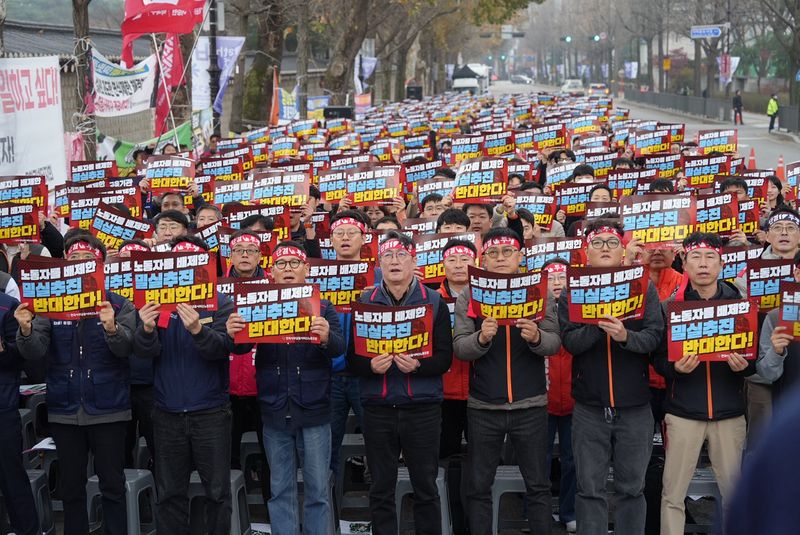
According to investment banking (IB) industry sources, the Mutual Aid Associations Labor Union Council and the KIC union held an all-out rally that afternoon in front of the Blue House in Jongno-gu, Seoul, on the 27th, to block the relocation of financial institutions to regional areas.
Eight mutual aid associations—including the Korean Teachers’ Credit Union (KTCU), Korea Local Government Officials Mutual Aid Association, Military Mutual Aid Association, The Police Mutual Aid Association, Korea Scientists & Engineers Mutual-aid Association, Construction Workers Mutual Aid Association, Korea Fire Officials Credit Union and Korea Local Finance Association—took part, along with KIC, the National Agricultural Cooperative Federation (NACF), the Korea Inclusive Finance Agency and Seoul Guarantee Insurance, bringing the total to 12 unions. The turnout was reported to be around 1,000 people.
The key issue raised by the unions is that the policymakers making the decisions are not the ones bearing the economic costs. In the case of mutual aid associations, they argue that higher costs from relocation to regional areas and lower investment returns could affect their ability to pay benefits to members.
The unions had previously presented findings from a study estimating that relocation to regional areas could result in economic losses of about 8.6 trillion won for five mutual aid associations serving teachers and education staff, public administrators, military personnel, police officers and firefighters.
In alternative investment markets—particularly private equity funds (PEFs), private credit, real estate and infrastructure—identifying investment opportunities, securing specialist talent and maintaining networks with domestic and international financial institutions are considered key factors determining investment management competitiveness.
The KIC union also maintains that the impact of relocation to regional areas on recruiting specialist talent and the long-term performance of national wealth management should be assessed in advance. The unions plan to call on the government and political circles to stop pursuing relocation unilaterally; develop a balanced regional development plan that takes into account Seoul’s financial infrastructure and the benefits of agglomeration; and discuss reasonable alternatives centered on institutional expertise and members’ interests.
Some have also called for the policy benefits of balanced regional development to be weighed alongside the management efficiency of institutional investors. They say various policy alternatives should be discussed, including not only physically relocating institutions but also expanding institutional investors’ regional investments.
Meanwhile, the Mutual Aid Associations Labor Union Council plans to step up its campaign in coordination with its 1.7 million members if the government pushes ahead with relocation to regional areas while disregarding the views of members and unions.
An official at one mutual aid association said, “Since mutual aid associations manage members’ assets, verifying the economic benefits is just as important as the policy rationale,” and stressed, “An analysis of the direct and indirect costs that could result from relocation to regional areas, as well as its long-term impact on investment performance, must come first.”
[email protected] Kim Gyeong-a Reporter