AI-Focused Schools at Elementary, Middle and High School Levels to Expand to 2,000 by 2028
- Input
- 2026-11-27 13:48:39
- Updated
- 2026-11-27 13:48:39
[Financial News] The number of “AI-focused schools,” which teach artificial intelligence (AI) and information studies intensively at elementary, middle and high schools, will reach 2,000 by 2028. The Ministry of Education announced on the 26th that it will hold the “2026 AI-Focused Schools Outcomes-Sharing Event” on the 28th at Inchon Memorial Hall at Korea University in Seongbuk-gu, Seoul, to share plans for expanding AI education and recognize outstanding schools this year.
AI-focused schools substantially increase the number of class hours devoted to information studies compared with regular schools, and offer experiential lessons that combine AI with other subjects. Regular elementary schools currently schedule at least 34 hours of information-related classes, while AI-focused schools teach at least twice as many—68 hours. Middle schools provide at least 102 hours, 1.5 times the 68 or more hours at regular schools. High schools require students to take information studies in their first year and have structured their curriculum so that students take AI and information studies every year throughout all three years.
This year, 1,141 AI-focused schools are operating nationwide: 530 elementary schools, 279 middle schools, 319 high schools and 13 special schools. Gyeonggi Province has the most, with 200, followed by Seoul with 182, South Chungcheong Province with 113 and Incheon with 107. The Ministry of Education plans to gradually increase the number of AI-focused schools to 1,500 next year and 2,000 in 2028 to create conditions for widespread AI education.
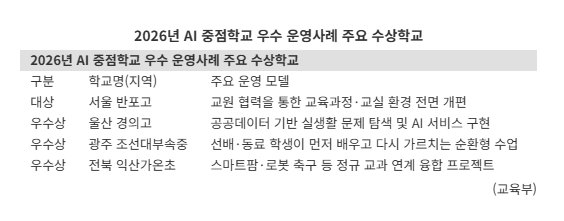
Teaching methods in schools are also rapidly shifting toward practical, hands-on learning. At the event on the 28th, 10 schools selected in a contest for outstanding practices will receive awards from the Minister of Education.
Ulsan Gyeongui High School, which will receive an Excellence Award, had students use public data to identify everyday problems and design and build AI services themselves. Another Excellence Award recipient, Gwangju Chosun University-affiliated Middle School, drew attention for introducing a cyclical teaching model in which students who learned AI first then taught other students. Grand Prize recipient Seoul Banpo High School brought teachers together to change both its curriculum and classroom environment, while Excellence Award recipient Iksan Gaon Elementary School in Jeonbuk integrated a smart farm that uses AI to grow crops and robot soccer classes into the regular curriculum.
About 700 people, including teachers from AI-focused schools nationwide and officials from metropolitan and provincial education offices, will attend the event, where 27 outstanding practices will be displayed as posters and participants will discuss plans for next year.
“We will continue to support the spread of outstanding educational practices from schools across the country so that more students can learn AI and use it properly,” said Kim Do-wan, director general of the Ministry of Education’s AI Talent Support Bureau.
[email protected] Kim Man-gi Reporter