Light-Activated 'Nanorobot' Developed to Carry Anticancer Drugs to Brain Tissue, Boosting Delivery Fivefold [Health LAB]
- Input
- 2026-11-29 09:00:00
- Updated
- 2026-11-29 09:00:04
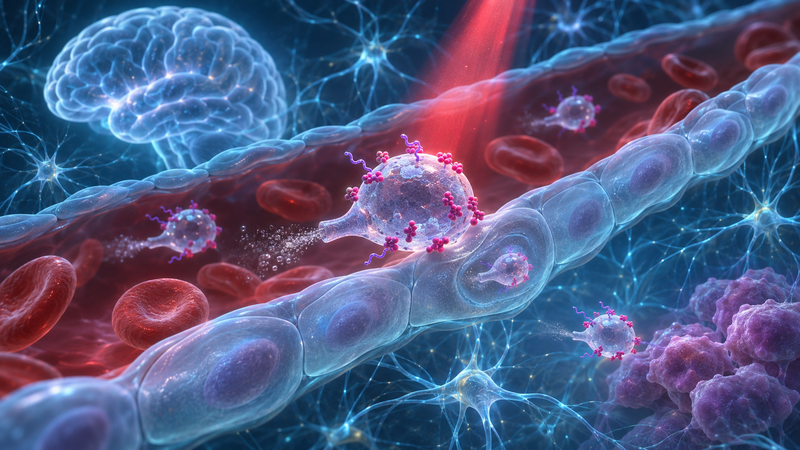
[Financial News] A nanorobot that swims on its own when exposed to light and carries drugs into brain tissue has been developed.
A team led by Professor Joo Jin-myeong of the Department of Biomedical Engineering at Ulsan National Institute of Science and Technology (UNIST), together with a team led by Professor Wei Gao (Wei Gao) of the California Institute of Technology (Caltech), developed a nanorobot called BrainBot that uses propulsion generated by near-infrared light to deliver drugs across the blood-brain barrier and into brain tissue, the university said on the 29th.
When exposed to external light, the developed BrainBot releases gas from within and moves on its own, allowing it to carry drugs through vascular endothelial cells and into cancer tissue. The gas effectively acts like rocket propulsion.
When BrainBots carrying the anticancer drug doxorubicin were injected into the veins of mice and exposed to near-infrared light from outside the body, the amount of the drug measured in brain tissue was 5.2 times that in mice given BrainBots without light exposure. Survival rates also increased in mice with brain tumors. At the 50-day mark, all mice in both the control group and the group given only the anticancer drug had died, while three of the six mice in the group given drug-loaded BrainBots and exposed to near-infrared light survived.
Methods already existed for attaching specific substances to the surfaces of nanoparticles to help them enter endothelial cells, but the particles could be expelled from the cells back toward the blood instead of into brain tissue. BrainBot uses its own propulsion to reduce this backflow and increase the amount delivered to brain tissue.
Unlike methods that widen the gaps between endothelial cells using ultrasound or other means, BrainBot delivers drugs without damaging the blood-brain barrier. Tests also showed that the barrier remained functional, with no noticeable damage, bleeding or inflammation observed in brain tissue.
Dr. Yoo Jeong-hyeon, who led the research as first author, explained, “Because light lets us control when and where it operates, we can externally determine when and where to deliver the drug.” Yoo added, “BrainBot is made of biodegradable materials, and three weeks after administration, the amount of carrier material remaining in the brain had fallen to near its pre-administration level.”
BrainBot is shaped like a tadpole. Inside the approximately 250-nanometer (nm) robot are fuel and a light-absorbing material, and its opening is sealed with a plug that melts when heated. An anticancer drug and an aptamer, a substance that binds to vascular endothelial cells, are attached to its surface. When near-infrared light is applied, the light-absorbing material generates heat, melting the plug; the fuel then decomposes and produces gas.
Professor Joo Jin-myeong explained, “When we identified an aptamer—a substance that passes through vascular endothelial cells—using a blood-brain barrier-mimicking microchip developed in Professor Park Tae-eun’s lab in 2023, we had secured the key to entering the brain.” He added, “This time, we added propulsion to that key and showed that the same molecule could deliver much more of the drug to the brain.” He said, “We expect to extend this approach beyond anticancer drugs to substances that have been difficult to deliver to the brain, such as protein and gene therapies, and to broaden its applications to conditions including Alzheimer’s disease, Parkinson’s disease and epilepsy.”
The study was a multidisciplinary collaboration in which teams led by Professors Park Tae-eun and Cho Hyeong-jun of UNIST’s Department of Biomedical Engineering and Professor Kim Jun-gi of Asan Medical Center in Seoul jointly carried out the robot’s design and synthesis, analysis of its operating principles, and animal experiments. Drs. Yoo Jeong-hyeon and Kim Su-hyeon were joint first authors. The study was published in the international journal Science Robotics on the 25th (local time).
[email protected] Yeon Ji-an Reporter