‘Detecting Ground Weakening Around Sewer Pipes in Advance’: Sinkhole Diagnostic Technology Developed
- Input
- 2026-11-27 13:16:25
- Updated
- 2026-11-27 13:16:25
[Financial News] Technology to diagnose sinkhole risks by detecting ground weakening around sewer pipes in advance has been developed.
The Korea Institute of Civil Engineering and Building Technology said on the 27th that it had developed technology to diagnose loosened ground and voids around aging urban sewer pipelines. The technology analyzes road-surface deflection together with images from inside the pipelines to identify the risk of road collapse (sinkholes) in advance.
According to KICT, damaged joints or gaps around connecting pipes in aging sewer lines can allow surrounding soil to enter the pipes, while fluctuations in water levels and pressure inside the pipelines during torrential rain can accelerate sinkhole formation. This can weaken the ground and create voids, potentially leading to road collapse or pipeline subsidence. Soil entering the pipelines also obstructs water flow and increases the risk of flooding. Existing ground-penetrating radar (GPR) surveys detect underground voids using reflected signals, but are limited in wet soils and have difficulty detecting ground weakening or reduced bearing capacity before voids form.
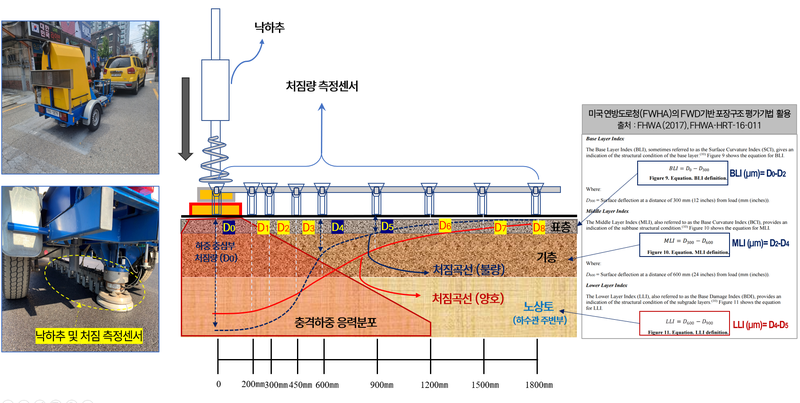
KICT’s Environmental Research Division and Road Traffic Research Division have developed a diagnostic method using a falling weight deflectometer (FWD). The FWD applies a load to the road surface and measures deflection to assess pavement condition. The research team overlaid and analyzed deflection measurements and CCTV footage from inside sewer pipelines by location using a geographic information system (GIS). It also developed draft diagnostic criteria for assessing ground conditions around pipelines, drawing on the U.S. Federal Highway Administration’s (FHWA) road pavement assessment methods.
With the cooperation of the Seoul Metropolitan Government, the research team conducted two demonstration surveys, in July 2025 and June 2026, along urban sewer pipeline routes in Eunpyeong-gu and Mapo-gu. Analysis of footage from inside pipelines at locations where deflection measurements were abnormal revealed voids at poorly joined connecting pipes and confirmed that aggregate had entered and accumulated inside the pipelines. This technology can serve as a practical diagnostic tool to complement CCTV inspections of pipeline interiors and GPR surveys, which are limited by radio-wave penetration. By combining non-destructive impact tests conducted at the surface with analysis of images from inside pipelines, it can predict signs of abnormalities in the ground around pipelines with a high degree of reliability.
KICT President Park Sun-kyu said, “In an environment where localized torrential rains are becoming more frequent due to climate change, this achievement will greatly contribute to preventing urban road-collapse accidents in advance and achieving self-reliance in smart underground infrastructure management technology.”
[email protected] Yeon Ji-an Reporter