'Student Sexual Assault Allegation': Nam Kyung-ju's Jury Trial Begins... Prosecutors and Defense Make All-Out Bid to Win Jurors Over With AI and Lady Justice Analogy
- Input
- 2026-11-27 14:06:14
- Updated
- 2026-11-27 14:06:14
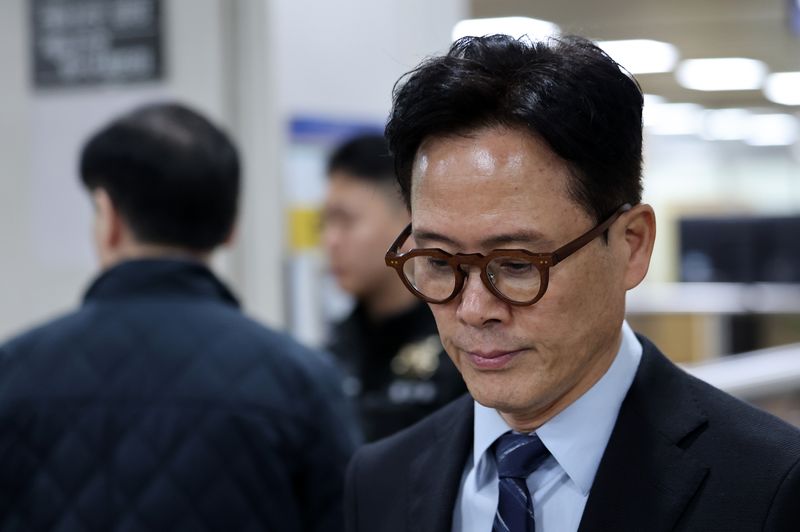
[Financial News] The citizen-participation jury trial of first-generation musical theater actor Nam Kyung-ju, 62, who was indicted on charges of sexually assaulting a graduate student, has gotten underway in earnest. Seeking to win over the 10 jurors who will effectively determine the outcome of the question of guilt or innocence, prosecutors and the defense mounted an all-out effort to persuade them from the very first day of trial, looking straight toward the jury box and deploying, respectively, AI question-and-answer results and an analogy involving the statue of Lady Justice.
The 29th Criminal Division of the Seoul Central District Court, presided over by Judge Eom Ki-pyo, held the first hearing in Mr. Nam's case involving a charge of sexual intercourse with a person under one's supervision on the 27th, with 10 citizen jurors—six women and four men—in attendance.
Nam is accused of having sexual intercourse with a student aspiring to become an actor at a year-end gathering while serving as an associate professor in the School of Performing Arts at Hongik University, a position he had held since 2020. In March, after the incident, the university relieved him of his position.
In a citizen-participation jury trial, a jury's verdict is not legally binding but carries strong persuasive weight. The judge makes the final ruling, but at least 90% of first-instance court rulings align with the jury's verdict. If the court delivers a ruling that differs from the jury's verdict, it must explain the reasons to the defendant when announcing the ruling and state in the written judgment why it reached a different conclusion. For this reason, both prosecutors and the defense focused their arguments at the first hearing on appealing to the jurors' common sense and impressions of the case.
The prosecutors, who spoke first, focused on impressing upon the jurors the existence of a “de facto relationship of protection and supervision” and Nam's “power.” After displaying presentation slides and footage of Nam's past television appearances, the prosecutors set out the charges: “On December 20, 2025, after holding a year-end gathering with his students at his private studio (Ashley Studio) in Seocho District, Seoul, the defendant was left alone with the victim after midnight. He laid the victim, who had expressed her refusal, on a yoga mat in the recording studio and had sexual intercourse with her.”
The prosecutors went on to stress to the jurors: “The victim was awaiting an academic evaluation by the defendant and had been offered a teaching assistant position for the following semester.” They added, “Given the defendant's influence as a professor and a superstar in the musical theater industry, this was a relationship of protection and supervision in which the victim could not help but fear that refusing his demands would harm her career and academic prospects.”
In particular, prosecutors even presented the jury with the results of generative AI queries to illustrate Nam's immense influence in the industry. They said, “When we asked Gemini to name ‘the most influential male musical theater actor in our country,’ it ranked the defendant first and Cho Seung-woo second,” adding, “ChatGPT also named the defendant first as a ‘male actor who influences casting.’”
Nam's defense team called the jurors “judges without robes” and earnestly urged them to set aside preconceptions formed by media coverage. The defense lawyer asked them to “press the ‘reset button in your mind’ to clear away the article headlines, personal experiences and preconceptions you encountered before coming to trial, and judge the case solely on the weight of the evidence presented in court, from a blank slate.”
The defense lawyer displayed on screen the blindfold, scales and sword of the statue of Lady Justice, arguing for the presumption of innocence—the cardinal principle of criminal trials—and the strict burden of proof. The lawyer stressed, “Unlike a civil trial, a criminal trial starts with a 0% likelihood of guilt and is a process in which the prosecutor must prove 100% guilt,” and added, “If even a single reasonable doubt remains, the sword of Lady Justice must not be swung. Please remember the principle: ‘When in doubt, rule in favor of the defendant.’”
The defense also argued that none of the elements of the charge of “sexual intercourse with a person under one's supervision” could be established. The lawyer countered, “The prosecution must prove a legally recognized relationship of protection or supervision, the use of that relationship to exert power, objective evidence that sexual intercourse was completed (penetration of the sex organ), and subjective evidence of intent,” adding, “The victim had already completed her classes, so the defendant had no influence over her academic evaluation, and the teaching assistant position was only under consideration; there was no substantive relationship of subordination.” The lawyer continued, “There was no overt exercise of power, and penetration did not occur, so the completed offense of sexual intercourse was not established. There is no provision for punishing an attempted offense of sexual intercourse with a person under one's supervision, so if the offense was not completed, the defendant must be acquitted.”
Starting this afternoon, the court will examine evidence, including CCTV footage and call recordings, and question witnesses requested by the defense. The court plans to wrap up on the 30th, after hearing the victim's testimony in the morning and questioning the defendant in the afternoon, followed by the prosecution's sentencing recommendation and closing arguments, jury deliberations and the announcement of the verdict.
[email protected] Lee Chang-hoon Reporter