“I Scrimped and Saved 70 Million Won—Surely Enough for a Car” ... The Calculation a Worker in Their 30s Overlooked [Money Planning Office]
- Input
- 2026-11-28 15:00:00
- Updated
- 2026-11-28 15:00:05

Even if you have enough cash to buy a car now, the picture changes when you also consider future expenses such as getting married or moving out. The important question is not whether you can buy a car now, but whether you can stick to your financial goals after buying one.
A 30-year-old who saved 70 million won: Should they buy a 40 million won car?
Park Jun-ho (30, a pseudonym), a fifth-year employee, has recently been considering buying a car. They have been steadily saving without spending large sums, and have accumulated 70 million won in financial assets. Their housing costs are relatively low because they live with their parents. They commute by public transportation but feel they need a car to take their parents on weekend trips.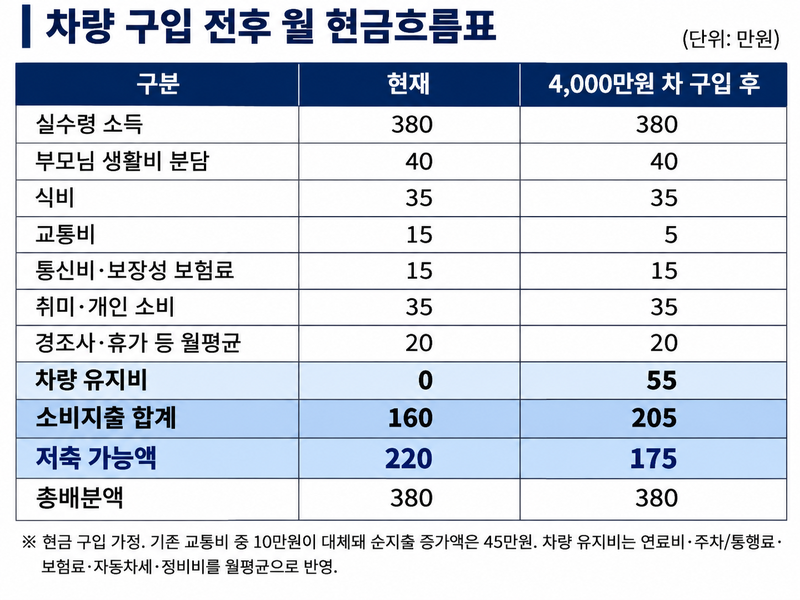
The car Jun-ho has his eye on costs around 40 million won. With a year-end discount event and a bonus payment coming up, they are increasingly tempted to hurry and sign a contract. The problem is that they plan to move out in three years. They want to save 80 million won for a deposit and moving costs to relocate closer to work. They have enough money to buy a car now, but are unsure whether they can still save for moving out as planned afterward.
Jun-ho’s monthly take-home pay is 3.8 million won. They spend a total of 1.6 million won on items including a 400,000-won contribution to their parents’ living expenses, 350,000 won on food, 150,000 won on transportation, 150,000 won on phone service and insurance, 350,000 won on hobbies and personal spending, and 200,000 won on social occasions and vacations. They save the remaining 2.2 million won.
Their financial assets total 70 million won: 10 million won in a demand deposit account, 50 million won in a time deposit, and 10 million won in principal paid into an installment savings account. The time deposit and installment savings account mature next month. They have no other debt.
After Buying a 40 Million Won Car, a 10 Million Won Hole in the Moving-Out Fund
Financial planner Park Chan-jong (AFPK), who advised Jun-ho, emphasized that they need to account not only for the purchase price but also for the monthly cost of keeping the car. Looking only at the price, Jun-ho appears to have enough to buy it now. But the picture changes when you calculate how much they will be able to save afterward.If Jun-ho buys a 40 million won car in cash, they would need 43 million won in total, including 3 million won for acquisition and registration costs and initial accessories. After spending 43 million won of their 70 million won in financial assets on the car, they would have 27 million won left. Once 20 million won is set aside for emergency funds and long-term needs, only 7 million won would be available for moving out.
The upkeep costs are substantial, too. The estimate assumes average monthly costs of 550,000 won, including 200,000 won for fuel, 100,000 won for parking and tolls, 100,000 won for car insurance, 50,000 won in vehicle tax, and 100,000 won for maintenance and consumables. Even after taking into account that transportation costs would fall by 100,000 won, monthly spending would rise from 1.6 million to 2.05 million won. As a result, the amount Jun-ho could save each month would fall from 2.2 million to 1.75 million won.
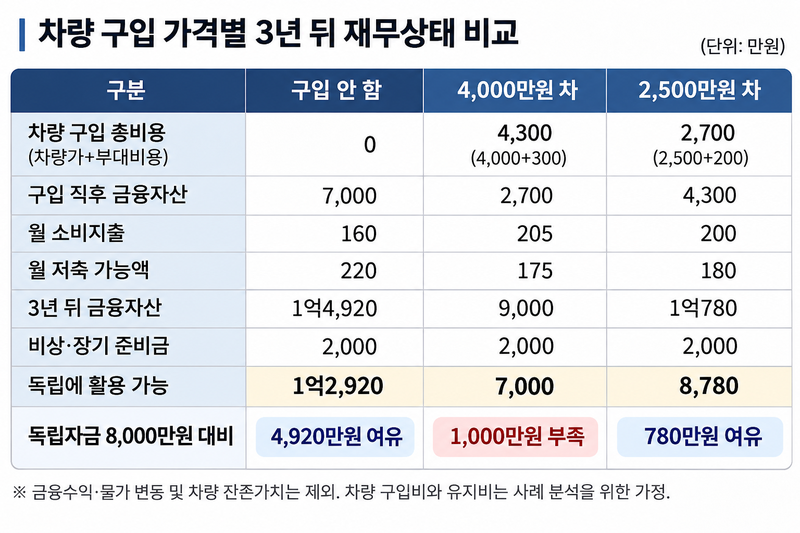
The challenge is saving enough to move out in three years. To reach the 80 million won goal with the 7 million won left after buying the car, Jun-ho would need to put away about 2.03 million won a month for 36 months. But they would only be able to save 1.75 million won, leaving them about 280,000 won short each month.
Planner Park proposed lowering the car budget to around 25 million won. Adding 2 million won for acquisition and registration costs brings the total purchase cost to 27 million won. Jun-ho would have 43 million won in financial assets left immediately after buying the car.
Set Aside a “Car Budget” for Three Months in Advance
Planner Park also advised caution about buying a car on installments. Financing would leave more cash in the bank at first, but monthly principal and interest payments could reduce the amount available for savings. In particular, if installment payments continue when Jun-ho moves out in three years, they could face new housing costs such as rent and maintenance fees on top of them. That is why it is important to calculate the total interest, repayment period and remaining balance when moving out, rather than deciding based only on the monthly payment.Rather than rushing to sign a contract to take advantage of year-end discounts, one option is to first experience the impact of car-related costs on the monthly budget. Planner Park said, “Year-end promotions have a set time limit, which can make people feel pressured to hurry into a contract,” and noted, “For the three months before signing, you could set aside 400,000 won each month as a separate car budget while maintaining monthly savings of 1.8 million won.”
The idea is to check in advance whether Jun-ho can manage savings and spending as planned after buying a car. The 1.2 million won saved during this period could go toward initial upkeep costs, such as insurance.
Planner Park emphasized that rather than giving up on buying a car altogether, it is important to set a reasonable price range that fits Jun-ho’s current income and assets. Choosing a car costing around 25 million won would allow Jun-ho to pursue both goals: buying a car and moving out in three years. However, with only 7.8 million won left as a cushion for the moving-out fund, they should prepare for unexpected expenses such as repairs or rising housing costs.
Planner Park said, “You should weigh how much you can adjust each goal—the desire to buy a car now and your plans to move out in the future—before setting a budget for the purchase.”
Earning, spending and saving money are things we do throughout our lives, but financial planning is always pushed to the back burner. Yet money has a timeline of its own and won’t wait. If we don’t make choices along the way, our finances are left unattended; if we don’t set a direction, money slips away. That’s why we need to plan the flow of money throughout our lives.[Money Planning Office]works with the Korea Financial Planner Association (IFPK), an AFPK certification body, to help people plan their lives.
[email protected] Lee Hyun-jung, Kim Tae-il Reporter