"There Are 55,000 High School Classes but Only 8,300 Detectors"
- Input
- 2026-11-27 11:55:18
- Updated
- 2026-11-27 11:55:18
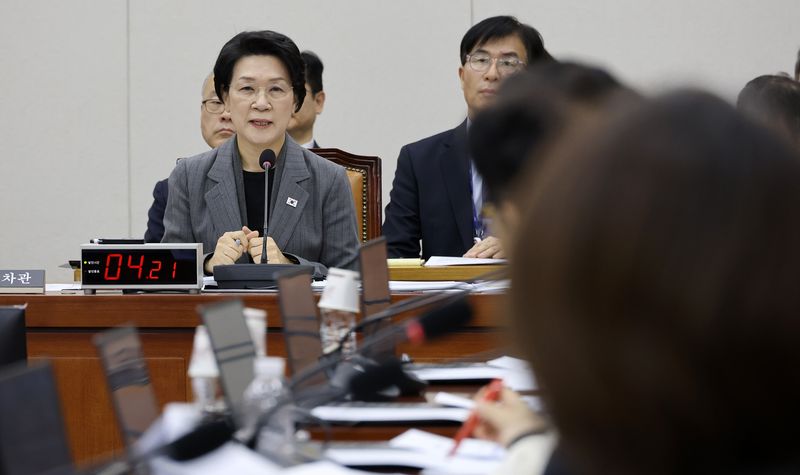
[Financial News] The Ministry of Education has announced tough measures for school-based exams starting with high schools’ second-semester final exams next month, including checking everyone with metal detectors and giving students zero points in all subjects on the day. At the National Assembly’s Board of Education, lawmakers from both the ruling and opposition parties sharply criticized the plan over a lack of equipment and legal grounds. It also emerged that CSAT papers for the 2026 academic year, administered last year, had been discarded at 237 high schools nationwide in violation of the required retention period.
A hearing on the Ministry of Education’s measures to strengthen exam management continued at a plenary meeting of the National Assembly’s Board of Education on the morning of the 27th.
Criticism focused first on the measures against cheating on high school exams, which lawmakers said amounted to desk-bound policymaking that ignored conditions in schools. Gang Gyeong-suk of the Rebuilding Korea Party cited this year’s survey of CSAT proctors, in which 95% said they felt burdened by their duties and 60–70% said they had received inadequate training to identify advanced devices, highlighting the limits on how schools could respond. “Provincial and metropolitan education offices currently have only about 8,300 metal detectors. Even if they buy an additional 12,000, that would still be nowhere near enough for the 55,000 high school classes nationwide,” she said. She added, “There is no legal basis for requiring students to undergo detector checks without the prior consent of students and their parents, and there are not even standard school-rule guidelines to distinguish mere possession from actual cheating. As a result, schools and teachers have been left to shoulder complaints and legal disputes in full,” she criticized.
Seo Beom-su of the People Power Party also joined the criticism, saying teachers were deeply dissatisfied because, with final exams just around the corner, the Ministry of Education had unilaterally issued only directives that shifted responsibility onto them. He pointed out that the ministry had only six staff members dedicated to responding to CSAT cheating and called for fundamental measures to be drawn up by a government-wide task force led by the Prime Minister, with relevant ministries such as the Ministry of Science and ICT and private-sector experts taking part. Baek Seung-a of the Democratic Party of Korea also called for practical supplementary measures, saying that unlike the CSAT, school-based exams administered by individual schools lack a system for support with expert staff and budgets.
In response, Acting Education Minister Choi Eun-ok acknowledged that the measures were temporary stopgaps that placed a burden on teachers, and said the ministry would pursue the development of detection technology to reduce proctors’ workload and provide budget support.
The controversy over the unauthorized disposal of CSAT papers for the 2026 academic year, administered last year, also surfaced. Jeong Seong-guk of the People Power Party said, “Our comprehensive survey found that CSAT papers from last year had already been discarded at 237 schools under 16 provincial and metropolitan education offices, excluding Sejong. Of these, 73 schools disposed of the papers early, in August or September, before even a year had passed since the exam.” He criticized the Ministry of Education, saying, “According to the National Archives of Korea’s authoritative interpretation, CSAT papers are public records and must be kept at least through the end of this year, in accordance with the retention period counted from January 1 of the year after production ends, and must undergo review by a records appraisal committee. Yet the ministry neglected oversight and tried to downplay what happened.”
Discussion also continued on the severity of penalties for cheating and the rewards system. In review reports by lawmakers from both parties and the chief expert adviser, there was agreement that simple violations of exam rules should be distinguished from planned cheating involving advanced devices, and that periods of disqualification from taking exams should be applied on a graduated basis for up to 10 years, in line with the constitutional principle of proportionality. Reviewers also said that, since disqualification is an administrative sanction rather than a criminal punishment, the stricter standards could be applied retroactively starting with those caught cheating on this year’s 2027 academic-year CSAT. Park Beom-kye of the Democratic Party of Korea stressed that, given the great public outrage over these criminal acts, a rigorous retrospective investigation should begin with this year’s CSAT. Kim Moon-soo of the Democratic Party of Korea called for careful design of the 100 million won reward system to prevent the educationally harmful side effect of encouraging students to spy on one another.
Lawmakers from both parties also unanimously called on the National Education Commission and the Ministry of Education to fundamentally overhaul the university admissions and assessment systems to meet the demands of an era in which AI can solve both short-answer and essay questions. Seo Beom-su also said that Lausanne College in Songdo International City, Incheon, run by the older sister of National Education Commission Chair Cha Jeong-in, was operating without authorization after its facility contract had been terminated, compounding harm from unrefunded tuition and unpaid teachers’ wages. He demanded a written report on the steps taken to suspend operations and the progress of the criminal complaint before the 18th of next month.
[email protected] Kim Man-gi Reporter