Port of Busan Targets Japan's Kyushu Logistics Market... Holds First Briefing in Oita
- Input
- 2026-11-27 11:03:04
- Updated
- 2026-11-27 11:03:04
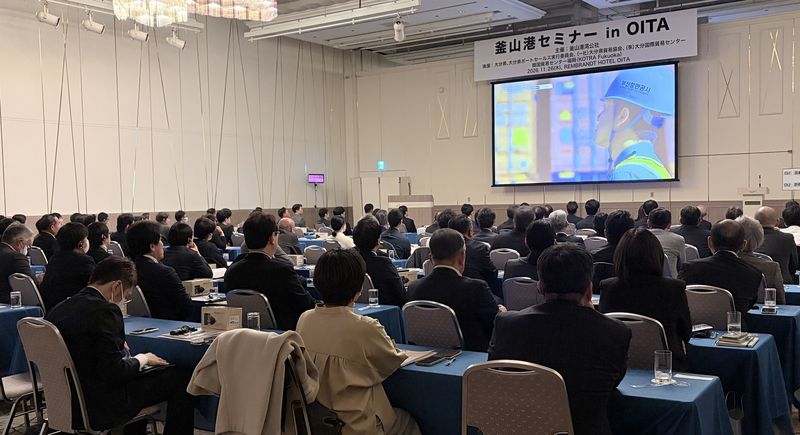
[Financial News] Busan Port Authority (BPA) is stepping up efforts to tap the local market by promoting the Port of Busan's logistics competitiveness to shippers in Japan's Kyushu region.
BPA said on the 27th that it held a briefing on the Port of Busan in Oita City, Oita Prefecture, Japan, on the 26th for about 120 people, including local import-export companies and logistics professionals. It was the first time a Port of Busan briefing had been held in Oita.
Last year, international container throughput at Kyushu's 13 ports totaled 1.48 million TEU, accounting for 8.3% of Japan's total. Of that, about 30%, or 450,000 TEU, passed through the Port of Busan. At Oita Port in particular, 55% of international cargo was transshipped at the Port of Busan, far above the Kyushu average.
Kyushu's cargo uses the Port of Busan because of its competitive deep-sea routes. Hakata Port, the largest port in Kyushu, has only one weekly direct sailing to the west coast of North America, while the Port of Busan has an extensive network of routes linking the Americas and Europe. The Port of Busan can be reached from major Kyushu ports in just over a day, reducing transit times and costs compared with routing cargo through major ports in Japan.
BPA chose Oita as the site of its first briefing in Kyushu because of this logistics potential. Oita Prefecture has the region's second-largest value of manufactured goods shipments, at about 50 trillion won, and stable cargo demand, with major companies in core industries—including Nippon Steel Corporation, Klasas Chemical and ENEOS—clustered in coastal industrial zones.
Oita Prefecture also plans to increase the annual handling capacity of the Oozai Container Terminal from 99,000 TEU to 160,000 TEU, preparing to accommodate rising cargo volumes. Above all, last year 55% of Oita Port's international cargo was transshipped at the Port of Busan, far above the Kyushu average of 30%. This means local shippers have already experienced the benefits of transshipment at the Port of Busan and have become accustomed to using it.
The Port of Oita and the Port of Busan have maintained ties for about 30 years, since the launch of their first scheduled container ship service in 1995. Carriers including Namsung Shipping and Korea Marine Transport Co. Ltd. (KMTC) operate around four scheduled services a week, transporting petrochemical products, medical devices and auto parts.
BPA introduced about 260 scheduled services a week and 32 routes whose final port of call is in North America. It also presented an inventory-hub logistics model that makes use of the hinterland complex at Busan New Port. Under this model, cargo is stored in advance at warehouses in the hinterland complex and then shipped according to local demand and vessel schedules, helping reduce logistics costs and transit times.
Before the briefing, BPA met with Oita Prefecture Governor Kiichiro Sato to discuss ways to cooperate in the port and logistics sectors.
BPA President Song Sang-geun said, "We will make the Port of Busan another option for Kyushu companies exporting to the Americas and Europe, helping them reduce logistics costs and save time," adding, "We will strengthen mutually beneficial cooperation with Oita Port and expand our engagement with shippers in Kyushu."
[email protected] Kwon Byeong-seok Reporter