K-Smart Livestock Farming Breaks Into Laos' National Platform... Soongsil University Startup Successfully Completes First AI Demonstration
- Input
- 2026-11-27 10:27:14
- Updated
- 2026-11-27 10:27:14
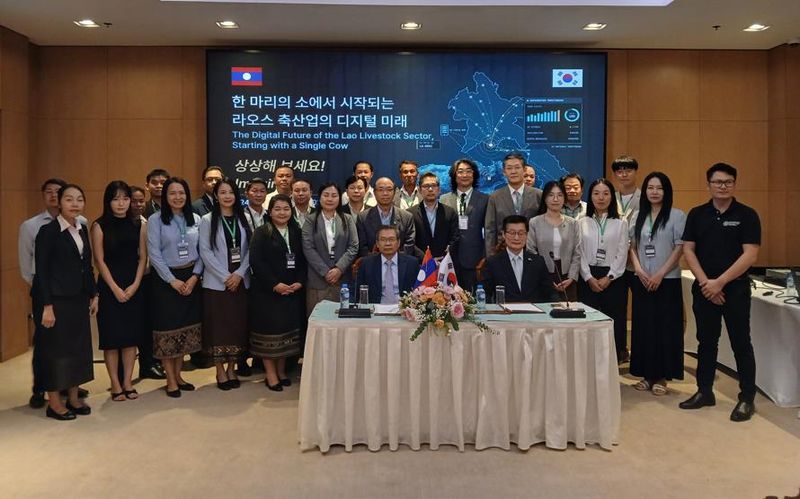
[Financial News] Artificial intelligence (AI)-based smart livestock technology developed by a startup nurtured by a South Korean university business incubator is expected to be adopted into the Lao government’s national livestock system. Soongsil University said on the 27th that Ybiz Co., Ltd., a Campus Town tenant company, had successfully completed Laos’s first pilot project for digital livestock management using AI and radio-frequency identification (RFID) technology.
On the 24th, Ybiz Co., Ltd. held a final results presentation in Vientiane, the capital of Laos, and discussed with the local government plans to expand the pilot model into a national integrated livestock information platform. Conducted jointly with the National Agriculture and Forestry Research Institute (NAFRI) of Laos for five months starting in July this year, the project was the first in Laos to digitize individual cattle information and breeding data.
The key to the project is precise individual-animal management using information technology (IT). Ybiz Co., Ltd. fitted cattle at local beef farms and research facilities with electronic ear tags (RFID tags) bearing unique identification numbers, and built a system that uses CCTV cameras in barns and AI to automatically detect signs of estrus in the cattle. When farm employees enter birth, breeding, and vaccination records into a smartphone app dedicated to the Lao language, the information is automatically saved to a server and can be accessed in real time through the integrated system.
Building on these results, Ybiz Co., Ltd. presented a phased business plan to roll out the system across Laos and agreed to establish a follow-up consultative body with the local government. During the pilot, it also held four operational training sessions for around 30 people, including local researchers and farm workers, laying the groundwork for field staff to use the system.
The technology also received high marks from the local government and diplomatic circles. Sainyakone Intavong, deputy minister of Laos’s Ministry of Agriculture and Environment, who attended the results presentation, said, “Seeing a system that actually works allowed me to confirm the high technological capabilities of Korean companies.” South Korean Ambassador to Laos Lee Jeong-hyeop also stressed, “Cooperation between our companies and the Lao government is essential for Laos’s digital transformation.”
Jeong Seung-baek, CEO of Ybiz Co., Ltd., said, “We have confirmed the potential to use records for individual animals on farms as livestock data at the national level,” adding, “We will actively cooperate on technology, training, and the establishment of local operating systems to help the Lao government’s national digital livestock platform take root.”
The project was supported by the Global Digital Innovation Network (GDIN). Ybiz Co., Ltd. is expanding its agricultural technology exports across Southeast Asia, including by setting up its container-based smart seedling system, “Farmseed,” at the Faculty of Agriculture of the National University of Laos.
[email protected] Kim Man-gi Reporter