Skin Sensor Developed to Assess Pressure Ulcer Risk With a 'Thin Wireless Patch'
- Input
- 2026-11-29 12:00:00
- Updated
- 2026-11-29 12:00:04
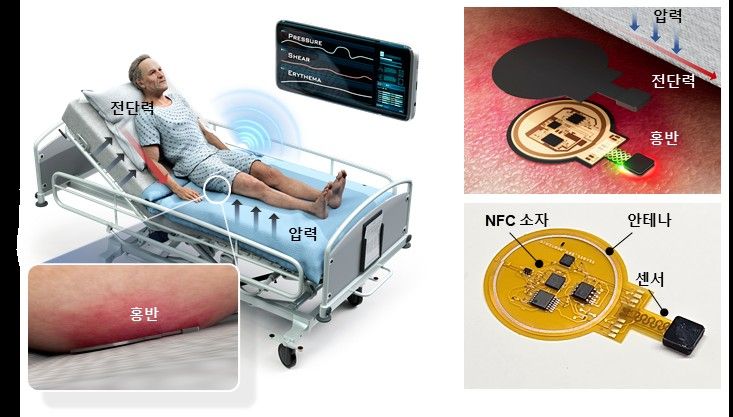
[Financial News] A wireless sensor has been developed that can use a single thin patch to assess in advance the risk of pressure ulcers in patients who spend long periods lying down. It measures everything from the force pressing and shearing the skin to changes in skin redness at the same time.
Korea Advanced Institute of Science and Technology (KAIST) announced on the 29th that a research team led by Distinguished Professor Park In-kyu of its Department of Mechanical Engineering had developed a “wireless, battery-free optoelectronic multimodal skin sensor” to measure multiple pressure-ulcer risk factors together, in collaboration with a research team led by Professor Wei Gao of the California Institute of Technology (Caltech).
Pressure ulcers are a condition in which the skin and underlying tissue are damaged when a particular part of the body remains under pressure for a long time. In addition to pressure pressing vertically on the skin, “shear force”—which occurs when the skin and internal tissue slide against each other, as when the body slips toward the foot of a bed—also contributes to their development. “Erythema,” or skin redness caused by changes in blood flow, is another sign that should be monitored closely. Existing sensors have had difficulty measuring all these factors at once.
The research team designed the sensor to measure both the forces exerted on the skin and the skin’s response using a single thin, soft patch. The key is its use of a light-emitting diode (LED) to emit light and optical sensors (photodiodes) to detect it.
When the patch is pressed or pushed sideways, the path of light inside it changes. Multiple optical sensors detect these changes to determine the magnitude and direction of the forces exerted on the skin. When forces from multiple directions act at the same time, an artificial neural network distinguishes the complex, overlapping signals.
Changes in skin redness are also measured using light. The method analyzes differences in the reflection of red and green light, taking advantage of the fact that hemoglobin in the blood absorbs more green light. This makes it possible to monitor changes in the skin as well as how much it is being pressed and sheared.
The patch is encased in a thin, flexible material so that it conforms gently to the contours of the skin. The design also reduces the effect of external lighting on measurements.
Another feature is that it operates wirelessly without a separate battery. Its near-field communication (NFC)-based circuit receives power from an antenna installed beneath the bed mattress and transmits measurement data wirelessly.
By attaching patches to multiple parts of the body, users can see in real time, in the form of a map, which areas are bearing concentrated pressure and shear forces as the patient changes position. They can also check whether the strain on those areas actually decreases after the patient’s position is changed. The technology is therefore expected to help with pressure-ulcer prevention tailored to each patient’s condition.
Distinguished Professor Park In-kyu said, “In many cases, damage has already begun beneath the skin before a pressure ulcer becomes visible, so it is important to monitor pressure, shear force and changes in blood flow together.” He added, “This technology could develop into a next-generation monitoring platform for the early identification of pressure-ulcer risks in older patients with limited mobility and bedridden patients.”
The findings were published last month in the international journal Nature Communications.
[email protected] Yeon Ji-an Reporter