Mercedes-Benz Teams Up With Korean Startups on Future Mobility Technology, Strengthens AI and Wireless-Charging Cooperation
- Input
- 2026-11-27 10:15:32
- Updated
- 2026-11-27 10:15:32
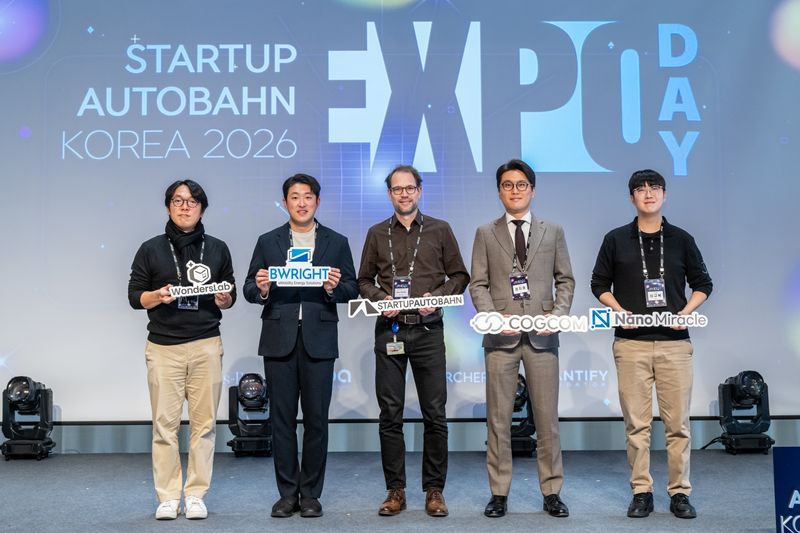
[Financial News] Mercedes-Benz Korea has teamed up with Korean startups to develop future mobility technologies. It is working with startups in a range of fields, from validating AI-based vehicle software to autonomous-driving tests and wireless charging for electric vehicles, while exploring the potential for mid- to long-term R&D and commercialization.
Mercedes-Benz Korea said on the 27th that it had held the STARTUP AUTOBAHN KOREA 2026 Expo Day at Startup Venture Campus Seoul on the 24th and shared the results of proof-of-concept (PoC) work on future mobility and workplace innovation projects carried out with four Korean startups. About 100 people, including representatives from startups, companies and investment institutions, attended the event.
This year’s program included four companies: Cogcom, WondersLab, Nano Miracle and Bright. Mercedes-Benz Korea pursued collaborations focused on real-world projects that could lead to mid- to long-term R&D results, with three of the four projects based on AI technology.
Cogcom validated technology that organizes problems found during vehicle software testing into a format usable by AI. Using about 10,000 records of real-world data, it assessed whether the technology could be applied to 52 tasks in day-to-day operations.
WondersLab validated technology that integrates work-related knowledge about navigation so AI agents can help employees find information and answer questions. Nano Miracle used AI to generate driving routes needed to validate autonomous-driving functions and assessed whether they could accommodate a range of test conditions.
Bright presented the validation results for its PXI unattended wireless-charging technology for 800V electric vehicles. It introduced technology that reduces the need to precisely align the positions of vehicles and charging equipment, and reviewed conditions for starting a charge in an unattended setting.
In a panel discussion following the presentations, experts in the automotive and investment sectors discussed key challenges in joint technology validation between large companies and startups, as well as plans for follow-up collaboration. The participating startups introduced their technologies to company and investment institution representatives at separate exhibition booths and explored further collaboration opportunities.
Startup Autobahn is a global open innovation platform launched by Mercedes-Benz Group in 2016. It was first introduced in Korea in 2020, and this year marks its seventh edition. Through the platform, Mercedes-Benz Korea provides promising Korean startups with opportunities for technology validation, commercialization and global collaboration. This year, it is also participating as an anchor company at Startup Venture Campus Seoul, expanding its collaboration with Korea’s startup ecosystem.
[email protected] Kim Dong-ho Reporter