Four in 10 Workers Experience Reduced Focus at Work Due to Stress... Need for Mental Health Care Grows
- Input
- 2026-11-27 11:29:18
- Updated
- 2026-11-27 11:29:18
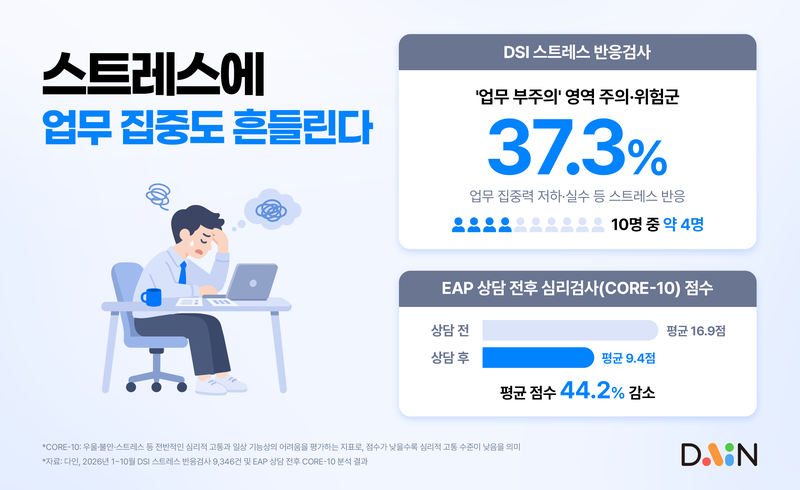
On the 27th, an analysis by Dain, Nudge Healthcare’s employee assistance program (EAP) specialist company, of 9,346 DSI Stress Response Tests conducted from January to October this year found that 37.3% (3,488 cases) were classified in the caution or at-risk groups in the “work inattention” category, which measures reduced concentration and mistakes. Of these, 22.3% (2,086 cases) were in the at-risk group.
The share in the caution or at-risk groups for overall stress levels was also 31.7% (2,967 cases). In particular, 21.9% of people in their 30s and 40s were in the at-risk group for overall stress, meaning that at least one in five workers in that age range were found to be exposed to a high risk of stress.
Workers’ psychological difficulties were also evident in counseling data. An analysis of 26,662 records of counseling sessions for employees themselves conducted by Dain from January to October this year found that counseling related to personal emotions made up the largest share, at 42.7%. Work-related counseling accounted for 26.5%. Together, the two categories made up 69.2% of all counseling, showing that workers experience substantial psychological burdens related not only to personal emotional issues but also to their work.
Improvements in psychological distress following professional counseling were also observed. According to the CORE-10 test, which assesses psychological distress, including depression and anxiety, as well as difficulties in everyday functioning, the average score fell 44.2%, from 16.9 before counseling to 9.4 afterward. Scores decreased after counseling in 87.1% of cases that completed both the pre- and post-counseling assessments.
A lower CORE-10 score indicates a lower level of psychological distress. The findings show that professional counseling can play a positive role in easing workers’ psychological difficulties.
As a result, it is becoming increasingly important for companies to establish systems for preventive mental health care. Rather than judging employees’ work status solely by attendance or job performance, companies need to identify early signs that psychological difficulties are affecting the work process, such as stress-related loss of concentration and work-related mistakes.
Through NudgeEAP, its employee assistance program (EAP), Dain helps employees assess their own well-being using mental health content and psychological tests and access professional counseling when needed. It offers in-person, phone, video and chat counseling, as well as a 24-hour on-demand counseling service. It also supports preventive mental health care at the organizational level by providing companies with organizational assessments, training and regular operating reports.
Na Seung-gyun, CEO of Dain, said, “This suggests that stress among workers can manifest not only as psychological strain but also in the course of work, through reduced concentration or mistakes.” He added, “Because these signs can easily be dismissed as everyday fatigue, it is important for companies to establish a prevention-focused management system that identifies employees’ mental health needs early and connects them with necessary support, such as psychological counseling and mental health content.”
[email protected] Jung Sang-hee Reporter