‘Distressed Assets Flood the Market, Exit Routes Narrow’... NPLs Hit a Record 3.4 Trillion Won [fn Market Watch]
- Input
- 2026-11-27 13:33:29
- Updated
- 2026-11-27 13:33:29
[Financial News] A record volume of non-performing loans (NPLs) is flooding the banking sector’s market, but investors’ exit routes are narrowing.
The volume of NPLs put up for sale in Q4 this year exceeded 3.4 trillion won, increasing more than fivefold in five years. Even nursing hospitals, once favored assets among NPL investors, are now hampered by bed-capacity regulations, while lending standards for commercial real estate have also tightened, making it increasingly difficult to turn around distressed assets and recover investments.
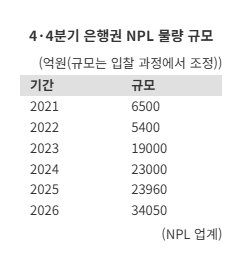
According to the investment banking (IB) industry on the 27th, the volume of NPLs sold by banks in Q4 this year (including Q3.5) stood at about 3.405 trillion won in outstanding principal balance (OPB), based on figures from early this month (including 281.2 billion won in negotiated sales). Fourth-quarter sales volumes in previous years were 650 billion won in 2021, 540 billion won in 2022, 1.9 trillion won in 2023, 2.3 trillion won in 2024, and 2.396 trillion won in 2025. The volume was also up about 42% from the same period a year earlier.
“Knowledge industry centers accounted for a smaller share this quarter, while the share of commercial real estate, such as retail properties, is at a record high,” an IB industry source said. “There are more than 15 hospital properties alone on the market, including nursing hospitals, in addition to retail buildings that failed to sell, gas stations and golf-related facilities.”
Nursing hospitals, in particular, have become assets shunned by NPL investors. The regional bed quota system has made it difficult to secure new beds, narrowing the pool of potential buyers. Industry observers warn that even in areas where beds can currently be secured, assets may be difficult to sell if those areas are brought under the regulations in the future.
Rising funding costs are also a burden. NPL investors’ funding rates have risen by about 200 basis points (1 bp = 0.01 percentage point) compared with during the COVID-19 pandemic. In the past, investors could make a profit even when the winning bid ratio was close to 100%, but industry participants say it has recently been difficult to remain profitable even in the 60% range.
The decline in winning bid ratios has been limited as banks have opted to withdraw assets from sale. The average winning bid ratio in the first half of this year was 67.9%, down just 2.9 percentage points from 70.8% in the same period a year earlier.
Worsening financing conditions for end buyers are also increasing the burden on NPL investors to recover their investments.
“Even when there are companies with genuine demand to acquire logistics centers and other assets, banks are sharply cutting the credit limits for those loans,” an IB industry source said, adding, “As a result, turning around and reselling assets after acquiring NPLs has become more difficult than before.”
Meanwhile, banks sold NPLs totaling 8.0125 trillion won last year. United Asset Management Company (UAMCO) led with 3.7142 trillion won, followed by Daishin F&I with 1.612 trillion won, Hana F&I with 1.05 trillion won, Kiwoom F&I with 871.7 billion won and Woori F&I with 509.6 billion won.
[email protected] Kang Gu-gwi Reporter