FSS Union: 'FSC Is De Facto a One-Person Body... Financial Administration Reform Plan Is a Half-Measure'
- Input
- 2026-11-27 09:00:00
- Updated
- 2026-11-27 09:03:18
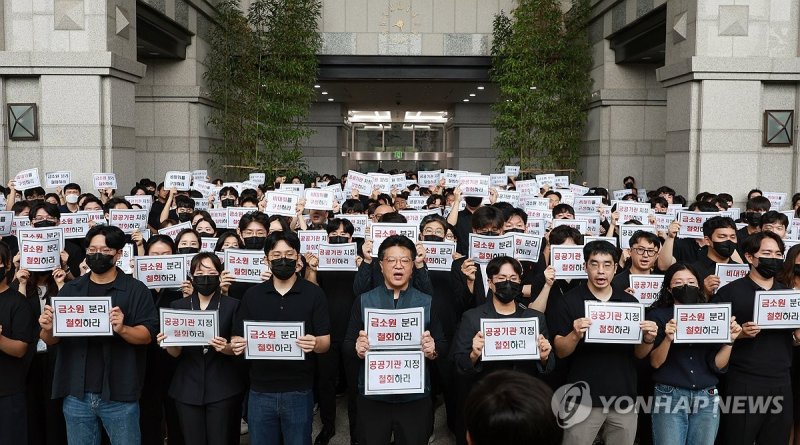
On the 27th, the FSS union said the financial administration reform plan announced by the financial authorities was “inadequate to support a transition to productive and inclusive finance,” adding that “improvements to the FSC’s decision-making structure, revisions to the surcharge reduction system and safeguards for inspectors must all be pursued together.”
The union first pointed out that although the FSC is a collegial administrative agency, it is effectively run like a one-person body. Of the nine commissioners, ex officio members including the chair, vice chair and a vice minister of the Ministry of Economy and Finance, as well as members recommended by the chair and the head of the Korea Deposit Insurance Corporation, account for a substantial proportion, making it difficult for a diversity of views to be reflected, it said.
The union also argued that this structure had led the secretariat to operate as a bureaucracy-centered organization, going beyond a simple support role. It criticized the fact that the agenda subcommittee, composed mainly of civil servants, does not even release its meeting minutes, saying that simply expanding opportunities to hear from experts would do little to improve decision-making transparency under these circumstances.
The union also challenged criticism of prior consultations between the FSC and the FSS over sanctions procedures. It said informal consultations between the two agencies had already been ongoing and that a formal channel for the FSC secretariat to express its views was also in place.
The director-general in charge of agenda items at the FSC secretariat may attend the Sanctions Review Committee as an ex officio member, and a division chief may also send a representative. However, according to the union, the director-general had not attended any of the committee’s 72 meetings held since 2024, and there were only two instances of a division chief attending through a representative.
The union argued that the difference between the FSC and the FSS in the amount of surcharges imposed in the sanctions process involving Hong Kong H Index-linked securities (ELS) was not due to insufficient prior consultation. It said the fundamental cause was that under the current system the FSS has no authority to reduce the amount of unjust gains, while the FSC has not established specific criteria for discretionary reductions.
The union said that unless the FSC defines the grounds and scope for reductions more clearly, financial companies will have no choice but to receive prior notice based on the surcharge amount before any reduction, even if prior consultations are strengthened, and the final reduction criteria will remain difficult to predict.
Current regulations allow a surcharge to be reduced by the amount exceeding the limit if the amount of unjust gains can be reasonably calculated and, after adjustments for aggravating or mitigating factors, the surcharge exceeds 10 times the amount of unjust gains. However, this applies only when the FSC specifically recognizes the circumstances, and the rules stipulate that it cannot be considered at the stage when the FSS governor recommends imposing a surcharge.
The union also raised the possibility that formalizing prior consultations, as the FSC plans to do, could instead delay the processing of agenda items. If the scope of consultations is not clearly limited, the FSS may bring more items forward for consultation to avoid criticism for omissions, potentially prolonging the review process, it said.
The union also expressed concern about extending the advance notice period for inspections and narrowing the conditions for surprise inspections. It said that while financial companies’ right to mount a defense would expand, safeguards to support inspection functions remained inadequate.
The union said the Financial Administrative Innovation Committee recommended in 2017 that an adversarial hearing system be introduced and standards for inspector immunity be clarified, but that, unlike the hearing system, there had been virtually no progress on immunity. It said legislative discussions on the matter also stopped after the Ministry of Justice said that each case needed to be assessed individually.
The union also said that lawsuits seeking damages from individual inspectors and concerns about being held accountable after the fact were fostering a rigid inspection culture focused on finding violations. It added that although inspectors must respond to financial companies’ omissions or delays in submitting materials, the lack of a legal basis for sealing measures to prevent the deletion or alteration of materials limits their ability to secure evidence.
The union therefore called for revisions to inspection and sanctions regulations to give the FSS authority to recommend discretionary surcharge reductions. It also said that the scope of prior consultations should be limited to cases such as the first application of a law or regulation, and that the FSC secretariat should be able to attend the Sanctions Review Committee directly and place its views on the official record.
The union further urged the authorities to strengthen penalties for obstructing inspections and promptly establish a legal basis for sealing materials and rules granting inspectors immunity.
[email protected] Park Mun-su Reporter