Chinese Ambassador to South Korea: “The ROK-U.S. Alliance Should Not Become a Stumbling Block, an Obstacle to China-ROK Relations”
- Input
- 2026-11-27 10:00:00
- Updated
- 2026-11-27 10:43:20
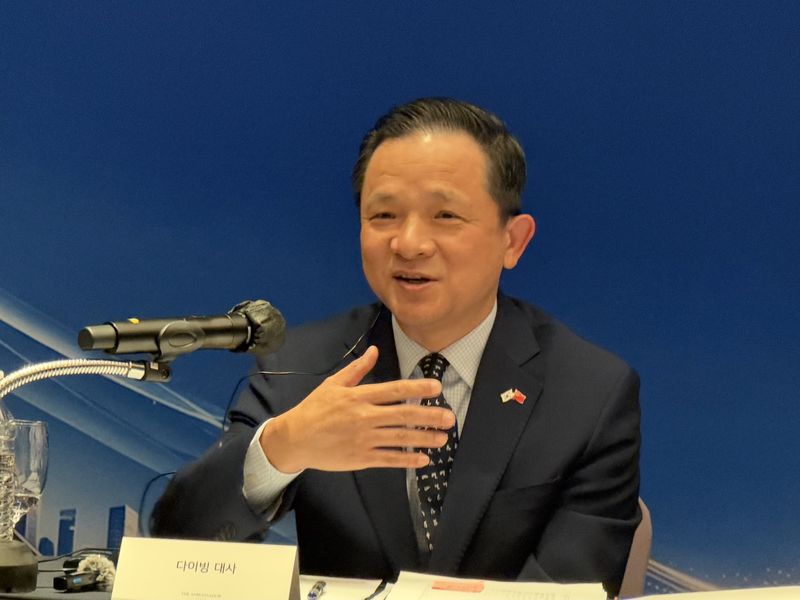
[Financial News] Dai Bing, China’s ambassador to South Korea, said the ROK-U.S. Alliance should not become a stumbling block or obstacle to China-ROK relations. He also expressed concern about strategic objectives such as modernizing the alliance and giving it strategic flexibility, and said he opposed it being directed against and used to counter China.
At a press conference at The Ambassador Seoul – A Pullman Hotel on the 26th, Ambassador Dai said China had never spoken of a binary choice between the United States and China, and that he hoped South Korea would manage its strategic autonomy well.
He also stressed that China and South Korea should continue to exclude interference by third countries in their bilateral relationship, strengthen their strategic standing, and build an even more mature strategic partnership.
On Taiwan, he said the One China principle is the political foundation for the development of bilateral relations and is highly sensitive, and that it should not hinder China-ROK relations.
On North Korea’s nuclear issue, he said China’s position and principles on denuclearization are firm, both with regard to North Korea’s nuclear weapons and globally. As a permanent member of the United Nations Security Council (UNSC), China takes a strict stance on compliance with the Treaty on the Non-Proliferation of Nuclear Weapons (NPT), he said. He added that China would continue to work and contribute in its own way to peace and stability on the Korean Peninsula.
Regarding the visa-free entry period for South Koreans traveling to China, which expires at the end of this year, he said China was reviewing whether to extend it, taking into comprehensive consideration reciprocity and fairness in relation to other countries. However, Ambassador Dai referred to the South Korean government’s decision to extend by another year, through the end of 2027, the temporary visa-free entry period for Chinese group tourists, signaling a positive attitude toward extending visa-free entry for South Koreans.
Regarding an additional panda loan, Dai pointed to diplomatic tensions, including a dispute over compliance with the One China principle in connection with the “Taiwan Pavilion” at the Gwangju Biennale in August. He said the loan process could proceed once a favorable environment had been established for loaning pandas, China’s national treasure, confirming that plans to loan pandas to Gwangju in Jeolla Province had been withdrawn for now.
Earlier, during his visit to China last January, President Lee Jae-myung asked Chinese President Xi Jinping to loan additional pandas. Plans had since been underway to loan an additional pair to Gwangju in Jeolla Province. Then, at the Gwangju Biennale last August, a dispute arose between China and the Biennale’s organizers, Gwangju City and others, after the Chinese side protested that the “One China principle” was not being upheld in connection with the name “Taiwan Pavilion.”
On expanding Hallyu, including large-scale performances in China by Korean singers and girl groups, Ambassador Dai struck a cautious tone, saying it would be pursued systematically, gradually and in a healthy direction, in accordance with the principle of reciprocity. His remarks suggest that performances in China by Korean girl groups, singers and other performers will move forward slowly.
Ambassador Dai noted the significance of next year being the 35th anniversary of the establishment of diplomatic relations between South Korea and China, and said preparations were underway for large-scale cultural and people-to-people exchange events.
[email protected] Lee Seok-woo, international affairs specialist Reporter