Soongsil University Unveils 'Ultra-Light Battery' With 78% Less Weight... Boosting Drone and Air Taxi Flight Times
- Input
- 2026-11-26 17:48:15
- Updated
- 2026-11-26 17:48:15
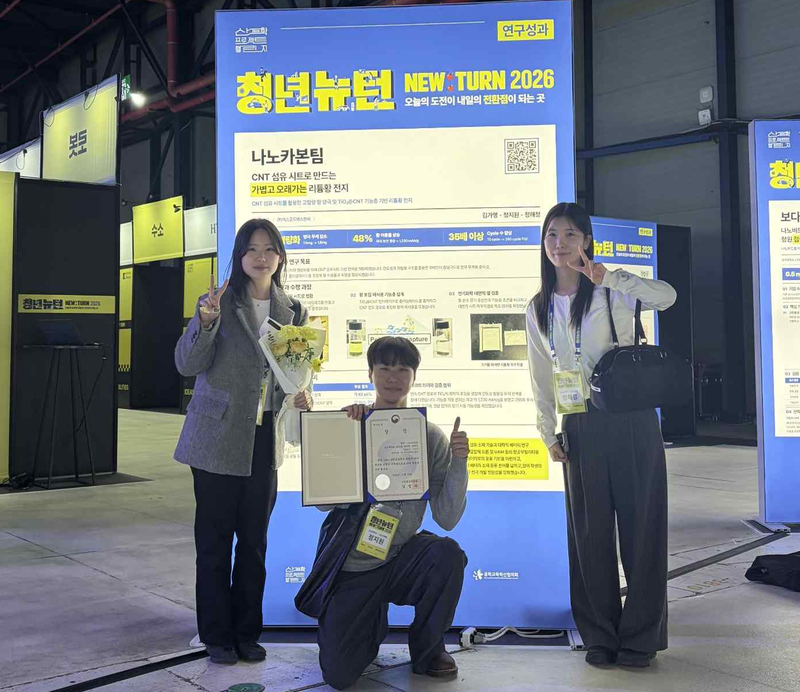
[Financial News] Soongsil University said on the 26th that its Nanocarbon Team in the Department of Materials Science and Engineering had developed an “ultra-light lithium-sulfur battery” in joint research with small and medium-sized enterprise Texroad SNC, reducing the weight of a key battery component by about 78% compared with existing components. The technology, which could dramatically extend flight times for drones and urban air mobility (UAM) air taxis, won the top prize, the Minister of Trade, Industry and Energy Award, at the 2026 Industry-Academia Project Challenge hosted by the Ministry of Trade, Industry and Energy on the 19th, beating 596 teams from across the country.
The lighter the batteries in flying drones and air taxis, the farther and longer they can fly. For this reason, lithium-sulfur batteries—which are lighter and store more energy than the widely used lithium-ion batteries—have been considered a leading candidate for next-generation batteries. But they have been difficult to turn into commercial products because they conduct electricity poorly and, as charging and discharging are repeated, key materials inside the battery dissolve, causing its lifespan to drop sharply.
The research team addressed the problem by turning carbon nanotubes (CNTs)—an advanced material tens of thousands of times thinner than a human hair—into a thin fabric (fiber sheet). By filling the carbon-fiber sheet with sulfur, the team drastically reduced the need for heavy adhesive, which had been essential for making conventional battery components (electrodes). As a result, it succeeded in cutting the component's weight by about 78%, from 7.5 mg to 1.6 mg.
The team also coated the surface of the carbon-fiber sheet with a special protective layer called “titanium dioxide,” preventing the battery's performance from declining with use and each recharge. In tests, the battery's initial energy storage capacity was more than 20% greater than that of existing products, and it reliably maintained its initial performance even after more than 350 charge-discharge cycles.
Notably, the research demonstrated that the battery could be scaled up beyond small laboratory models and made in the flat, large-area pouch-cell format used in actual smartphones and drones without any loss in performance, strengthening its potential for industrial application.
The Nanocarbon Team said, “Thanks to on-site advice from company representatives and guidance from our faculty adviser, we were able to overcome the daunting challenges in our experiments,” adding, “It is all the more meaningful because it is the result of industry-academia collaboration in which we communicated and worked through the challenges together.”
[email protected] Kim Man-gi Reporter