Discarded Solar Panels Boost Power Generation by 10%... University of Seoul Research Team to Launch a Startup Next Year
- Input
- 2026-11-26 17:25:05
- Updated
- 2026-11-26 17:25:05
[Financial News]
The University of Seoul said on the 26th that its Department of Materials Science and Engineering lab startup team had swept four government- and local-government-organized startup competitions this year with technologies for recycling discarded solar panels and making antibacterial plastic, and would launch a full-fledged technology startup in 2027.
The key technology behind the startup is a “reflector made from end-of-life solar panels,” which gives discarded panels a new lease on life as mirrors that reflect light. The panels are coated with a thin layer of silver (Ag) and installed beneath the latest solar equipment, which absorbs light on both the front and back to generate electricity. By reflecting light that would otherwise escape toward the ground back onto the rear of the panels, the system can increase electricity-generation efficiency by at least 10% compared with existing systems. It is an environmentally friendly technology that reduces difficult-to-dispose-of panel waste while also increasing power generation.
The “high-performance antibacterial plastic” being developed for commercialization alongside the reflector is also attracting market attention. The process evenly disperses and fixes tiny silver particles in ordinary plastic; the particles are tens of thousands of times smaller than the thickness of a strand of hair. This enables powerful sterilizing and antibacterial functions that block harmful bacteria and viruses from reaching the plastic surface at the source.
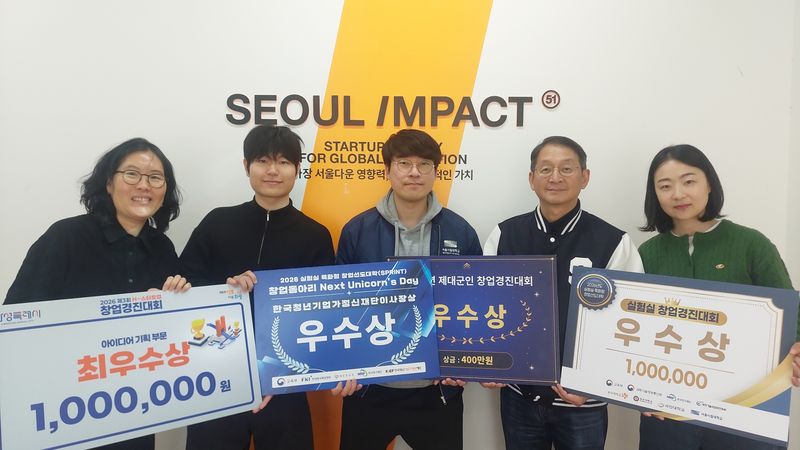
The team’s technological capabilities were recognized for their commercial potential after it won awards in succession at major startup competitions held recently. The team, comprising materials science and engineering master’s student and team leader Moon Ji-won and third-year undergraduate researcher Yoo Gang-min, with professor Song O-seong as its advisor, took home four awards in total. It began with the Excellence Award (Minister of Patriots and Veterans Affairs Award) at the “2026 Veterans Startup Competition” on the 30th of last month, followed by the Excellence Award (Korea Entrepreneurship Foundation Chairman’s Award) at “2026 SPRINT Startup Club NEXT Unicorn’s Day” and the Grand Prize (Hwaseong Mayor’s Award) at the “3rd H-Startup Competition” on the 10th of this month, and the Excellence Award at the “Lab Startup Competition” on the 18th, hosted by the Ministry of Education, the Ministry of Science and ICT, the National Research Foundation of Korea (NRF) and the Korea Institute for Science and Technology Commercialization.
The achievement was backed by systematic startup support from the university. The University of Seoul has operated a specialized support system, centered on its Startup Support Group and Industry-Academic Cooperation Foundation, to help promising technologies developed in its labs lead to the establishment of actual companies. The team plans to secure patents for its core technologies and complete performance evaluations of its prototypes before beginning full-scale startup operations next year.
Team leader Moon Ji-won said, “We achieved good results thanks to the faculty and the university’s startup support infrastructure, which encouraged us to take on real-world challenges without fearing failure.” She added, “After succeeding with the startup, I will establish an education support foundation and give opportunities back to society.”
[email protected] Kim Man-gi Reporter