President Lee on SNS Communication: “Being Criticized Is Helpful ... I Block Verbal Abuse and Profanity”
- Input
- 2026-11-26 19:00:00
- Updated
- 2026-11-26 19:00:06
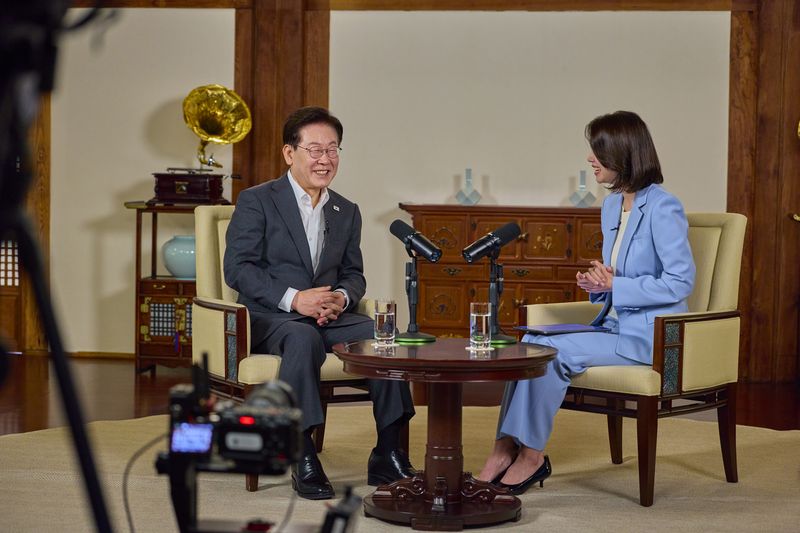
[Financial News] Asked about expanding direct communication through social networking services (SNS), President Lee Jae Myung said, “I think being criticized is helpful,” adding, “That said, there’s one thing: I don’t like things like verbal abuse and profanity. So I block them in those cases.”
In a behind-the-scenes video for the first episode of “The President’s Y,” released on YouTube on the 26th, President Lee said, “I’m looking at it to see other perspectives that I might not otherwise see.”
President Lee said he was willing to accept criticism, adding, “If someone has a modicum of decency and says, ‘This is wrong’ or ‘This should be done this way,’ who would object to that?”
Referring to situations in which people use abusive language or spread lies in the public sphere and disrupt discussion, he said, “The same goes for social media,” and criticized the practice: “If you let that go in the name of communication, it actually gets in the way of communication.” He added, “You can’t see other people’s genuinely meaningful posts,” and stressed that “feedback is important.”
On anonymity on social media, he said, “It can be a strength in terms of freedom of expression, but anonymity makes excessive hatred, disparagement and things like that a problem,” adding, “It intensifies conflict. That’s the biggest problem with social media right now.”
President Lee also addressed the current system, under which people must apply themselves to receive welfare support. “If they meet certain eligibility requirements, it should of course be provided,” he said, emphasizing a shift to an “automatic system” that provides support without requiring an application.
President Lee said, “Why should I have to get documents proving I’m poor and take them in, saying, ‘I’m poor,’ ‘Please help me’? Why should I have to do that?” He added, “Shouldn’t people be spared the need to get documents and prove things—a cumbersome process that can even be humiliating?”
He then mentioned the case of the mother and her daughters in Songpa, pointing out, “There are what we call blind spots. Neither the people themselves nor the administrative authorities know about them.” He explained, “The administration has more information,” adding, “We draw a clear line, and if someone qualifies, we provide support automatically, without an application. We’re making a lot of changes.”
On the 6.7% increase in the standard median income, he said, “When the median income goes up, the number of people eligible increases sharply, and the amount of support rises sharply, too. This is, in fact, determined as a matter of policy. That’s why we raised it significantly.”
He also described the presidential approval process. Asked whether he often deliberates over approval documents right up to the last moment, President Lee replied, “Not very often,” adding, “Most of the work is delegated to the ministries, offices and agencies.”
President Lee said, “The important things are actually all done before that,” explaining, “Before I approve something, it is discussed at a Cabinet meeting. At the earlier stage, each ministry, office and agency holds internal meetings and reaches a conclusion, and we tend to have a lot of discussion.” He added, “It’s very rare for the president to make the final decision by asking, ‘Which of A, B and C should we choose?’”
[email protected] Choi Jong-geun, Seong Seok-woo Reporter