Lee: “Companies That Succeed With Government Support Shouldn’t Keep All the Profits ... We Need a Reinvestment System”
- Input
- 2026-11-26 17:30:58
- Updated
- 2026-11-26 17:30:58
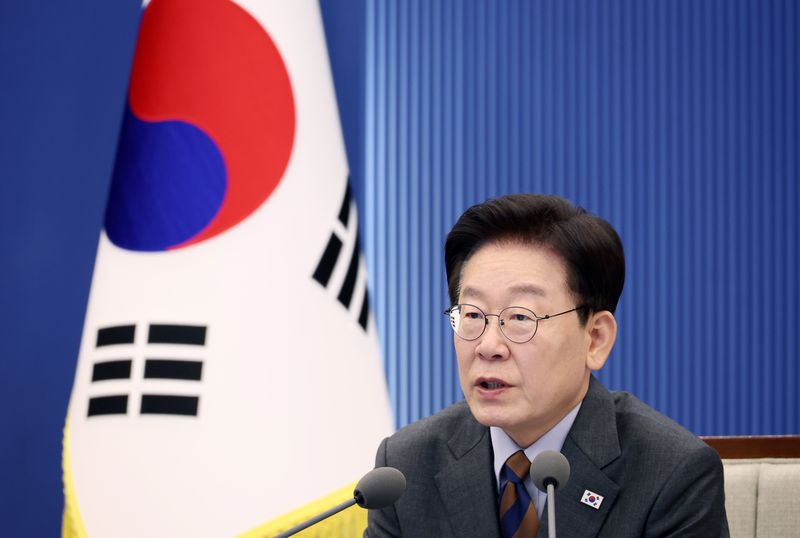
[Financial News] President Lee Jae Myung stressed on the 26th, regarding a performance-sharing fiscal support plan, that “we need to create a system that allows reinvestment so that companies that succeed with government support don’t simply get lucky and keep all the profits for themselves.”
In a written briefing, Cheong Wa Dae spokesperson Kim Seong-wan said Lee had made this request during the closed-door session of the 54th meeting of senior secretaries and aides, which he chaired at Cheong Wa Dae that day.
Lee said that when large companies have promising business ideas, the government should take equity stakes instead of providing fiscal support, helping to address fiscal problems as well as boost national income and tackle employment issues.
He called for careful institutional design to ensure that the government’s sharing of returns does not constrain business activities. Lee said, “We need to develop detailed operating guidelines,” and urged officials to “prepare carefully, with the idea of sharing the profits if a company succeeds, while ensuring that companies’ day-to-day activities are not disrupted.”
He said that the selection of investment targets should take into account not only the likelihood of success but also the value the outcome would leave to society. Lee stressed, “Don’t focus on investing where the odds of success are high; even if a project is risky, support those where success would result in something that accumulates as a social asset.”
The “Plan to Establish a Performance-Sharing Fiscal Support and Management System,” presented that day by the Office of the Senior Secretary for Fiscal Planning, was drawn up in line with the trend of expanding the state’s role from a “passive supporter” to an “active investor” in future sectors requiring large-scale investment, such as AI.
Senior Secretary for Fiscal Planning Ryu Deok-hyeon reported, “We need to overcome the problem with traditional fiscal support, where the returns accrue to companies if they succeed, but the government—and, by extension, society as a whole—has to share the risk if they fail.” He added that it was urgent to expand support methods to include equity investment alongside existing royalty-based and investment consortium models, and to establish a management system.
Lee also ordered a review of the status of public-sector technology transfers to the private sector. He said, “Please get a detailed picture of what technologies are being developed in the public sector, transferred to the private sector and commercialized, what the criteria are, and how compensation is being received, and report back separately.”
Regarding the “Current Status and Future Plans for the Seven SEED Projects,” also presented that day, Lee called for bold relaxation of regulations that pose no or little risk.
The Office of the Senior Secretary for AI Future Planning shared companies’ investment announcements and contract results, and reported tailored implementation strategies for each project to enable public-private cooperation throughout the process ahead of full-scale project implementation next year.
[email protected] Seong Seok-woo Reporter