Plans Advance to Link Sejong City and Cheongju International Airport in 20 Minutes... Expand Regional Road Network, Including First Village IC
- Input
- 2026-11-26 17:16:13
- Updated
- 2026-11-26 17:16:13
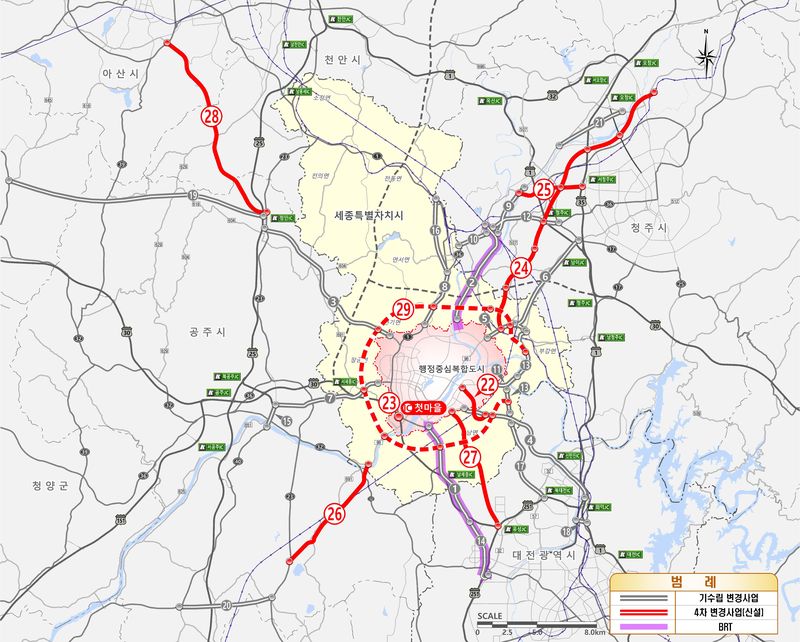
The National Agency for Administrative City Construction said on the 26th that the fourth revision to the metropolitan transport improvement plan for Sejong City had passed review by the Metropolitan Area Transport Commission. The revision includes eight new projects, including First Village IC, and is to be finalized after review by the Administrative City Promotion Committee.
The Cheongju Airport high-speed road project will directly link Sejong City with the airport via a 24.8-kilometer, four-lane, two-way road. Traffic analysis forecast that travel time on the route would fall by 18 minutes, from about 38 minutes to 20.
The Jeongan IC–Asan connecting road will be built or widened as a four-lane, two-way road over a 17.2-kilometer stretch. It is planned to cut travel time from Asan to Sejong City from about 68 minutes to 46 and improve access to Pyeongtaek International Port and the Asan–Pyeongtaek semiconductor belt. Work will first proceed on the high-demand 10.2-kilometer first section of the Sejong City–Tancheon connecting road, which links to KTX Gongju Station. Analysis found that travel time from Gongju Station to Sejong City would fall from about 56 minutes to 43.
Access routes to major facilities, including the National Assembly Sejong Complex, will also be improved. The Goehwa Mountain Tunnel connecting road is a 3.1-kilometer, four-lane, two-way road linking Gujeuk Sejong-ro and Bangok Intersection. About 2.3 kilometers of it will be built as a tunnel, and travel time from Dungok Intersection to the planned site of the National Assembly Sejong Complex is expected to fall from about 19 minutes to 11.
The First Village IC project involves building a new Hi-Pass interchange on the Dangjin–Yeongdeok Expressway and constructing about 0.7 kilometers of connecting road. It will help divert traffic that currently detours via West Sejong IC and South Sejong IC. Travel time on the route is expected to fall from 13 minutes to 7 toward Gongju, and from 11 minutes to 9 toward Daejeon.
The Sejong City–Yuseong Junction (JC) connecting road is planned as a 10.7-kilometer, four-lane, two-way road linking Boram-dong in Sejong City with Hagi-dong in Daejeon's Yuseong District. It will divert traffic from National Route 1 and other roads and supplement the four transport corridors connecting to Daejeon. The Sejong City–West Cheongju IC connecting road will be built or expanded over 5.71 kilometers to improve links among the Seoul–Sejong Expressway, Jungbu Expressway and arterial roads in the Cheongju area.
In the long term, a third ring road will be built alongside the BRT ring corridor, the existing first ring road, and the second ring road reserved for motor vehicles. The plan is to connect major regional roads, divert through traffic in the city center to the outskirts, and prepare for future urban expansion.
After the revision is finalized, the National Agency for Administrative City Construction will assess the impact, urgency and feasibility of each project, then take follow-up steps, including applying to have high-priority projects selected for preliminary feasibility studies.
“This fourth revision to the metropolitan transport improvement plan is an important step beyond simply expanding the road network. It lays a long-term transportation foundation so that Sejong can fully carry out its pivotal functions as South Korea's de facto administrative capital and grow alongside surrounding areas,” said Kang Ju-yeop, head of the National Agency for Administrative City Construction.
[email protected] Choi Ga-young Reporter