SMEs and Startups Minister: Telemedicine Regulations to Be Adjusted in Talks With the Ministry of Health and Welfare
- Input
- 2026-11-26 17:37:54
- Updated
- 2026-11-26 17:37:54
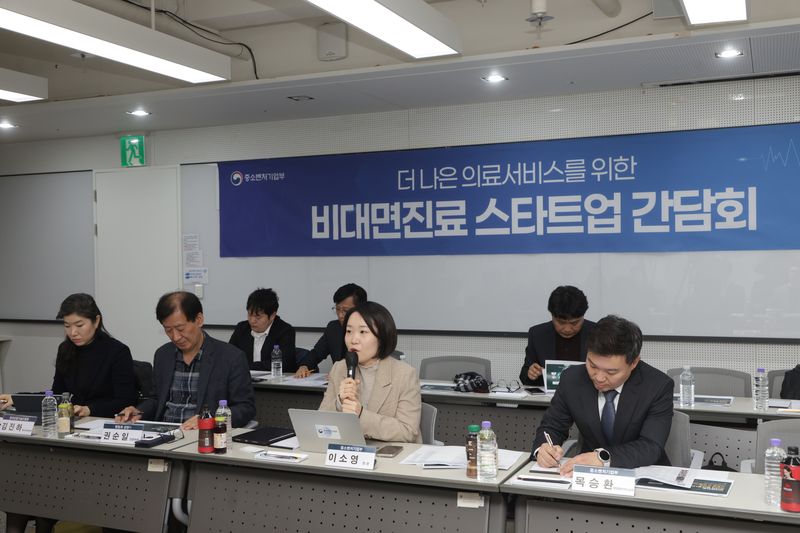
Minister Lee held a roundtable with telemedicine platform companies on the 26th at the Seoul Center for Creative Economy & Innovation, hearing their concerns about the subordinate regulations of the amended Medical Service Act, which takes effect on the 24th of next month (the draft amendment to the enforcement rule and the draft notice). Representatives of four major platform companies, including Dr.Now, Meraki Place, SOLDOC and Goodoc, as well as Choi Ji-young, head of the Korea Startup Forum, experts in regulatory impact assessments for small and medium-sized businesses, and others attended. There were around 10 participants.
Once the amended Medical Service Act takes effect, patients who have received in-person care for the same symptoms at the medical institution within the past six months will be able to receive telemedicine. Telemedicine will also be available to patients who do not meet the requirement for a history of in-person care if their registered address and the location of the medical institution are in the same province-level administrative region.
The industry, however, expressed concern that the various restrictions included in the subordinate regulations could instead reduce the public’s access to healthcare and shrink the market.
Lee said, “Regulations that protect patients’ safety and health are important, but even though there are ways to minimize regulations while preserving their essential purpose, ‘maximum regulation’ is being created, resulting in things allowed overseas being prohibited only in Korea. No matter how many seeds of startups and ventures are sown, if speed bumps are put on the runway and barricades are erected, no one will want to run.”
She added, “Instead of putting up dozens of speed bumps before running down the runway, we need to take a careful, reflective approach. Based on the views expressed at the roundtable, the MSS will directly and actively consult with the Ministry of Health and Welfare and work to ensure that unnecessary or excessive regulations are adjusted reasonably.”
The roundtable discussed five detailed standards: limits on prescription duration for initial consultations; procedures for verifying registered and actual residential addresses; how telemedicine is to be provided; the range of medications subject to prescription restrictions; and the obligation to report changes to service operating standards.
Jeong Jin-ung, CEO of Dr.Now, said, “Regulations are necessary to ensure safe implementation, but when regulations with good justifications pile up, they ultimately make services inconvenient for the public. The current enforcement-rule and notice drafts are set to introduce so many barriers that, from the user’s perspective, access to healthcare will actually be worse than with in-person care.”
Choi Ji-young also said, “The process of legislating telemedicine after seven years of pilot programs is an area the startup industry has had high hopes for. I hope we can find constructive solutions through the Regulatory Rationalization Committee and other channels within the broader institutional framework, including global standards and regulatory sandboxes.”
[email protected] Kim Hyeon-cheol Reporter